

Description
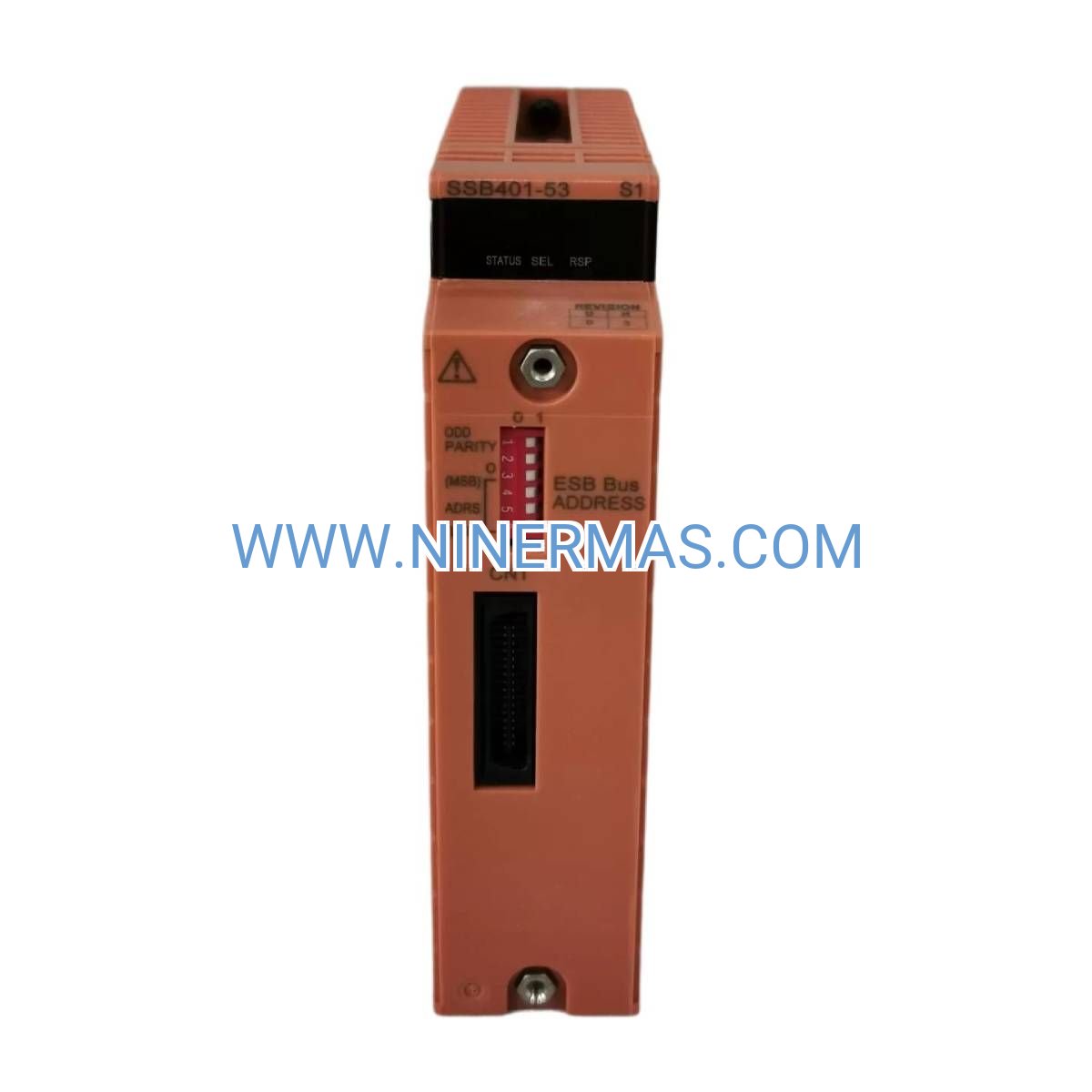
SSB401-53 S1 ESB Bus Slave Interface Module (Industrial-Grade Safety Communication)
The SSB401-53 S1 represents Yokogawa's advanced approach to safety-critical network communication within ProSafe-RS architectures. Functioning as an Extended Serial Bus slave interface, this module bridges safety node units with centralized controllers through fault-tolerant data pathways. Designed for environments where system availability directly impacts operational safety, it delivers deterministic communication performance under IEC 61508 SIL 3 standards.
Process industries facing stringent safety requirements—from offshore platforms to chemical reactors—rely on this module to maintain continuous monitoring and control loops. Its redundant bus architecture eliminates single points of failure, while hot-swappable construction enables maintenance without compromising system integrity. Engineers specify the SSB401-53 S1 when emergency shutdown sequences, fire suppression networks, or toxic gas detection systems demand uninterrupted data exchange.
Key differentiators include auto-configuration upon installation, real-time diagnostic feedback, and compatibility with Yokogawa's comprehensive ProSafe-RS ecosystem. Whether retrofitting legacy safety systems or deploying greenfield installations, this ESB interface provides the communication backbone for mission-critical protection layers.
Core Features & Business Value
→ Dual-Channel Redundancy: Parallel ESB pathways ensure continuous operation during cable faults or network disruptions—critical for maintaining safety integrity levels in hazardous process areas.
→ SIL 3 Certification (IEC 61508): Meets the highest safety integrity requirements for process industry applications, reducing liability exposure and ensuring regulatory compliance across global jurisdictions.
→ Hot-Swap Maintenance: Field-replaceable design allows technicians to service modules during scheduled maintenance windows without initiating plant-wide shutdowns—minimizing production losses.
→ Integrated Diagnostics: Onboard status monitoring detects communication anomalies, power fluctuations, and configuration errors before they escalate into safety system failures.
→ Wide Environmental Range: Operates reliably from -20°C to +70°C with ISA G3 corrosion resistance, suitable for offshore platforms, desert refineries, and arctic processing facilities.
→ Plug-and-Play Integration: Direct mounting to SNB10D safety nodes with automatic address assignment reduces commissioning time and eliminates manual configuration errors.
Application Scenarios
Offshore Oil & Gas Emergency Shutdown (ESD) Systems
Platform operators deploy SSB401-53 S1 modules to link distributed safety nodes monitoring wellhead pressures, gas detectors, and fire loops. When abnormal conditions trigger, the ESB network transmits shutdown commands to isolation valves within milliseconds—preventing blowouts and protecting personnel. Redundant communication ensures failover during harsh marine environments.
Chemical Reactor Protection Networks
Batch processing facilities use these interfaces to coordinate temperature sensors, pressure transmitters, and emergency cooling systems. The module's deterministic response time enables precise interlock sequencing during runaway reaction scenarios, while SIL 3 certification satisfies process safety management (PSM) requirements.
Power Plant Turbine Overspeed Protection
Utility operators integrate SSB401-53 S1 modules into turbine control systems where speed excursions demand immediate trip actions. The ESB bus delivers sub-10ms latency for critical signals, while hot-swap capability allows maintenance during scheduled outages without compromising grid stability.
Petrochemical Compressor Anti-Surge Control
Refineries employ these modules in compressor safety systems to prevent catastrophic surge events. Real-time data exchange between flow sensors, recycle valves, and safety controllers maintains equipment within safe operating envelopes—extending asset life and preventing unplanned shutdowns.
LNG Terminal Fire & Gas Detection
Liquefied natural gas facilities utilize SSB401-53 S1 interfaces to network hundreds of flame detectors, toxic gas sensors, and suppression actuators. The module's corrosion-resistant construction withstands cryogenic environments, while redundant architecture ensures detection coverage during maintenance activities.
Technical Parameters & Selection Guide
| Parameter | Specification |
|---|---|
| Model Designation | SSB401-53 S1 |
| Interface Type | ESB Bus Slave (Extended Serial Bus) |
| Safety Integrity Level | SIL 3 per IEC 61508 |
| Compatible Systems | ProSafe-RS (SNB10D nodes, SEC401/SEC402 controllers) |
| Communication Speed | High-speed deterministic (vendor-specific protocol) |
| Power Requirements | 24V DC backplane-fed, ~0.5A consumption |
| Temperature Range | -20°C to +70°C (-4°F to 158°F) |
| Humidity Tolerance | 5% to 95% RH non-condensing |
| Corrosion Resistance | ISA Standard G3 (severe industrial environments) |
| Physical Dimensions | Compact DIN-rail compatible form factor |
| Weight | 0.2 kg (0.44 lbs) |
| Installation Method | Direct plug-in to SNB10D safety node backplane |
| Diagnostic Indicators | LED status for power, communication, fault conditions |
| MTBF (Mean Time Between Failures) | >100,000 hours under standard conditions |
Selection Criteria: Choose the SSB401-53 S1 when your safety architecture requires slave-side ESB connectivity for distributed I/O nodes. Verify compatibility with existing ProSafe-RS controllers (SEC401/SEC402 series) and confirm that your safety node units (SNB10D series) support ESB expansion. For applications demanding dual-redundant bus topologies, pair with ANB10D connector units featuring integrated terminators. Consult Yokogawa's system configuration tools to validate network loading and response time requirements.
Extended Functions
Advanced Diagnostics & Predictive Maintenance: The module continuously monitors bus voltage levels, signal integrity, and communication error rates. Diagnostic data streams to the engineering workstation enable predictive maintenance strategies—replacing modules before failures occur rather than reacting to outages.
Cybersecurity Hardening: While operating on dedicated safety networks isolated from enterprise IT systems, the SSB401-53 S1 incorporates protocol-level safeguards against unauthorized configuration changes. This defense-in-depth approach aligns with IEC 62443 industrial cybersecurity frameworks.
Scalable Network Topologies: Support for linear, star, and ring ESB configurations allows engineers to optimize network layouts based on physical plant geography. Redundant ring topologies provide maximum fault tolerance for critical applications.
Third-Party Integration: Through Yokogawa's gateway modules, ESB data can interface with DCS (Distributed Control Systems), SCADA platforms, and asset management software—enabling holistic plant-wide visibility without compromising safety network isolation.
Delivery & Service Assurance
✓ Lead Time: Standard configurations ship within 3-5 business days from our certified distribution center. Custom-configured modules with pre-loaded firmware require 7-10 business days for validation testing.
✓ Warranty Coverage: 24-month manufacturer's warranty covering defects in materials and workmanship. Extended warranty programs available for critical infrastructure deployments.
✓ Technical Support: Access to Yokogawa-certified engineers for configuration assistance, troubleshooting, and system integration guidance. Remote diagnostic support available 24/7 for emergency situations.
✓ Documentation Package: Each module includes installation manual, wiring diagrams, configuration software, and IEC 61508 certification documents. Digital copies accessible through Yokogawa's technical library portal.
✓ Calibration & Testing: Factory-calibrated with test certificates traceable to international standards. Optional on-site commissioning services available for large-scale deployments.
Frequently Asked Questions
How does the SSB401-53 S1 interface with existing ProSafe-RS safety controllers?
The module connects directly to SNB10D safety node units via backplane slots, which then communicate with SEC401 or SEC402 controllers through the ESB network. Configuration occurs through Yokogawa's engineering workstation software, where you define I/O mappings and safety logic. The ESB protocol handles all data exchange automatically once configured.
What redundancy options exist for mission-critical applications?
Deploy dual SSB401-53 S1 modules in separate safety nodes connected to redundant ESB buses. This configuration ensures continuous operation even if one module, cable, or bus segment fails. The ProSafe-RS architecture automatically switches to the healthy communication path without operator intervention.
Can this module reduce energy consumption in safety system operations?
While the SSB401-53 S1 itself draws minimal power (~12W at 24V DC), its primary value lies in system-wide efficiency. By enabling distributed I/O architectures, you reduce wiring costs and cabinet space compared to centralized designs. Hot-swap capability also eliminates the energy waste associated with full system shutdowns during maintenance.
What installation requirements must be met for reliable operation?
Ensure proper grounding per IEC 61000-5-2 standards to prevent electromagnetic interference. Use shielded ESB cables with 360-degree shield termination at both ends. Maintain ambient temperatures within the -20°C to +70°C range and protect from direct water ingress (IP20 enclosure minimum). Verify backplane power supply delivers clean 24V DC within ±10% tolerance.
Does the module support remote monitoring and diagnostics?
Yes—diagnostic data transmits through the ESB network to the engineering workstation, where operators monitor communication health, error counters, and module status. Integration with Yokogawa's Exaquantum plant information management system enables remote access to diagnostic trends and alarm histories.
How does this compare to legacy safety communication protocols?
The ESB architecture offers deterministic response times (<10ms typical) compared to older serial protocols (50-100ms). Higher bandwidth supports more I/O points per node, while built-in redundancy eliminates the need for external failover logic. SIL 3 certification also simplifies compliance documentation versus non-certified legacy systems.
Take the Next Step
Ready to enhance your safety system reliability? Contact our technical team for application-specific guidance on integrating the SSB401-53 S1 into your ProSafe-RS architecture. We provide configuration support, compatibility verification, and volume pricing for multi-site deployments. Request a detailed quotation or schedule a consultation with our safety system specialists today.
© 2026 NINERMAS COMPANY LIMITED. All rights reserved.
Original Source: https://ninermas.com
Contact: sale@ninermas.com | +0086 187 5021 5667
PDF Specification
Download PDF file here:
Click to Download PDFRelated products





Contact Info
-
Address:22 / F, South Wo Hang building, 148 Wing Lok Street, Sheung Wan, Western District, Hong Kong
-
Phone:+8618750215667
-
Email: