Description
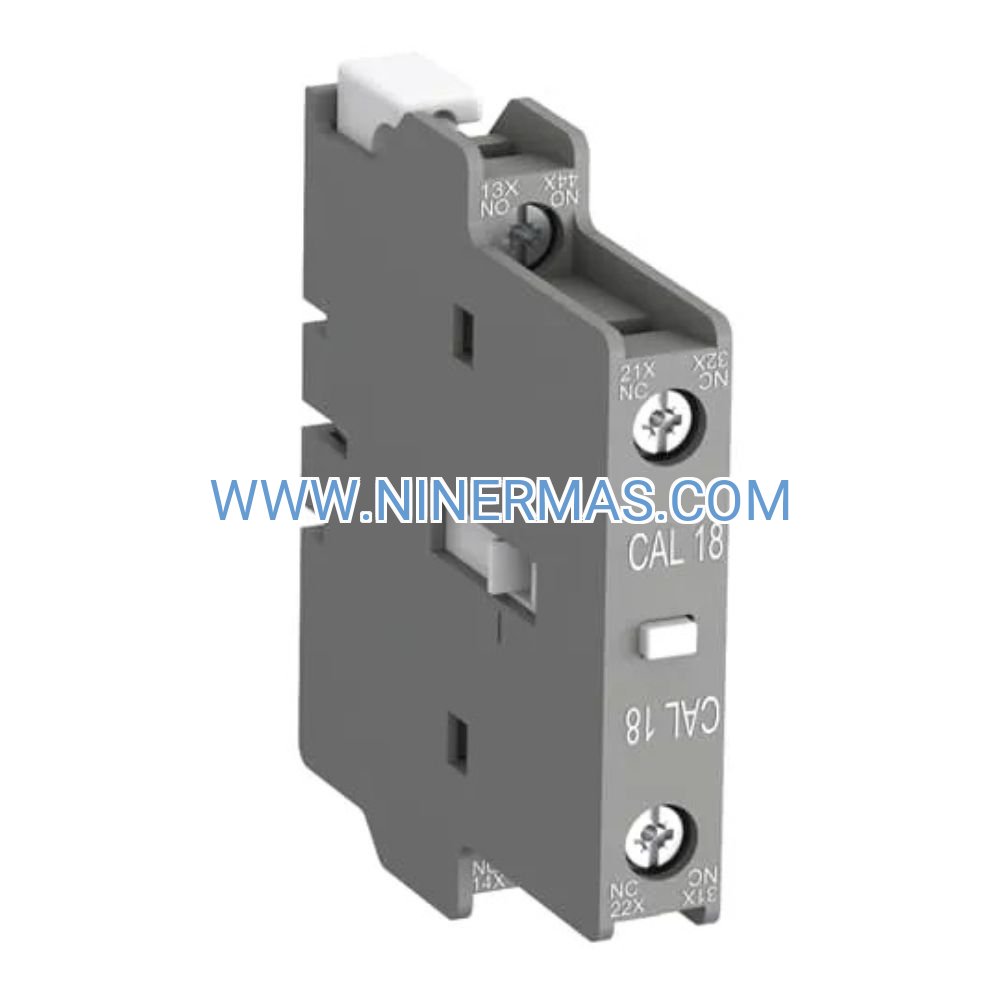
ABB CAL18-11 Auxiliary Contact Block (Industrial-Grade Signal Expansion)
The ABB CAL18-11 (1SFN010720R1011) is a side-mount auxiliary contact module engineered for industrial contactor applications requiring additional control circuits. This dual-contact block delivers one normally-open (NO) and one normally-closed (NC) contact path, enabling advanced interlocking logic, remote status monitoring, and multi-stage sequencing in automated production environments. Designed for ABB A-series and AF-series contactors, the CAL18-11 provides reliable signal switching up to 10A at 690V AC, meeting the demands of heavy industrial installations.
Electrical contractors, panel builders, and maintenance teams rely on auxiliary contact blocks to expand contactor functionality without adding separate relay components. The CAL18-11 solves space constraints in crowded control cabinets while maintaining synchronized operation with the main contactor—critical for applications where timing precision affects product quality or worker safety. From packaging machinery to HVAC systems, this component bridges the gap between power switching and intelligent control.
Key advantages include tool-free snap-fit mounting, hot-swap capability during maintenance windows, and universal compatibility across multiple ABB contactor families. With 10 million mechanical operations rated life and global safety certifications (CE, UL, CSA), the CAL18-11 delivers long-term reliability in demanding 24/7 industrial operations.
Core Features & Benefits
→ Dual Contact Configuration: 1NO + 1NC contacts provide maximum flexibility—use NO for start signals and NC for stop/alarm circuits within a single compact module, reducing component count and wiring complexity.
→ High Current Capacity: Rated 10A at AC-15 duty (control circuits) and 6A at DC-13, this block handles demanding pilot light loads, solenoid coils, and PLC input circuits without derating or external relays.
→ Snap-Fit Installation: Integrated mounting clips attach directly to contactor sides in seconds—no screws, no alignment tools, no drilling required. Add or remove blocks during scheduled maintenance without powering down adjacent equipment.
✓ Wide Voltage Range: Operates reliably from 24V to 690V AC and up to 220V DC, accommodating diverse control voltage standards across global industrial facilities and legacy equipment upgrades.
✓ Synchronized Switching: Mechanically linked to main contactor operation ensures zero time delay between power contacts and auxiliary signals—essential for coordinated motor reversing and emergency stop sequences.
✓ Compact Footprint: Adds only 12mm width to contactor assembly, preserving valuable DIN rail space in high-density panels where every millimeter impacts layout efficiency and cooling airflow.
Typical Application Scenarios
Motor Reversing Interlocks: In conveyor systems and crane hoists, the CAL18-11 NC contact prevents simultaneous energization of forward and reverse contactors. When the forward contactor closes, its NC auxiliary contact opens the reverse contactor coil circuit, eliminating the risk of phase-to-phase short circuits that destroy motor windings and trip upstream breakers.
PLC Feedback Confirmation: Manufacturing automation requires verification that commanded actions actually occurred. Connect the NO contact to a PLC digital input—when the contactor closes, the PLC receives confirmation before advancing to the next production step, preventing material waste from incomplete operations.
Remote Status Indication: In water treatment plants and HVAC systems, operators monitor pump and fan status from central control rooms. Wire the NO contact to panel-mounted indicator lights or SCADA systems, providing real-time visibility of equipment state across distributed facilities.
Sequential Start Control: Compressor stations and chiller plants require staged motor starting to manage inrush current. The first contactor's NO auxiliary contact energizes the second contactor coil after a time delay, creating a cascading start sequence that prevents voltage sags and nuisance trips.
Emergency Stop Circuits: Safety regulations mandate fail-safe operation in hazardous areas. The NC contact integrates into E-stop chains—when the contactor drops out during an emergency, the NC contact opens to de-energize downstream equipment and activate audible/visual alarms.
Technical Parameters & Selection Guide
| Parameter | Specification |
|---|---|
| Catalog Number | 1SFN010720R1011 |
| Series Designation | CAL18-11 |
| Contact Configuration | 1 Normally Open + 1 Normally Closed |
| Rated Operational Current | 10A (AC-15) / 6A (DC-13) |
| Maximum Voltage | 690V AC / 220V DC |
| Terminal Type | Screw clamp (1.5-2.5mm² wire) |
| Torque Specification | 0.8-1.2 Nm |
| Mounting Method | Side-mount snap clips |
| Operating Temperature | -25°C to +60°C |
| Mechanical Durability | 10 million operations minimum |
| Compliance Standards | CE, UL 508, CSA C22.2 |
| Dimensions (W×H×D) | 12mm × 75mm × 65mm |
| Weight | 50 grams |
Selection Criteria: Verify your contactor model accepts auxiliary blocks—ABB A9 through A300 frames and AF-series contactors are compatible. Count required NO and NC contacts for your application; if you need more than 1NO+1NC, consider stacking multiple CAL18-11 blocks or selecting a different contact configuration (CAL18-22 offers 2NO+2NC). Ensure control circuit voltage and current fall within the 690V AC / 10A ratings to prevent contact welding or premature failure.
Extended Functions
Multi-Block Stacking: Depending on contactor frame size, mount 2-4 auxiliary blocks on a single contactor to achieve up to 8 additional contacts. This modular approach eliminates separate control relays, reducing panel complexity and potential failure points in critical control circuits.
IoT Integration Readiness: Auxiliary contacts interface seamlessly with industrial IoT gateways and edge controllers. Connect NO/NC outputs to digital input modules for cloud-based equipment monitoring, predictive maintenance analytics, and remote troubleshooting via mobile dashboards.
Custom Wiring Configurations: Advanced users can parallel NO contacts for higher current capacity (consult ABB for derating factors) or series-connect NC contacts across multiple contactors to create complex safety interlocks meeting SIL-rated machinery directives.
Delivery & Service Assurance
Standard Lead Time: In-stock CAL18-11 blocks ship within 24 hours via express courier. Typical delivery to major industrial hubs: 3-5 business days (North America/Europe), 5-7 days (Asia-Pacific), 7-10 days (other regions).
Custom Orders: Bulk quantities (50+ units) or special packaging for OEM integrators: 10-15 business days from order confirmation. Volume pricing available—contact our sales team for project-specific quotes.
Warranty Coverage: 12-month manufacturer warranty against material and workmanship defects. Warranty includes free replacement and return shipping for confirmed manufacturing faults.
Technical Support: Our application engineers provide wiring diagrams, compatibility verification, and troubleshooting assistance via email/phone. Average response time: 4 hours during business hours (GMT+8).
Documentation Included: Each unit ships with installation instructions, dimensional drawings, and terminal wiring diagrams. Full technical datasheets and CAD models available for download on our website.
Frequently Asked Questions
Q: Can I install auxiliary contact blocks on energized contactors?
A: Yes, the CAL18-11 supports hot-swap installation. The auxiliary block mounts mechanically to the contactor side and does not require power-down for attachment. However, always de-energize control circuits before connecting wires to auxiliary terminals to prevent shock hazards.
Q: What wire gauge should I use for auxiliary contact connections?
A: Screw terminals accept 1.5-2.5mm² (16-14 AWG) solid or stranded copper conductors. Use ferrules on stranded wire to prevent strand breakage. Tighten terminals to 0.8-1.2 Nm torque—over-tightening damages threads, under-tightening causes high resistance and overheating.
Q: How do I determine if my contactor model is compatible?
A: Check your contactor nameplate for series designation. CAL18-11 fits ABB A-series (A9, A12, A16, A26, A30, A40, A50, A63, A75, A95, A110, A145, A185, A210, A260, A300) and AF-series contactors. Older B-series and K-series contactors require different auxiliary block models.
Q: Can auxiliary contacts switch motor loads directly?
A: No. Auxiliary contacts are rated for control circuits only (resistive/inductive pilot loads up to 10A). Motor loads require the contactor's main power poles, which feature arc chutes and higher interrupting capacity. Using auxiliary contacts for motor switching will cause contact welding and fire hazards.
Q: What is the difference between AC-15 and DC-13 ratings?
A: AC-15 (10A) applies to alternating current control circuits like solenoid coils and electromagnetic relays. DC-13 (6A) applies to direct current loads such as DC contactors and electromagnets. DC arcs are harder to extinguish, hence the lower current rating for DC applications.
Q: Do I need separate power supplies for auxiliary contacts?
A: Auxiliary contacts are passive switching devices—they do not require external power. They simply open or close circuits based on contactor state. The voltage/current through auxiliary contacts comes from your control circuit power supply (PLC outputs, pilot lights, relay coils, etc.).
Ready to Expand Your Control Capabilities?
Order the ABB CAL18-11 auxiliary contact block today to enhance your contactor-based control systems with reliable signal expansion. Our team is ready to assist with technical questions, compatibility verification, and volume pricing for panel builders and OEM projects.
Contact us now: sale@ninermas.com | +0086 187 5021 5667
© 2026 NINERMAS COMPANY LIMITED. All rights reserved.
Original Source: https://ninermas.com
Contact: sale@ninermas.com | +0086 187 5021 5667
Related products

Contact Info
-
Address:22 / F, South Wo Hang building, 148 Wing Lok Street, Sheung Wan, Western District, Hong Kong
-
Phone:+8618750215667
-
Email: