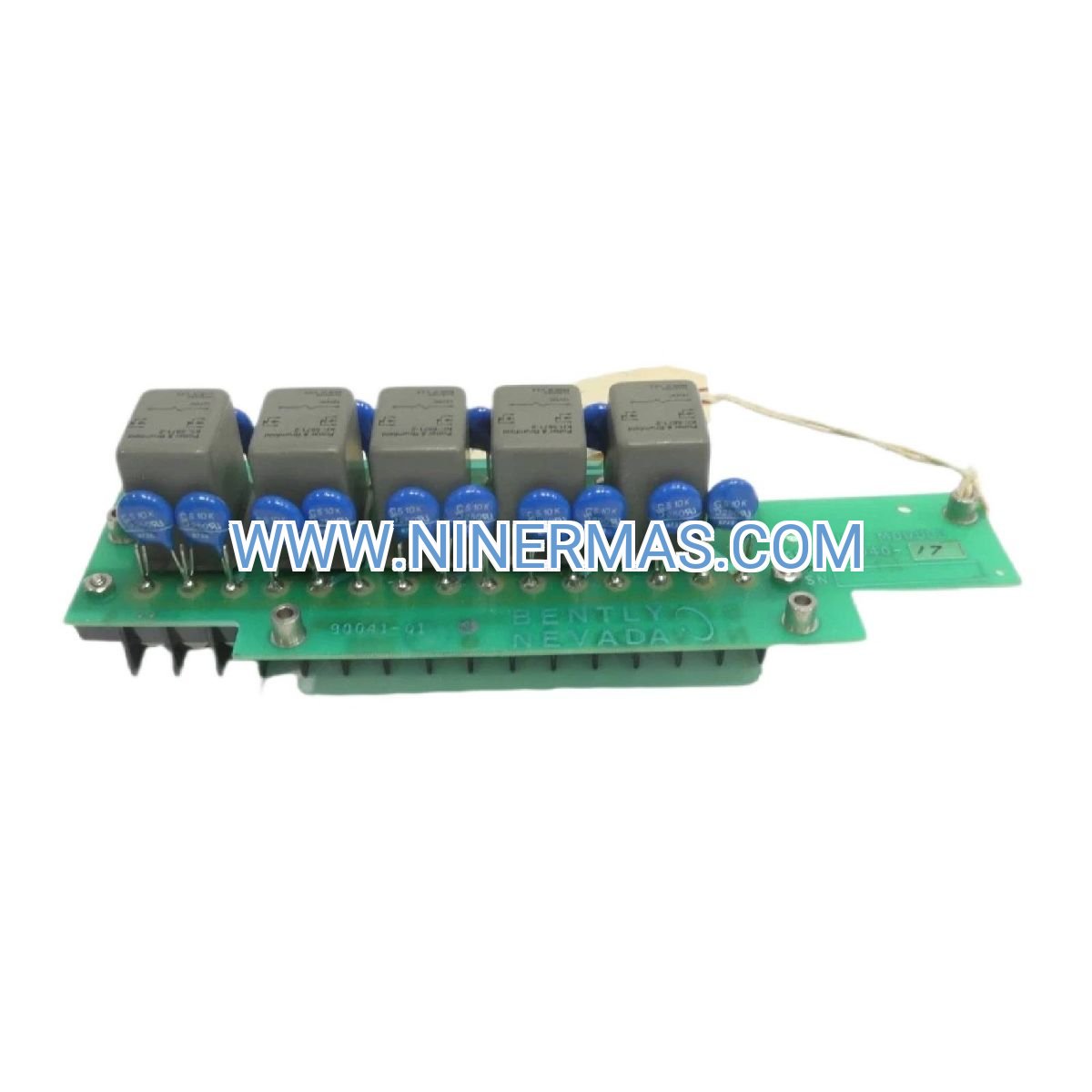
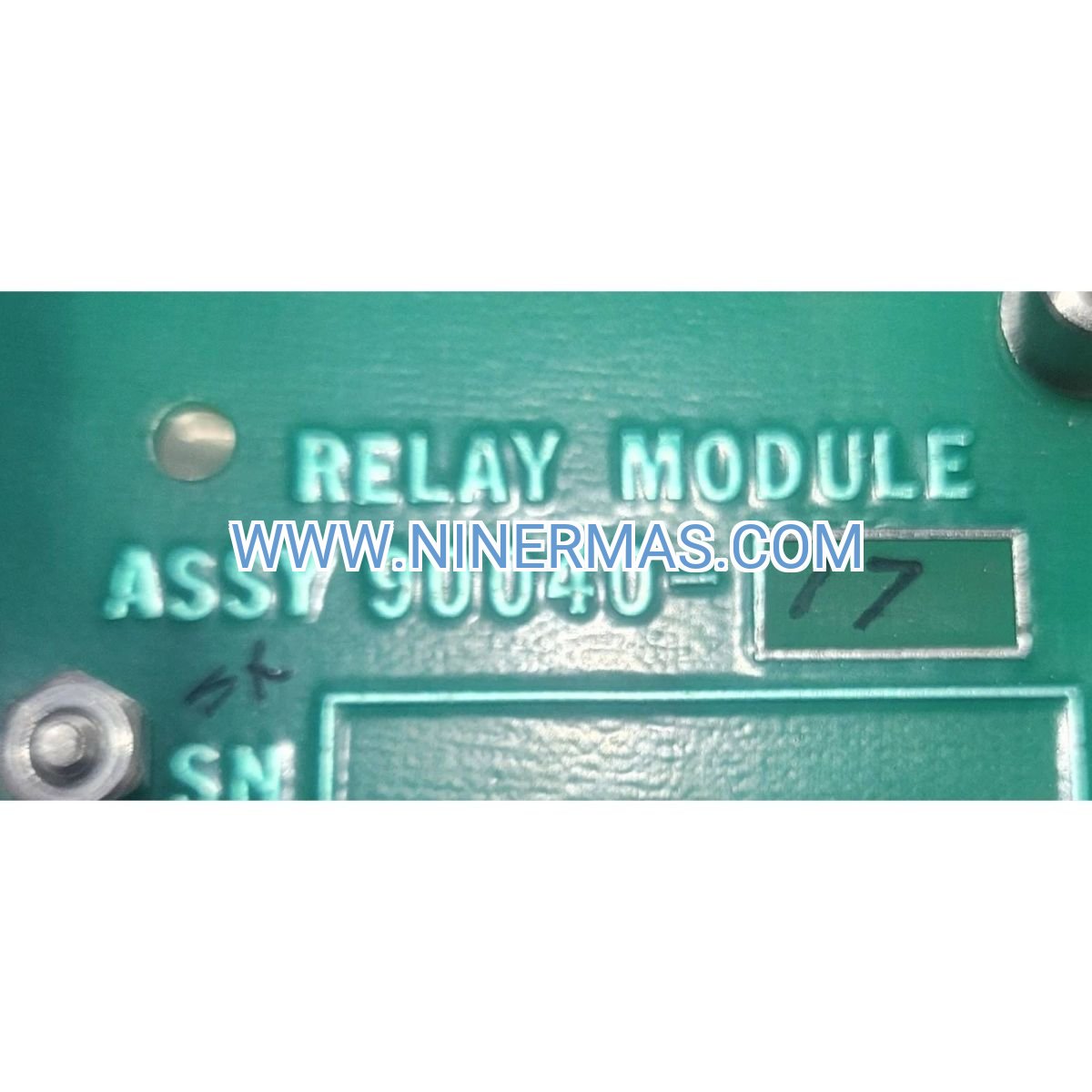
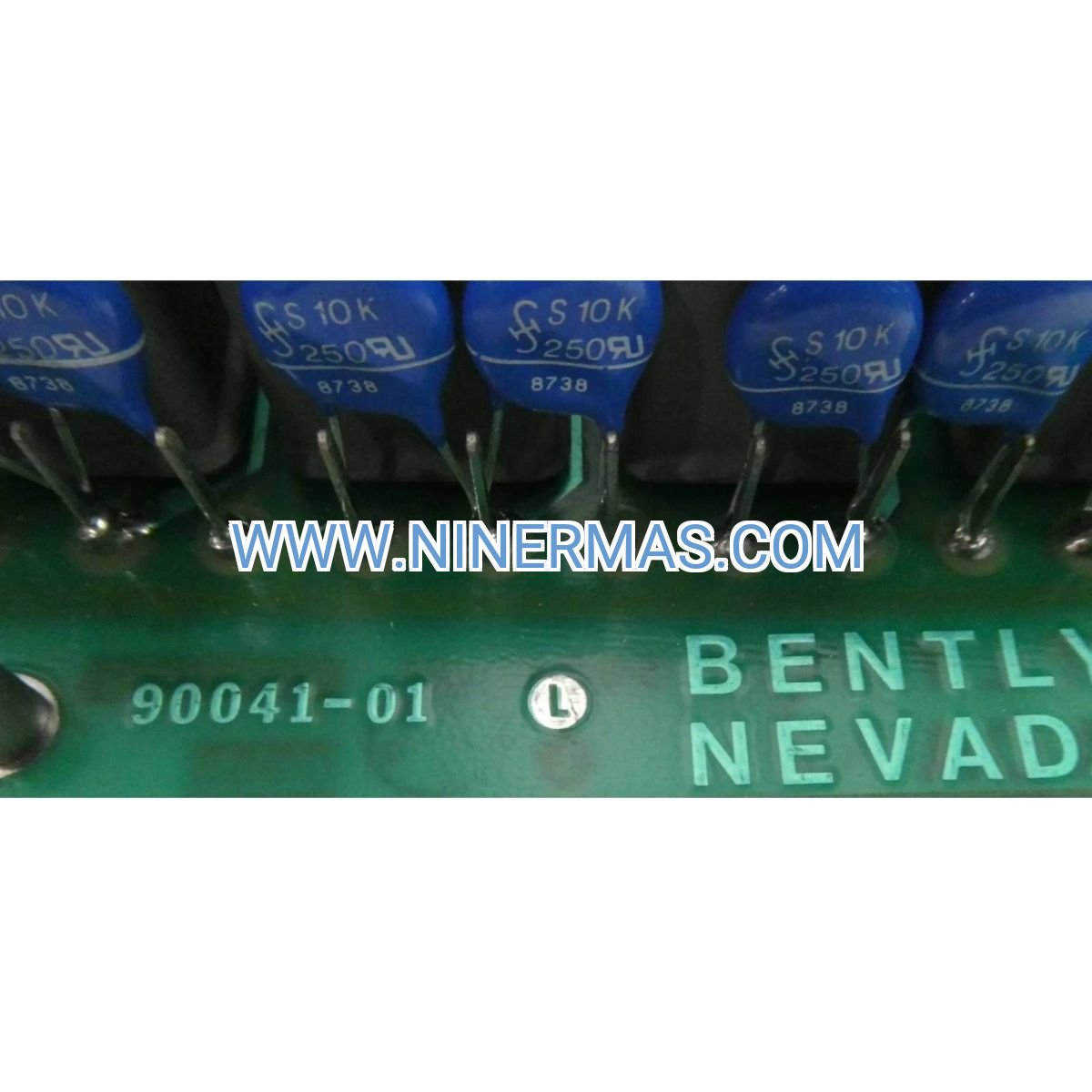
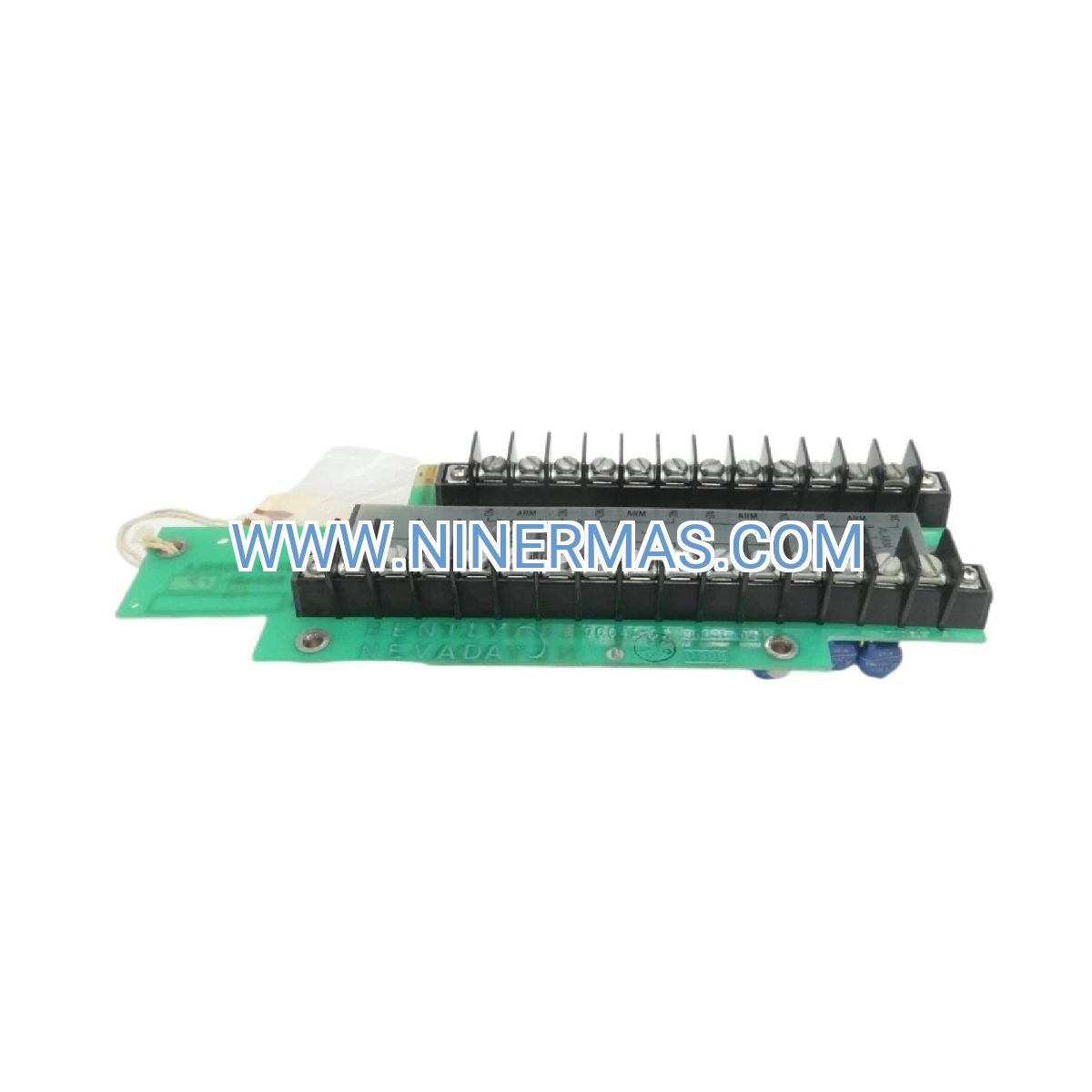
Bently Nevada 90040-17 High-Current Relay Module | 10A SIL 2 Certified | NINERMAS
Description
90040-17 Heavy-Duty Relay Output Module (Industrial-Grade Protection Interface)
The 90040-17 is a high-current relay output module designed for mission-critical machinery protection applications where standard relay modules fall short. Engineered specifically for Bently Nevada 9000 Series monitoring systems, this module bridges the gap between low-power monitoring signals and high-power protective devices—emergency shutdown valves, circuit breakers, and industrial actuators—that demand robust 10-ampere switching capability with proven reliability in harsh industrial environments.
Built for industries where equipment failure carries severe consequences—power generation, oil & gas processing, petrochemical manufacturing—the 90040-17 serves as the final execution layer in safety instrumented systems. When vibration monitors detect bearing failure, temperature sensors identify overheating, or position monitors flag shaft misalignment, this relay module translates alarm conditions into immediate protective actions: valve closures, breaker trips, or alarm activations that prevent catastrophic equipment damage and safeguard personnel.
With SIL 2 functional safety certification, silver alloy arc-resistant contacts rated for 100,000 operations, and 2500 VAC isolation protecting sensitive electronics from high-voltage transients, the 90040-17 delivers the durability and safety compliance required for regulatory adherence and long-term operational reliability in safety-critical installations.
Core Capabilities & Technical Advantages
→ 10-Ampere Switching Capacity: Form C (SPDT) contacts rated for 10A @ 250 VAC resistive loads enable direct control of high-power solenoid valves, motor starters, and industrial actuators without intermediate contactors. This eliminates additional relay stages, reducing system complexity and potential failure points in emergency shutdown chains.
✓ Arc-Resistant Silver Alloy Contacts: Specialized contact metallurgy withstands the electrical arcing inherent in inductive load switching (solenoid coils, motor windings). The 5A inductive load rating with extended electrical life (100,000 operations) ensures reliable performance through years of cycling in demanding applications where contact welding or erosion would compromise safety.
→ Sub-10ms Response Time: Relay operate time under 10 milliseconds ensures rapid conversion of alarm signals to protective actions. In turbomachinery protection, this speed minimizes the interval between fault detection and shutdown valve actuation, reducing the risk of secondary damage from continued operation under dangerous conditions.
✓ 2500 VAC Isolation Barrier: High-voltage isolation between relay coil and switched contacts protects monitoring system electronics from electrical transients in power circuits. This isolation is critical when switching circuit breaker trip coils or interfacing with medium-voltage switchgear, preventing ground loops and voltage spikes from damaging sensitive instrumentation.
→ SIL 2 Functional Safety Certification: Certified to IEC 61508 Safety Integrity Level 2 standards, the module meets reliability and failure mode requirements for use in safety instrumented functions. This certification supports facility safety integrity calculations and demonstrates compliance with process safety management regulations in chemical, refining, and power industries.
✓ Visual Status Indication: Dedicated LED indicators per relay channel provide immediate visual confirmation of relay state during commissioning, operation, and troubleshooting. Technicians can verify proper energization without test equipment, accelerating fault diagnosis and reducing mean time to repair during unplanned outages.
Industrial Application Scenarios
Steam Turbine Emergency Shutdown Systems: In power plants and cogeneration facilities, the 90040-17 controls high-flow steam admission valves that must close within seconds during overspeed, vibration, or thrust bearing failure events. The module's 10A contact rating handles the high inrush current of large solenoid operators (typically 3-8A), while its fast response ensures valve closure begins immediately upon alarm activation. Installation in redundant configurations (dual relay modules controlling separate valve solenoids) provides fail-safe protection even if one relay fails, meeting NFPA 85 boiler protection requirements.
Gas Compressor Protection Circuits: Natural gas pipeline compressors and LNG facilities use the 90040-17 to trip anti-surge valves, shutdown valves, and depressurization systems when vibration monitors detect impending surge or bearing failure. The relay's inductive load rating accommodates the reactive nature of solenoid valve coils, while its arc suppression capability prevents contact degradation from repetitive switching. Integration with API 670 compliant monitoring systems ensures coordinated protection across multiple compressor trains.
Petrochemical Process Interlock Systems: Refineries and chemical plants deploy the module in safety interlock chains controlling reactor feed valves, emergency isolation valves, and flare system actuators. The SIL 2 certification enables inclusion in Safety Instrumented Systems (SIS) designed to IEC 61511 standards, while the relay's proven reliability (10 million mechanical operations) supports the low failure rate requirements of high-demand safety functions. Wiring in series with emergency stop circuits provides defense-in-depth protection.
Critical Motor Circuit Breaker Trip Applications: Large motor-driven equipment (induced draft fans, boiler feed pumps, cooling water pumps) requires reliable breaker trip capability when bearing temperature, vibration, or motor winding temperature exceeds safe limits. The 90040-17 interfaces with motor protection relays and circuit breaker shunt trip coils, providing the current capacity and isolation voltage needed for safe operation in 480 VAC and 600 VAC motor control centers.
High-Power Alarm Annunciation: Industrial facilities with high ambient noise levels require powerful alarm devices—120 dB horns, high-intensity strobes, rotating beacons—that exceed the 2-3A capacity of standard relay modules. The 90040-17 drives multiple alarm devices simultaneously, ensuring personnel notification during machinery emergencies across large plant areas where standard alarms would be ineffective.
Technical Specifications & Selection Criteria
| Parameter | Specification |
|---|---|
| Part Number | 90040-17 |
| Module Classification | High-current relay output module |
| Compatible Platform | Bently Nevada 9000 Series Machinery Protection |
| Relay Type | Multiple Form C (SPDT) electromechanical |
| Resistive Load Rating | 10A @ 250 VAC / 30 VDC |
| Inductive Load Rating | 5A @ 250 VAC / 30 VDC |
| Maximum Switching Voltage | 300 VAC / 125 VDC |
| Contact Material | Silver alloy (arc suppression optimized) |
| Mechanical Endurance | 10,000,000 operations minimum |
| Electrical Endurance | 100,000 operations @ rated load |
| Operate Time | <10ms typical |
| Release Time | <5ms typical |
| Coil-to-Contact Isolation | 2500 VAC |
| Input Signal Type | Logic-level from 9000 Series monitors |
| Status Indication | LED per relay channel |
| Power Supply Options | 24 VDC or 115/230 VAC |
| Operating Temperature Range | -20°C to +65°C (-4°F to +149°F) |
| Mounting Configuration | 9000 Series rack or panel mount |
| Safety Certifications | UL, CE, CSA, ATEX, SIL 2 (IEC 61508) |
Selection Guidance: Choose the 90040-17 when switched load currents exceed 3 amperes or when SIL 2 certification is required for safety instrumented functions. For loads under 3A, standard relay modules may suffice. When switching inductive loads (solenoids, contactors), verify that load inrush current does not exceed 10A and steady-state current remains below 5A. Install arc suppression devices (RC snubbers for AC loads, flyback diodes for DC loads) to maximize contact life and prevent electrical noise injection into monitoring circuits.
Extended Integration & Customization Options
Redundant Configuration Support: Deploy dual 90040-17 modules in 1oo2 (one-out-of-two) voting configurations for critical shutdown functions requiring fault tolerance. Wire relay contacts in parallel to energize separate solenoid valves or in series to create fail-safe trip circuits that activate if either relay fails.
Remote Monitoring Integration: Relay status LEDs can be monitored via plant DCS or SCADA systems by adding auxiliary contacts or optical isolators. This enables centralized alarm verification and relay health monitoring without field visits, supporting predictive maintenance programs that track relay cycle counts and schedule replacement before failure.
Custom Terminal Configurations: Available with screw terminal, spring-clamp, or plug-in terminal blocks to match existing installation standards and simplify field wiring. Consult factory for high-vibration applications requiring locking terminal hardware or conformal coating for corrosive environments.
Delivery Timeline & Service Commitment
Standard Lead Time: 3-5 business days for in-stock units; 2-3 weeks for factory orders requiring configuration or testing
Warranty Coverage: 24-month manufacturer warranty covering defects in materials and workmanship
Technical Support: Global application engineering support for relay selection, load calculations, and arc suppression design
Documentation Package: Includes wiring diagrams, contact derating curves, load compatibility charts, installation manual, and SIL 2 certification documents
Frequently Asked Questions
Q: How do I calculate the required relay contact rating for my solenoid valve application?
A: Measure or obtain from the valve manufacturer the solenoid coil's steady-state current and inrush current (typically 3-5× steady-state for the first 50-100ms). The relay's resistive rating (10A) must exceed peak inrush current, while the inductive rating (5A) must exceed steady-state current. For a solenoid with 8A inrush and 3A steady-state, the 90040-17 is appropriately rated. Install an RC snubber across the coil to suppress voltage spikes during switching.
Q: Can the 90040-17 switch 480 VAC three-phase motor starter coils directly?
A: The module's 300 VAC maximum switching voltage limits application to 277 VAC phase-to-neutral circuits. For 480 VAC three-phase systems, use the relay to switch 120 VAC control power to the motor starter's control circuit rather than switching line voltage directly. Alternatively, use the relay to energize an intermediate contactor rated for 480 VAC operation.
Q: What maintenance intervals are recommended for relay modules in critical safety applications?
A: Perform annual functional testing by energizing relays under load and measuring contact voltage drop (should be <0.5V at rated current). Every 3-5 years or after 50,000 operations, conduct contact resistance measurements using a low-resistance ohmmeter; readings above 50 milliohms indicate contact degradation requiring module replacement. Document all test results to support safety system proof testing requirements per IEC 61511.
Q: How does the SIL 2 certification affect my facility's safety integrity level calculations?
A: The module's SIL 2 rating indicates a probability of failure on demand (PFD) between 10⁻² and 10⁻³, meaning it meets reliability requirements for safety functions with SIL 2 risk reduction targets. When combined with SIL 2-rated sensors and logic solvers in a properly designed safety instrumented function, the overall loop can achieve SIL 2 certification. Consult IEC 61511 or a certified functional safety engineer for complete SIF design and verification.
Q: What arc suppression components are required for inductive load switching?
A: For AC solenoid loads, install an RC snubber (typically 0.1µF capacitor in series with 100Ω resistor) across the load to absorb switching transients. For DC inductive loads, install a flyback diode (1N4007 or equivalent) across the coil with cathode toward positive supply. These components reduce contact arcing, extend relay life, and prevent electrical noise from coupling into nearby instrumentation circuits.
Q: Is the 90040-17 suitable for hazardous area installations requiring ATEX or IECEx certification?
A: The module carries ATEX certification for installation in Zone 2 hazardous areas when mounted in appropriate enclosures. For Zone 1 or Zone 0 applications, install the module in a purged or explosion-proof enclosure rated for the specific gas group and temperature class. Consult the ATEX certificate for detailed installation requirements and temperature class limitations based on ambient conditions and switched load power dissipation.
Take the Next Step in Machinery Protection
Ensure your critical equipment protection systems have the switching capacity and reliability required for safe, compliant operation. Contact our application engineering team to discuss your specific relay requirements, load characteristics, and safety integrity level targets. We provide detailed load analysis, arc suppression design, and configuration recommendations to optimize relay selection for your application.
Request a technical consultation: Share your valve specifications, circuit breaker trip coil data, or actuator requirements for personalized relay selection guidance and wiring diagrams.
© 2026 NINERMAS COMPANY LIMITED. All rights reserved.
Original Source: https://ninermas.com
Contact: sale@ninermas.com | +0086 187 5021 5667

Contact Info
-
Address:22 / F, South Wo Hang building, 148 Wing Lok Street, Sheung Wan, Western District, Hong Kong
-
Phone:+8618750215667
-
Email: