


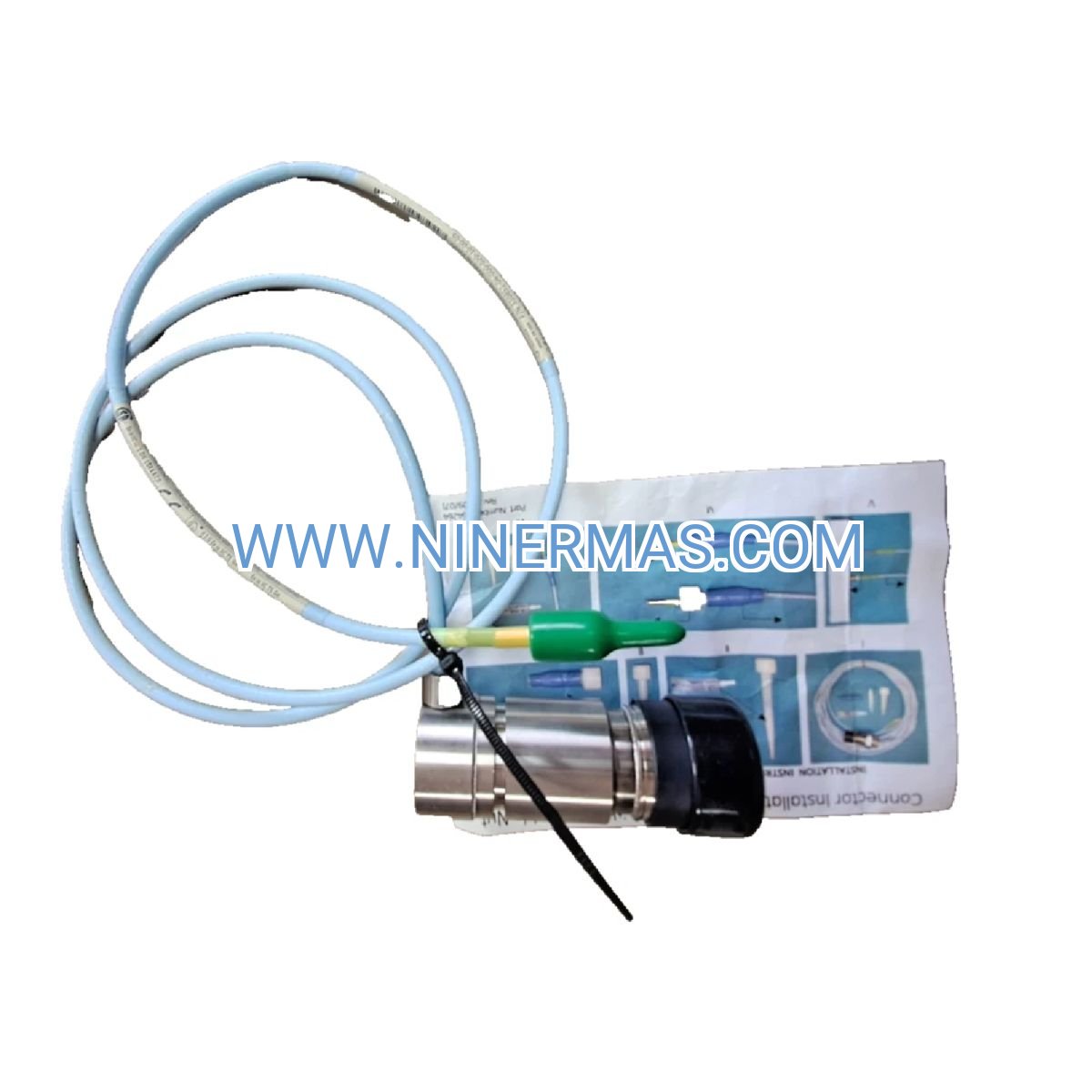
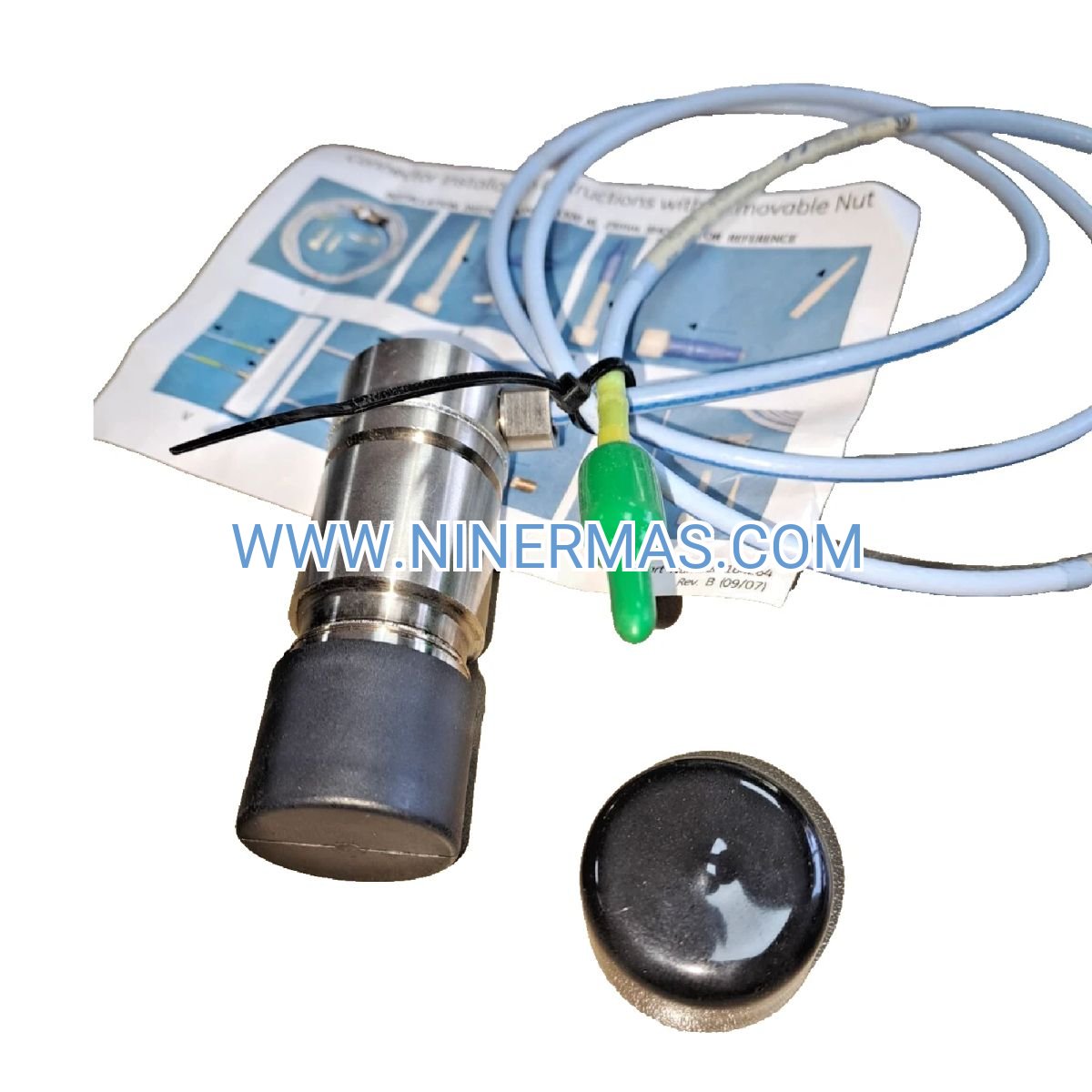
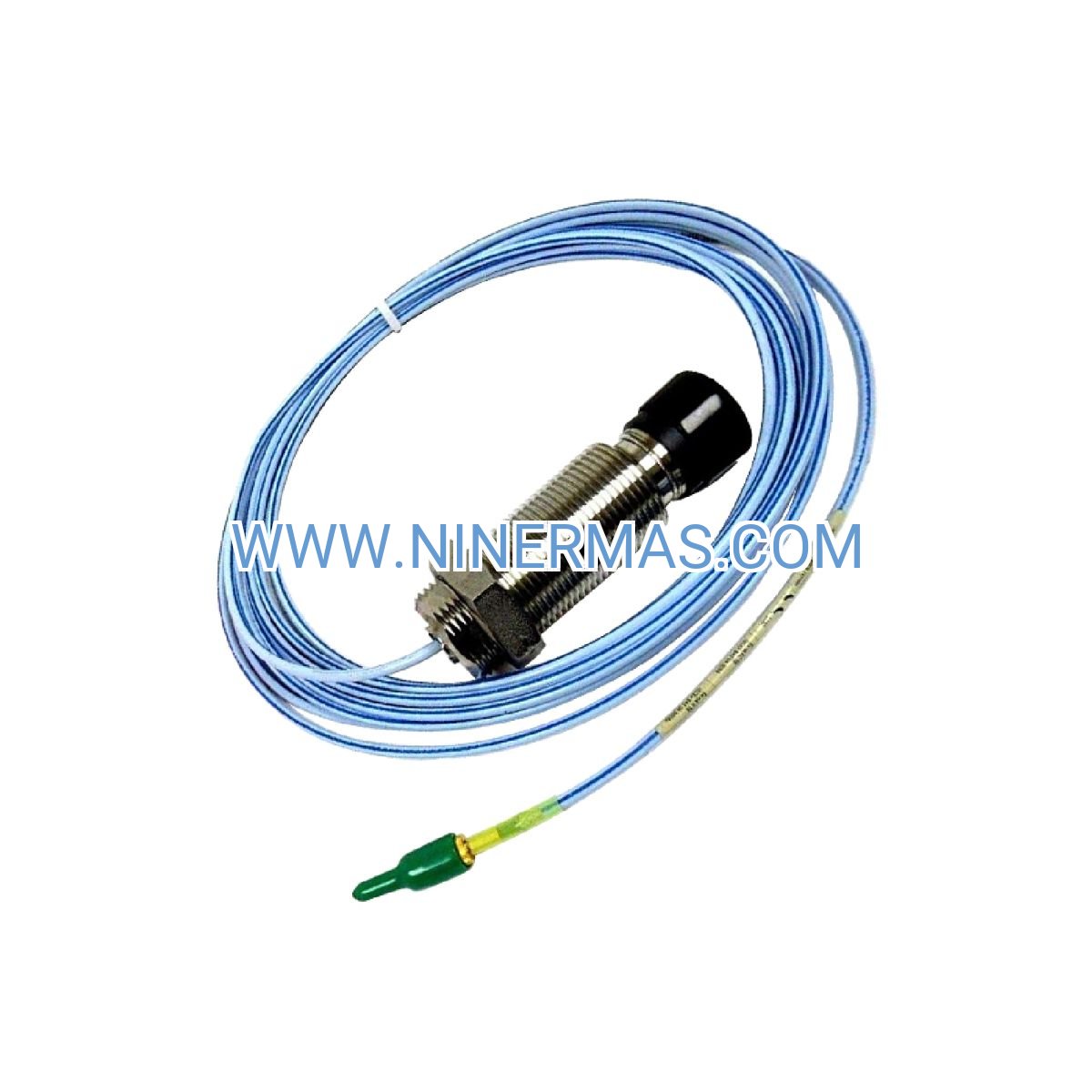
Description
8mm Proximity Probe for Industrial Turbomachinery Vibration Monitoring
The Bently Nevada 330851-04-000-030-10-01-00 is an industrial-grade 8mm eddy current proximity probe designed for continuous shaft vibration and axial position monitoring in critical rotating equipment. Utilizing non-contact electromagnetic sensing technology combined with factory-calibrated sensor-cable assemblies, this probe delivers precise displacement measurements for turbines, compressors, pumps, and high-speed motors.
Ideal for power generation plants, petrochemical facilities, oil & gas processing units, and heavy manufacturing operations where machinery uptime directly impacts production efficiency. The probe addresses common challenges including undetected bearing degradation, rotor imbalance, shaft misalignment, and thermal growth—enabling predictive maintenance strategies that reduce unplanned downtime by up to 40% and extend equipment service life.
Through API 670 4th Edition compliance and ISO 20816 conformance, this proximity sensor provides reliable performance across extreme operating conditions. The system features 0.040" to 0.200" linear measurement range, 0-10 kHz frequency response for capturing high-speed transient events, and rugged stainless steel construction rated for -40°C to +125°C environments. Suitable for design engineers, instrumentation contractors, plant maintenance teams, and OEM integrators requiring certified vibration monitoring solutions. Contact our application engineers for customized cable configurations and system integration guidance.
Core Features & Technical Advantages
Factory-Calibrated Sensor Assembly
Each probe ships as a matched sensor-cable system with documented calibration certificates, eliminating field calibration procedures and reducing installation time by 60%. Calibration data includes sensitivity verification across the full linear range and frequency response characterization per Bently Nevada QA protocols.
Extended Operating Temperature Range
Engineered with high-temperature coil windings and thermal-stable insulation materials, the probe maintains ±1% accuracy from -40°C to +125°C. This capability supports applications in steam turbine casings, hot gas compressor environments, and cryogenic pump installations without performance degradation.
High-Frequency Response Capability
With flat frequency response from DC to 10 kHz (-3 dB point), the sensor captures both slow-roll shaft runout (0.1 Hz) and blade-pass vibration events (8-10 kHz), providing comprehensive machinery health data for multi-stage turbomachinery diagnostics.
API 670 & ISO Standards Compliance
Meets or exceeds API 670 4th Edition requirements for machinery protection systems and ISO 20816 vibration severity criteria. Certification documentation supports regulatory compliance for ASME, PED, and ATEX installations in hazardous area classifications.
Robust Environmental Protection
Stainless steel housing with hermetically sealed coil assembly provides IP67-equivalent protection against moisture ingress, chemical exposure, and mechanical shock. Proven reliability in offshore platforms, mining operations, and corrosive process environments.
Universal System Compatibility
Standard 200 mV/mil output scaling and 5/8-18 UNF-2A threading ensure drop-in compatibility with Bently Nevada 3300 XL Proximitor sensors, legacy 3300 systems, and third-party vibration monitors supporting eddy current probe inputs.
Typical Application Scenarios
This proximity probe serves critical monitoring functions across industries where rotating equipment reliability determines operational safety and economic performance:
Steam & Gas Turbine Protection Systems
Monitors radial shaft vibration at bearing locations and thrust collar axial position in utility-scale turbines (50-500 MW). Detects rotor bow during startup/shutdown thermal transients, prevents blade tip rubs, and provides emergency trip signals when vibration exceeds alarm setpoints per NFPA 85 requirements.
Centrifugal Compressor Condition Monitoring
Tracks shaft displacement in multi-stage compressors handling natural gas, air separation, and refrigeration duties. Early detection of impeller fouling, seal wear, and aerodynamic instability (surge/stall) through vibration signature analysis, reducing catastrophic failure risk in API 617 applications.
High-Speed Pump Vibration Analysis
Measures radial runout and axial thrust in boiler feed pumps, pipeline transfer pumps, and process circulation pumps operating above 3,600 RPM. Identifies cavitation, hydraulic imbalance, and coupling misalignment before bearing damage occurs, supporting ISO 10816-7 pump vibration standards.
Motor-Driven Rotating Equipment
Provides keyphasor reference signals and shaft position data for large induction motors (>500 HP), synchronous motors, and variable-frequency drive applications. Enables torsional vibration monitoring, soft-foot detection, and rotor bar crack identification in predictive maintenance programs.
Gearbox & Drivetrain Monitoring
Captures gear mesh frequencies, bearing defect signatures, and shaft torsional oscillations in industrial gearboxes, wind turbine drivetrains, and marine propulsion systems. Supports condition-based maintenance strategies aligned with AGMA 6011 and ISO 8579 gearbox standards.
Technical Specifications & Selection Guide
To ensure optimal measurement performance and system compatibility, the following parameters define the probe's operational characteristics:
| Parameter | Specification |
|---|---|
| Model Number | 330851-04-000-030-10-01-00 |
| System Series | Bently Nevada 3300 XL |
| Probe Diameter | 8mm (-300 mil range) |
| Thread Specification | 5/8-18 UNF-2A |
| Linear Measurement Range | 1.0 to 5.1 mm (0.040" to 0.200") |
| Operating Temperature | -40°C to +125°C (-40°F to +257°F) |
| Frequency Response | DC to 10 kHz (-3 dB) |
| Output Sensitivity | 200 mV/mil (7.87 mV/μm) nominal |
| Target Material | 4140 steel or equivalent ferromagnetic |
| Surface Finish Requirement | ≤63 μin Ra (1.6 μm Ra) |
| Housing Material | 300 Series Stainless Steel |
| Cable Configuration | Custom lengths available (specify at order) |
| Compliance Standards | API 670 4th Ed., ISO 20816, ISO 10816 |
| Environmental Rating | IP67 equivalent (sealed construction) |
Selection Considerations:
When specifying this proximity probe for your application, evaluate the following project parameters: maximum shaft speed (RPM), expected vibration amplitude range, installation space constraints (radial clearance), ambient temperature profile, target shaft material and surface condition, required cable length from probe tip to proximitor sensor, and applicable industry standards (API, ISO, NFPA). For installations requiring hazardous area certification (ATEX, IECEx, CSA), consult with our application engineers to verify intrinsic safety barrier requirements and system grounding specifications.
System Integration & Compatibility
Proximitor Sensor Pairing
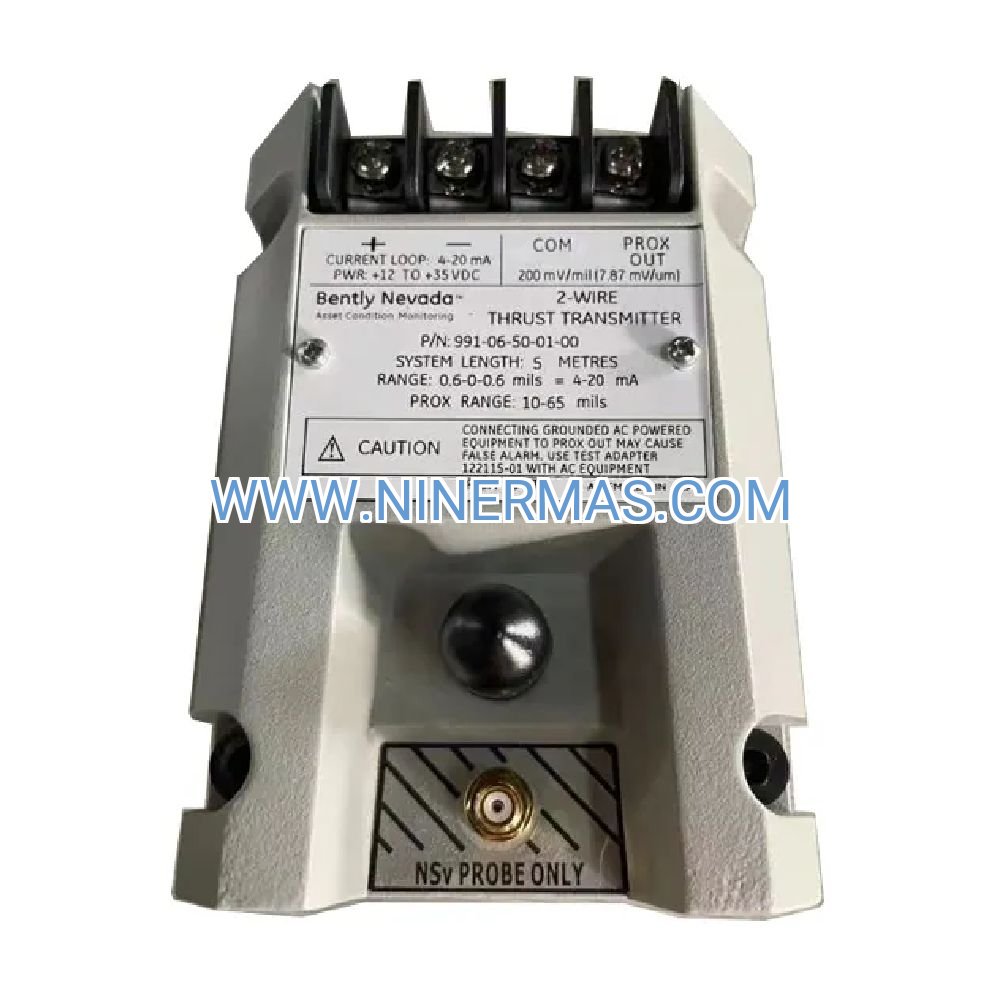
This probe requires connection to a Bently Nevada 3300 XL Proximitor sensor (such as 330180-90-CN or 330180-91-CN) which provides -24 VDC excitation voltage and converts the probe's variable inductance into a calibrated 4-20 mA or ±10 VDC output signal. The proximitor performs signal conditioning, linearization, and buffering for connection to DCS, PLC, or dedicated vibration monitoring systems.
Extension Cable Compatibility
Factory calibration accounts for the total system cable length (probe integral cable + extension cable). When field conditions require cable extension beyond the standard configuration, use only Bently Nevada approved extension cables (330130 or 330330 series) to maintain calibration accuracy. Maximum recommended total cable length: 9 meters (30 feet) for standard applications.
Mounting Hardware Requirements
Probe installation requires a threaded mounting bracket or probe holder with 5/8-18 UNF-2A internal threads. Ensure the mounting surface provides rigid support with minimal vibration transmission. Maintain the specified probe tip-to-target gap (typically set at mid-range: 0.120" or 3.0 mm) using precision gap-setting tools or feeler gauges during installation.
Target Shaft Preparation
For optimal measurement accuracy, the observed shaft surface must be machined from ferromagnetic material (4140 steel preferred) with surface finish better than 63 micro-inches Ra. Avoid chrome plating, nickel plating, or non-magnetic coatings in the probe observation zone. Minimum target diameter: 25mm (1.0") for 8mm probes to minimize curvature effects.
Delivery, Service & Quality Assurance
Lead Time & Availability
Standard catalog configurations with common cable lengths (1m, 3m, 5m) typically ship within 3-5 business days from stock. Custom cable length assemblies and special thread configurations require 10-15 business days for factory assembly and calibration. Expedited processing available for critical outage support and emergency replacement scenarios.
Warranty Coverage
All proximity probes include a comprehensive 12-month manufacturer's warranty covering material defects, workmanship issues, and calibration accuracy degradation under normal operating conditions. Warranty excludes damage from improper installation, mechanical impact, electrical overstress, or operation beyond published environmental limits.
Technical Support Services
Our application engineering team provides pre-sale consultation for probe selection, installation guidance including gap-setting procedures, troubleshooting assistance for signal quality issues, and system integration support for multi-channel monitoring configurations. Remote diagnostic support and on-site commissioning services available in select regions.
Documentation Package
Each probe ships with factory calibration certificate (sensitivity and linearity data), installation instructions with dimensional drawings, recommended proximitor sensor pairing guide, and material traceability documentation. Digital copies of operation manuals, wiring diagrams, and 3D CAD models (STEP format) available upon request.
Frequently Asked Questions (FAQ)
Q: What is the difference between 8mm and 11mm proximity probes for vibration monitoring?
A: The 8mm probe offers a more compact form factor suitable for tight installation spaces and smaller shaft diameters (25-100mm), with a linear range of 0.040" to 0.200". The 11mm probe provides an extended linear range (0.050" to 0.260") better suited for larger shafts (>100mm diameter) and applications requiring greater measurement span. Both probe sizes deliver equivalent frequency response and temperature performance when properly installed.
Q: Can this Bently Nevada proximity probe work with non-Bently monitoring systems?
A: Yes, when paired with a compatible 3300 XL Proximitor sensor, the system outputs industry-standard analog signals (4-20 mA or ±10 VDC) that interface with most DCS, PLC, and third-party vibration monitoring platforms. However, achieving published accuracy specifications requires using Bently Nevada proximitor sensors due to the factory-matched calibration between probe and signal conditioner.
Q: What target shaft material and surface finish are required for accurate measurements?
A: Optimal performance requires ferromagnetic target materials such as 4140 steel, 1045 carbon steel, or 400-series stainless steel. The observed surface must have a finish of 63 micro-inches Ra (1.6 μm Ra) or better. Chrome plating, nickel plating, and non-magnetic stainless steels (300-series) significantly reduce sensitivity and should be avoided in the probe observation zone. Surface hardness and heat treatment do not affect measurement accuracy provided the material remains ferromagnetic.
Q: Is field recalibration required after installing extension cables?
A: Factory-calibrated probe systems maintain specified accuracy when extended using approved Bently Nevada extension cables (330130 or 330330 series) up to the maximum recommended total cable length of 9 meters. The factory calibration accounts for cable capacitance and inductance effects. However, using non-approved cables, exceeding maximum cable length, or field-splicing cables will invalidate calibration and require system recalibration using certified test equipment.
Q: How do I set the correct probe-to-target gap during installation?
A: The probe tip should be positioned at the mid-point of the linear range, typically 0.120" (3.0 mm) from the shaft surface for 8mm probes. Use a calibrated feeler gauge or gap-setting tool to establish this distance with the shaft at rest. After setting the gap, lock the probe in position using the mounting bracket jam nut. Verify the gap voltage reading at the proximitor output falls within the specified range (typically -9 to -11 VDC for mid-gap positioning).
Q: What is the maximum shaft speed this proximity probe can monitor?
A: The probe's 10 kHz frequency response supports shaft speeds up to 600,000 RPM theoretically. Practical limitations depend on the number of vibration harmonics requiring capture. For comprehensive machinery diagnostics capturing up to the 10th harmonic, maximum recommended shaft speed is approximately 60,000 RPM. Most industrial turbomachinery applications (3,600-15,000 RPM) operate well within the probe's frequency capability.
Request Technical Consultation & Quotation
For customized proximity probe configurations, system integration assistance, or project-specific technical support, please provide the following information to our application engineering team:
- Project name and application description (equipment type, operating conditions)
- Shaft diameter, material, and surface finish at probe observation location
- Operating speed range (minimum/maximum RPM)
- Expected vibration amplitude and frequency content
- Ambient temperature range and environmental conditions
- Required cable length from probe mounting location to signal conditioner
- Applicable industry standards or certification requirements (API, ISO, ATEX)
- Quantity required and delivery timeline
Our engineers will provide probe selection recommendations, proximitor sensor pairing guidance, installation drawings, and detailed quotations within 24-48 hours for standard inquiries.
© 2026 NINERMAS COMPANY LIMITED. All rights reserved.
Original Source: https://ninermas.com
Contact: sale@ninermas.com | +0086 187 5021 5667

Contact Info
-
Address:22 / F, South Wo Hang building, 148 Wing Lok Street, Sheung Wan, Western District, Hong Kong
-
Phone:+8618750215667
-
Email:
