


Description
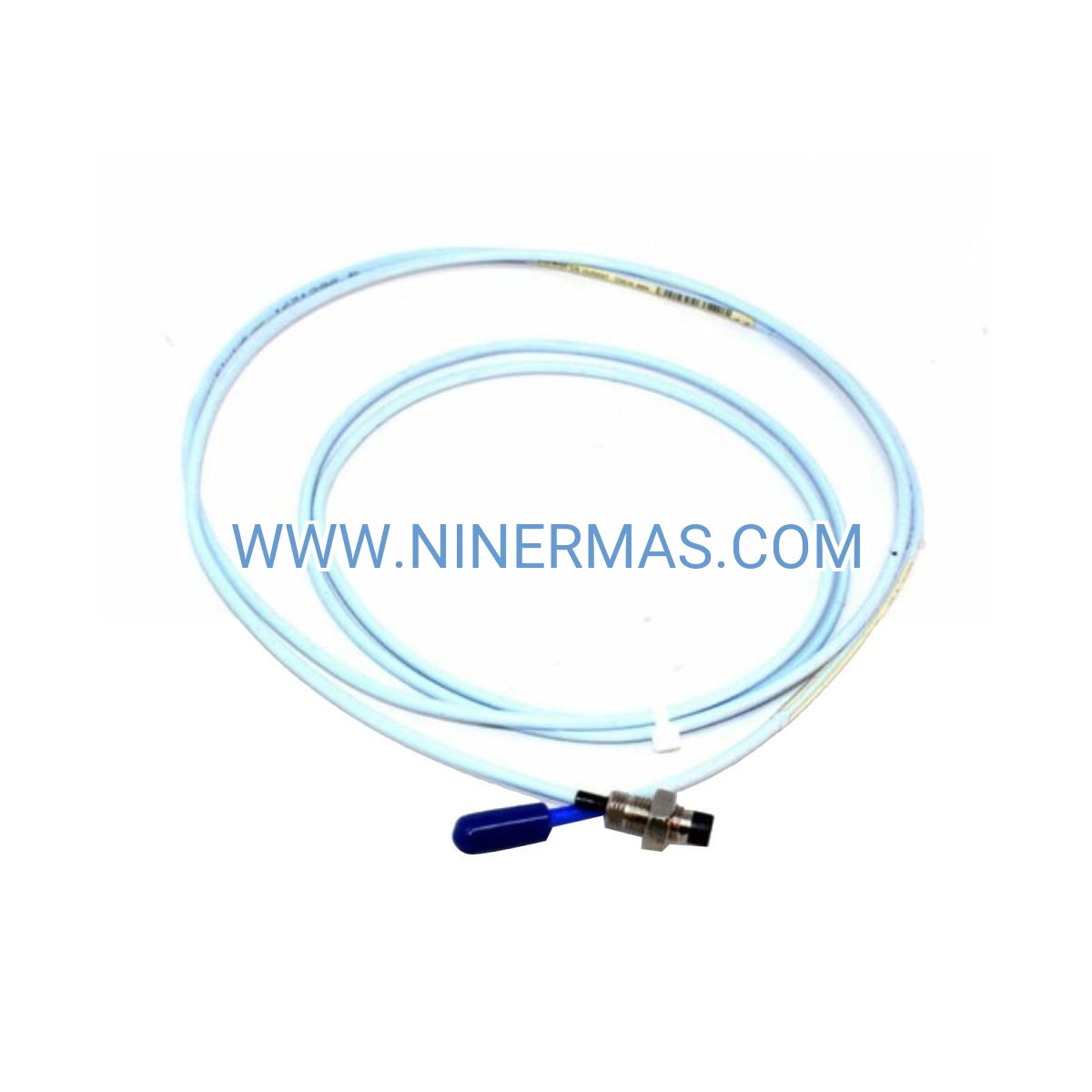
8mm Proximity Transducer for Industrial Vibration Monitoring (Bently Nevada 330191 Series)
The 330191-00-40-90-02-00 is an industrial-grade proximity transducer designed for non-contact displacement measurement in rotating machinery applications. Utilizing eddy current sensing technology with an 8mm probe diameter, this sensor delivers precise shaft position and vibration data through continuous monitoring, enabling predictive maintenance strategies and equipment protection in critical industrial processes.
Engineered for turbomachinery, compressor systems, high-speed motors, and generator sets across power generation, petrochemical, oil & gas, and heavy manufacturing sectors, this transducer addresses common challenges including bearing wear detection, shaft misalignment identification, rotor imbalance monitoring, and thermal growth tracking. The sensor's wide frequency response captures both low-speed roll conditions and high-frequency vibration events that precede catastrophic failures.
Through field-proven design and robust stainless steel construction, the 330191 series offers extended operational life, minimal maintenance requirements, excellent electromagnetic interference resistance, and seamless integration with existing 3300 XL monitoring infrastructure. Ideal for design engineers, maintenance teams, instrumentation contractors, and plant reliability specialists seeking dependable condition monitoring solutions. Contact our application engineers for system configuration assistance and technical specifications tailored to your monitoring requirements.
Core Capabilities & Performance Advantages
Non-Contact Eddy Current Sensing
Employs electromagnetic induction principles to measure target displacement without physical contact, eliminating friction-related wear and extending sensor service life while maintaining measurement accuracy over millions of operational cycles.
Wide Frequency Response Bandwidth
Captures vibration signatures from 0 Hz (static displacement) to 10 kHz, enabling detection of slow thermal expansion, subsynchronous vibration phenomena, gear mesh frequencies, and bearing defect harmonics within a single measurement channel.
Extended Temperature Operating Range
Functions reliably across -40°C to +105°C ambient conditions, accommodating arctic installations, desert climates, and high-temperature process environments without performance degradation or calibration drift.
Rugged Industrial Construction
Features corrosion-resistant stainless steel housing with hermetically sealed electronics, providing IP67-equivalent protection against moisture ingress, chemical exposure, and mechanical shock in harsh industrial atmospheres.
System Compatibility & Integration
Direct compatibility with 3300 XL proximitor modules and monitoring platforms ensures plug-and-play installation, standardized signal conditioning, and unified data acquisition across multi-machine monitoring networks.
Precision Thread Design
5/8-18 UNF-2A thread specification enables secure mounting with precise axial positioning control, critical for maintaining optimal air gap dimensions and measurement linearity throughout equipment operation.
Industrial Application Scenarios
This proximity transducer serves critical monitoring functions across industries demanding continuous equipment availability and early fault detection:
Power Generation Turbomachinery
Monitors steam turbine shaft displacement, generator rotor eccentricity, and thrust bearing position in combined-cycle plants, nuclear facilities, and coal-fired stations where unplanned outages carry severe economic penalties.
Oil & Gas Compression Systems
Tracks centrifugal and reciprocating compressor vibration in offshore platforms, pipeline booster stations, and LNG facilities, detecting bearing degradation and aerodynamic instabilities before catastrophic failure occurs.
Petrochemical Process Equipment
Provides continuous surveillance of high-speed pumps, blowers, and agitators handling corrosive fluids in refineries and chemical plants, where equipment reliability directly impacts production throughput and safety performance.
Manufacturing & Heavy Industry
Supports condition-based maintenance programs for paper machine rolls, steel mill drives, mining conveyors, and cement kiln systems, optimizing maintenance intervals and reducing spare parts inventory costs.
Marine Propulsion & Auxiliary Systems
Monitors main engine crankshaft deflection, turbocharger rotor dynamics, and propeller shaft alignment in commercial vessels and naval applications operating under variable load and environmental conditions.
Technical Specifications & Selection Parameters
To facilitate engineering design and procurement decisions, key specifications are provided below. Custom configurations including specialized cable lengths, connector types, and environmental certifications are available upon request.
Electrical & Performance Characteristics
- Model Designation: 330191-00-40-90-02-00
- Probe Diameter: 8mm (0.315 inches)
- Frequency Response: DC to 10 kHz (-3dB)
- Linear Range: 0.5mm to 2.5mm (20 to 100 mils typical)
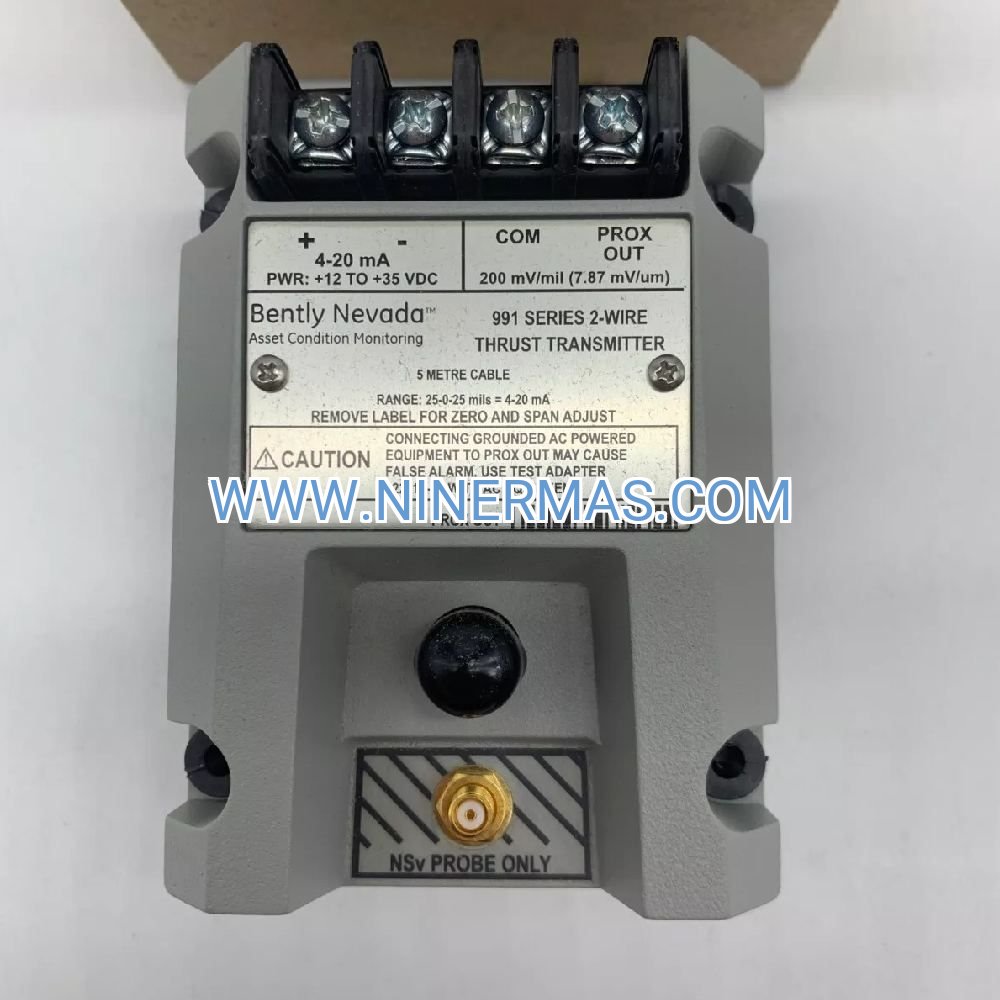
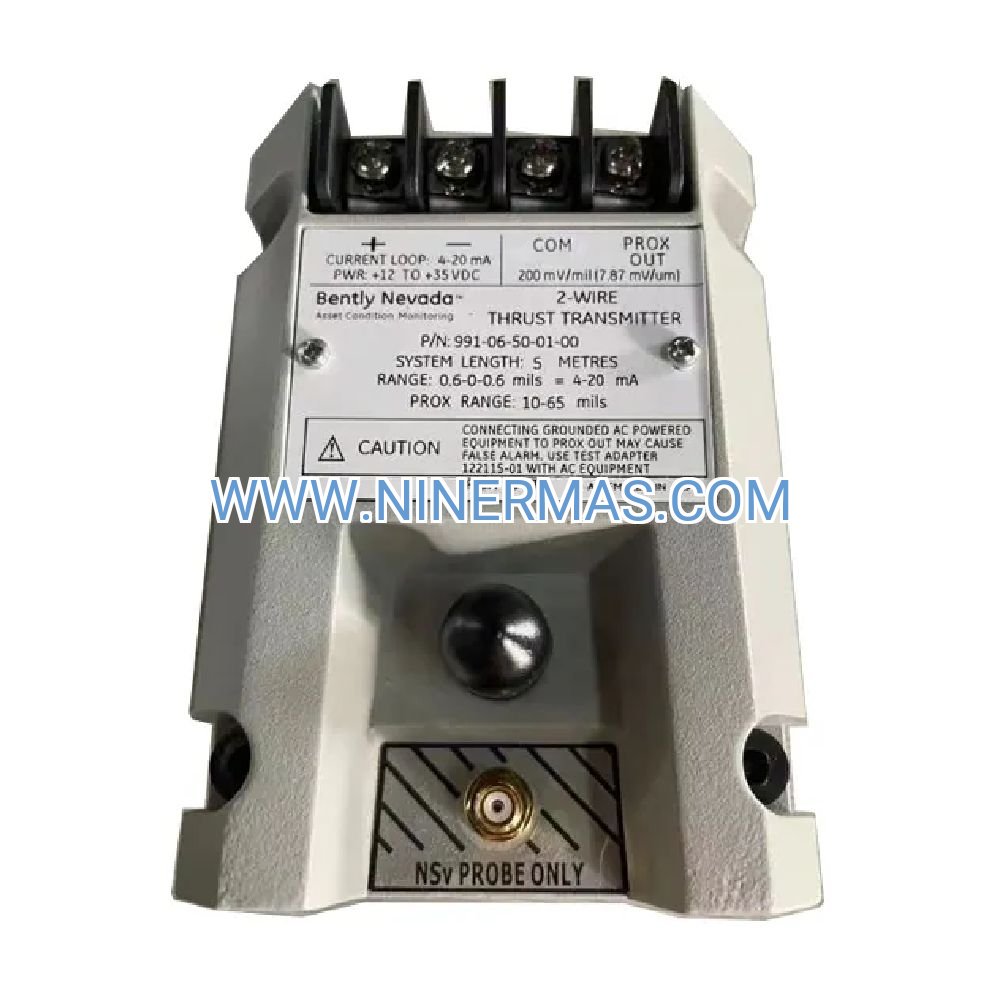
- Sensitivity: Approximately 200 mV/mil (7.87 mV/μm)
- Operating Temperature: -40°C to +105°C continuous
- Storage Temperature: -55°C to +125°C
Mechanical & Installation Details
- Thread Specification: 5/8-18 UNF-2A external
- Housing Material: 300-series stainless steel
- Cable Construction: Low-noise coaxial design
- Mounting Torque: 15-20 ft-lbs (20-27 N⋅m)
- Probe Length: Standard and extended options available
- Environmental Rating: Suitable for industrial Zone 2/Division 2 when properly certified
Selection Guidance
When specifying proximity transducers, consider the following parameters: target material conductivity and magnetic permeability, maximum shaft speed and vibration amplitude, available mounting space and access constraints, ambient temperature extremes and chemical exposure, required cable routing distance to proximitor location, and existing monitoring system architecture. Our engineering team can review your application worksheet and recommend optimal sensor placement, gap voltage settings, and system configuration. Submit machinery nameplate data, operating conditions, and monitoring objectives for personalized technical consultation.
System Architecture & Signal Chain
The 330191 proximity probe functions as the sensing element within a complete three-component measurement system. The probe generates a high-frequency electromagnetic field that induces eddy currents in the conductive target surface. Changes in target distance modulate the field strength, which the proximitor module converts to a calibrated DC voltage output proportional to displacement. This analog signal feeds monitoring systems, protection relays, or data acquisition platforms for trending analysis, alarm generation, and automated shutdown logic.
Typical system configuration includes: proximity probe mounted at optimal radial or axial position, extension cable connecting probe to proximitor (length-matched for phase accuracy in dual-probe applications), proximitor module providing excitation and signal conditioning, and monitoring system performing data logging, spectral analysis, and diagnostic functions. Proper grounding, shielding, and cable routing practices are essential for noise immunity in electrically harsh environments.
Delivery, Quality Assurance & Technical Support
Standard catalog items ship within 3-5 business days from regional distribution centers. Custom configurations including specialized cable assemblies, hazardous area certifications, or extended temperature ratings require 2-4 weeks manufacturing lead time. All products undergo factory calibration and functional testing prior to shipment, with test certificates available upon request.
Each transducer includes a minimum 12-month warranty covering material defects and workmanship under normal operating conditions. Technical support services encompass pre-sale application engineering, installation guidance documentation (including dimensional drawings, wiring diagrams, and gap voltage setup procedures), commissioning assistance via remote consultation, and post-installation troubleshooting support. On-site startup services and training programs are available for complex multi-channel installations.
Complete documentation packages include: mechanical installation drawings with mounting dimensions and torque specifications, electrical connection schematics showing cable pinouts and grounding requirements, calibration data sheets with gap voltage curves, and operation manuals covering setup procedures and maintenance recommendations. Digital formats compatible with CAD systems and asset management databases can be provided for integration into plant documentation systems.
Frequently Asked Questions
Q: How does the 8mm proximity transducer integrate with existing 3300 XL monitoring systems?
A: The 330191 series utilizes standard -24 VDC excitation and produces industry-standard output signals compatible with all 3300 XL proximitor modules. Connection requires appropriate extension cable length-matched to system requirements, with proximitor providing signal conditioning and buffered outputs to monitoring equipment. Verify proximitor model supports 8mm probe diameter for optimal linearity.
Q: What is the maximum number of measurement points a single monitoring system can accommodate?
A: System capacity depends on monitoring platform architecture. Typical rack-mounted systems support 16-64 channels per chassis, with networked configurations scaling to hundreds of measurement points. Each radial bearing position typically requires two probes (X-Y orientation) plus one keyphasor for phase reference, while thrust monitoring uses single axial probe.
Q: What target surface preparation is required for accurate proximity measurements?
A: Target surfaces should be smooth, clean, and free from coatings, rust, or debris within the measurement zone. Surface finish of 63 microinches (1.6 μm Ra) or better is recommended. Conductive materials such as 4140 steel, 400-series stainless steel, or Inconel provide optimal performance. Non-magnetic stainless steels (300-series) require sensitivity compensation.
Q: Can proximity transducers operate in hazardous classified areas?
A: Yes, when installed as part of a certified intrinsically safe system or within purged/pressurized enclosures meeting applicable standards (ATEX, IECEx, NEC 505/500). Consult factory for specific certifications and associated entity parameters. Proximitor modules must also carry appropriate hazardous location approvals for complete system compliance.
Q: What maintenance intervals are recommended for proximity transducer systems?
A: Proximity probes are passive sensors requiring minimal maintenance. Annual inspection during scheduled outages should verify cable integrity, connector tightness, mounting security, and target surface condition. Gap voltage verification confirms system calibration. Cable replacement every 5-7 years or upon insulation degradation prevents measurement drift. Proximitor modules may require recalibration every 3-5 years depending on environmental exposure.
Q: How do I select appropriate cable length for my installation?
A: Total system cable length (probe integral cable plus extension cable) affects high-frequency response and noise susceptibility. Standard systems accommodate up to 9 meters (30 feet) total length. Longer runs require special consideration for capacitance loading and may necessitate proximitor model selection with extended cable compensation. Provide routing distance and environmental conditions for engineering review.
Request Technical Consultation & Quotation
For detailed system design assistance, pricing information, or application-specific recommendations, please provide the following details: project name and timeline, equipment type and operating parameters (speed, temperature, environment), number of measurement points and monitoring objectives, shaft material and diameter at probe location, available mounting access and space constraints, electrical area classification requirements, and preferred delivery schedule. Our application engineering team will respond within one business day with tailored solutions and budget pricing.
© 2026 NINERMAS COMPANY LIMITED. All rights reserved.
Original Source: https://ninermas.com
Contact: sale@ninermas.com | +0086 187 5021 5667

Contact Info
-
Address:22 / F, South Wo Hang building, 148 Wing Lok Street, Sheung Wan, Western District, Hong Kong
-
Phone:+8618750215667
-
Email:
