Description
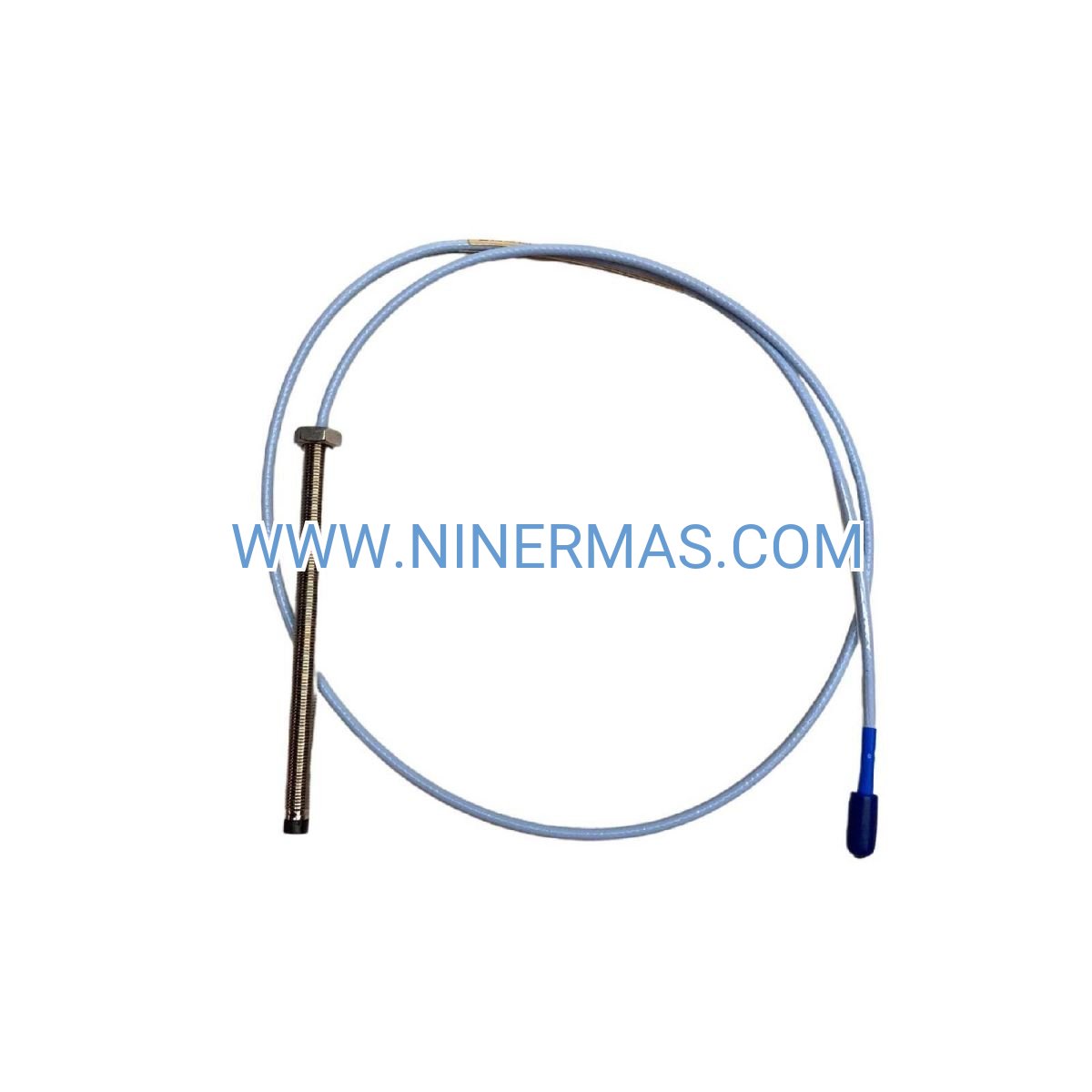
8mm Proximity Transducer for Industrial Turbomachinery Monitoring (3300 XL Compatible)
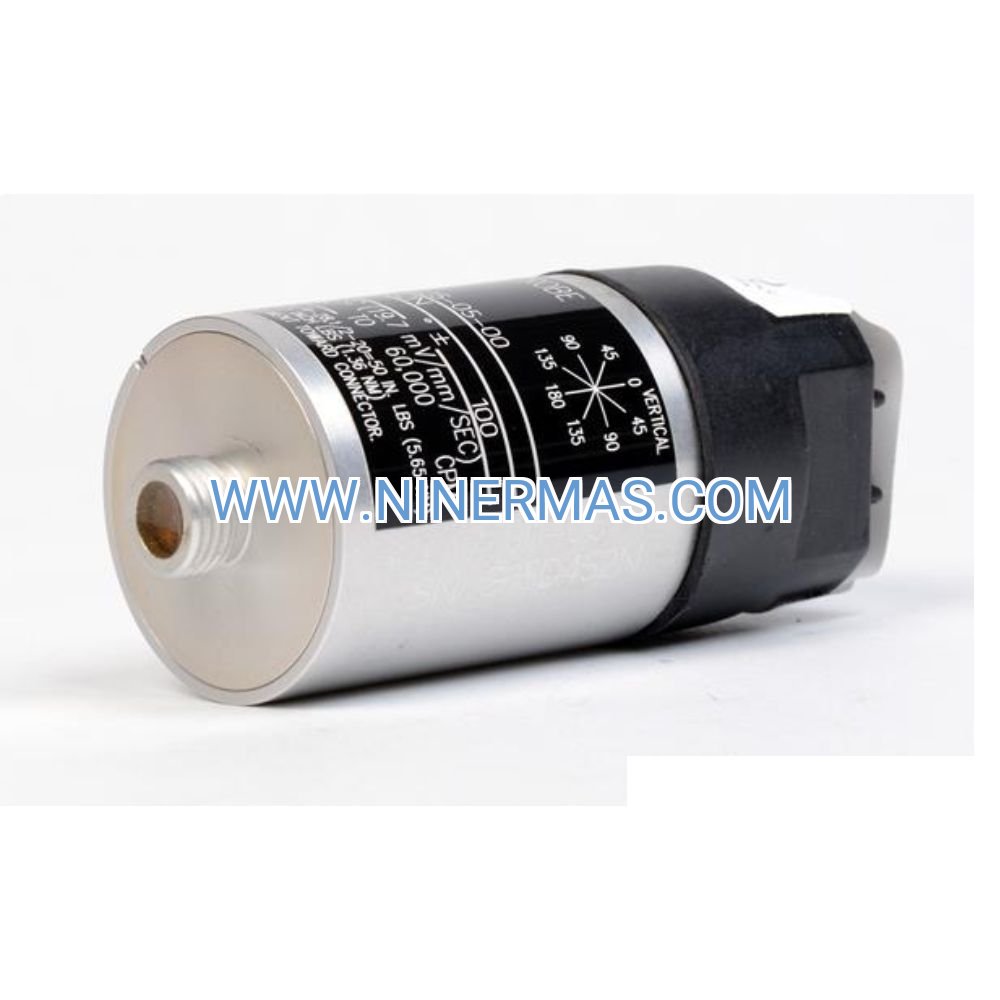
The Bently Nevada 330141-08-05-11-05-00 is an industrial-grade proximity transducer engineered for non-contact displacement measurement in critical rotating machinery. Utilizing eddy current sensing technology with 8mm probe diameter, this sensor delivers precision shaft position tracking, radial vibration analysis, and axial displacement monitoring across steam turbines, gas compressors, centrifugal pumps, and motor-driven equipment.
Designed for harsh industrial environments including power generation plants, petrochemical facilities, and heavy manufacturing operations, this transducer addresses common challenges such as bearing wear detection, shaft runout measurement, rotor eccentricity monitoring, and early fault diagnosis. The sensor helps prevent catastrophic failures by providing real-time displacement data to condition monitoring systems, reducing unplanned downtime and maintenance costs.
Through standardized 3300 XL platform integration and field-proven reliability, this proximity transducer offers IP67 environmental protection, wide temperature tolerance (-40°C to +125°C), stainless steel construction, and armored cable design. Ideal for design engineers, maintenance teams, plant reliability specialists, and OEM equipment integrators requiring accurate vibration data. Contact our application engineers for system configuration guidance and technical specifications tailored to your monitoring requirements.
Core Features & Technical Advantages
- Precision Eddy Current Sensing
Utilizes proven electromagnetic induction principles with 8mm probe diameter to achieve micron-level accuracy. Linear measurement range of 0.5-2.0mm (20-80 mils) with -7.87 V/mm nominal sensitivity ensures reliable detection of shaft displacement, vibration amplitude, and position changes in rotating equipment. - Extreme Environment Durability
Continuous operation from -40°C to +125°C with IP67-rated sealing protects against moisture ingress, chemical exposure, and particulate contamination. 300-series stainless steel housing withstands corrosive atmospheres, high-pressure wash-down environments, and outdoor installations without performance degradation. - Seamless 3300 XL Integration
Direct compatibility with Bently Nevada 3300 XL proximitor modules (330180/330980 series) and monitoring racks eliminates complex interface requirements. Backward compatibility with legacy 3300 systems enables cost-effective upgrades without complete system replacement, protecting existing infrastructure investments. - Armored Cable Protection
Integral armored construction with BNC connector termination provides mechanical protection against vibration-induced fatigue, cable flexing damage, and accidental impact. Supports total system cable lengths up to 9 meters while maintaining signal integrity and noise immunity in electrically noisy industrial environments. - Precision Threading & Mounting
5/16-24 UNF-2A precision thread specification ensures secure installation in bearing housings, custom brackets, and OEM mounting fixtures. Standardized thread design facilitates rapid sensor replacement during maintenance windows and ensures perpendicular alignment to shaft rotation axis for accurate measurements. - Factory Calibration & Traceability
Each unit ships with calibration certification against 4140 steel targets, complete traceability documentation, and quality assurance records. Pre-calibrated sensitivity reduces commissioning time and ensures measurement accuracy from initial startup through long-term operation.
Industrial Application Scenarios
This proximity transducer serves critical monitoring functions across industries where rotating equipment reliability directly impacts production continuity, safety compliance, and operational efficiency:
- Power Generation Facilities
Monitors steam turbine journal bearings, generator shaft positioning, and thrust collar displacement in coal-fired, combined-cycle, and nuclear power plants. Detects bearing wear, thermal growth, and rotor eccentricity before catastrophic failures occur, supporting predictive maintenance programs and regulatory compliance requirements. - Oil & Gas Processing Plants
Tracks compressor shaft vibration, centrifugal pump radial displacement, and gas turbine rotor position in upstream production, midstream processing, and downstream refining operations. Operates reliably in hazardous area classifications with exposure to hydrocarbon vapors, high ambient temperatures, and corrosive process environments. - Chemical & Petrochemical Manufacturing
Provides continuous monitoring for high-speed centrifugal equipment, reactor agitator shafts, and process pump assemblies handling corrosive fluids. Enables condition-based maintenance strategies that reduce spare parts inventory, minimize process interruptions, and extend mean time between failures (MTBF). - Heavy Industry & Manufacturing
Supports vibration analysis programs for paper mill dryer sections, steel rolling mill drive trains, mining conveyor systems, and cement kiln support rollers. Integrates with plant-wide condition monitoring networks to optimize maintenance scheduling and reduce total cost of ownership. - Marine Propulsion & Offshore Platforms
Withstands harsh marine environments including saltwater exposure, extreme temperature cycling, and continuous vibration in ship engine rooms, offshore drilling rigs, and floating production platforms. IP67 sealing and stainless construction ensure long-term reliability in corrosive offshore conditions.
Technical Specifications & Selection Parameters
To ensure optimal performance and compatibility with your monitoring system, review these critical specifications during the selection process:
| Parameter | Specification |
|---|---|
| Part Number | 330141-08-05-11-05-00 |
| Sensor Type | Eddy Current Proximity Transducer |
| Probe Diameter | 8mm (0.315 inch) |
| Platform Compatibility | Bently Nevada 3300 XL Series / Legacy 3300 Systems |
| Linear Measurement Range | 0.5 to 2.0 mm (20 to 80 mils) |
| Sensitivity (Nominal) | -7.87 V/mm (-200 mV/mil) |
| Operating Temperature | -40°C to +125°C continuous |
| Thread Specification | 5/16-24 UNF-2A precision threading |
| Housing Material | 300-Series Stainless Steel |
| Cable Construction | Integral Armored with BNC Connector |
| Environmental Protection | IP67 (Dust-tight, Temporary Immersion) |
| Target Material (Calibration) | 4140 Steel (Custom calibration available) |
| Maximum System Length | 9 meters (with appropriate extension cables) |
| Weight (Approximate) | 0.2 kg |
Selection Guidelines for Your Application
When specifying this proximity transducer for your monitoring system, consider these critical factors to ensure proper performance:
- Target Material Verification: Factory calibration is performed against 4140 steel targets. If your shaft material differs significantly (aluminum, titanium, non-magnetic stainless), custom calibration may be required to maintain specified accuracy.
- Mounting Configuration: Verify available mounting space for 8mm probe diameter and thread length. Ensure perpendicular alignment capability to shaft rotation axis for accurate radial measurements.
- Environmental Conditions: Confirm operating temperature range, chemical exposure potential, and moisture/contamination levels match IP67 protection capabilities.
- System Architecture: Identify compatible proximitor module (330180 or 330980 series) and verify total cable length requirements including extension cables.
- Measurement Objectives: Determine whether monitoring radial vibration (requires X-Y dual transducer configuration), axial position (thrust monitoring), or both for complete machinery protection.
Need assistance with sensor selection or system design? Provide our engineering team with your application details including equipment type, shaft diameter, operating speed, ambient conditions, and monitoring objectives. We'll recommend the optimal transducer configuration and compatible system components for your specific requirements.
Advanced System Integration Capabilities
- Multi-Channel Monitoring Networks: Integrate multiple transducers into centralized condition monitoring systems supporting MODBUS, 4-20mA, and proprietary Bently Nevada communication protocols for plant-wide asset management.
- Predictive Maintenance Integration: Connect to vibration analysis software platforms for trend analysis, alarm threshold configuration, and automated fault diagnosis using machine learning algorithms.
- Remote Monitoring Capability: Enable SCADA system integration and cloud-based condition monitoring platforms for remote diagnostics, expert system consultation, and mobile alert notifications.
- Redundant Measurement Configurations: Deploy in dual or triple redundant architectures for critical safety systems requiring SIL-rated reliability and voting logic fault tolerance.
Delivery, Technical Support & Quality Assurance
Inventory & Lead Times: Standard configurations typically ship within 3-5 business days from our regional distribution centers. Custom calibrations or special cable lengths may require 10-15 business days. Expedited shipping options available for critical outage situations.
Warranty Coverage: All units include a comprehensive 12-month manufacturer's warranty covering material defects and workmanship failures under normal operating conditions. Extended warranty programs and calibration service contracts available for long-term maintenance agreements.
Technical Documentation Package: Each shipment includes factory calibration certificate, installation guidelines, dimensional drawings, electrical specifications, and compatibility matrices. Digital copies of technical manuals and application notes provided upon request.
Application Engineering Support: Our technical team provides pre-sale consultation for system design, installation guidance during commissioning, and post-sale troubleshooting assistance. Remote support and on-site field service available depending on geographic location and service agreement terms.
Quality Certifications: Products sourced through authorized distribution channels with full OEM traceability. ISO 9001-compliant quality management systems ensure authentic components and proper handling throughout the supply chain.
Frequently Asked Questions (FAQ)
Q: How does the 330141-08-05-11-05-00 differ from the 330141-08-05-11-00-00 model?
A: The final digit pairs in the part number indicate specific cable length and connector configurations. The -05-00 suffix denotes a particular factory-configured cable assembly. Consult the official Bently Nevada product catalog or contact our technical team with your application requirements to verify the exact specification needed for your installation.
Q: Can a single proximity transducer measure both radial and axial vibration simultaneously?
A: No. Each proximity transducer measures displacement along a single axis perpendicular to the probe face. Complete radial vibration monitoring requires two transducers mounted 90 degrees apart in an X-Y configuration. Axial position monitoring (thrust measurement) requires a separate transducer oriented toward the shaft thrust collar or coupling face. A typical turbine monitoring system may use 4-8 transducers per bearing for comprehensive coverage.
Q: What proximitor signal conditioning module is required for this transducer?
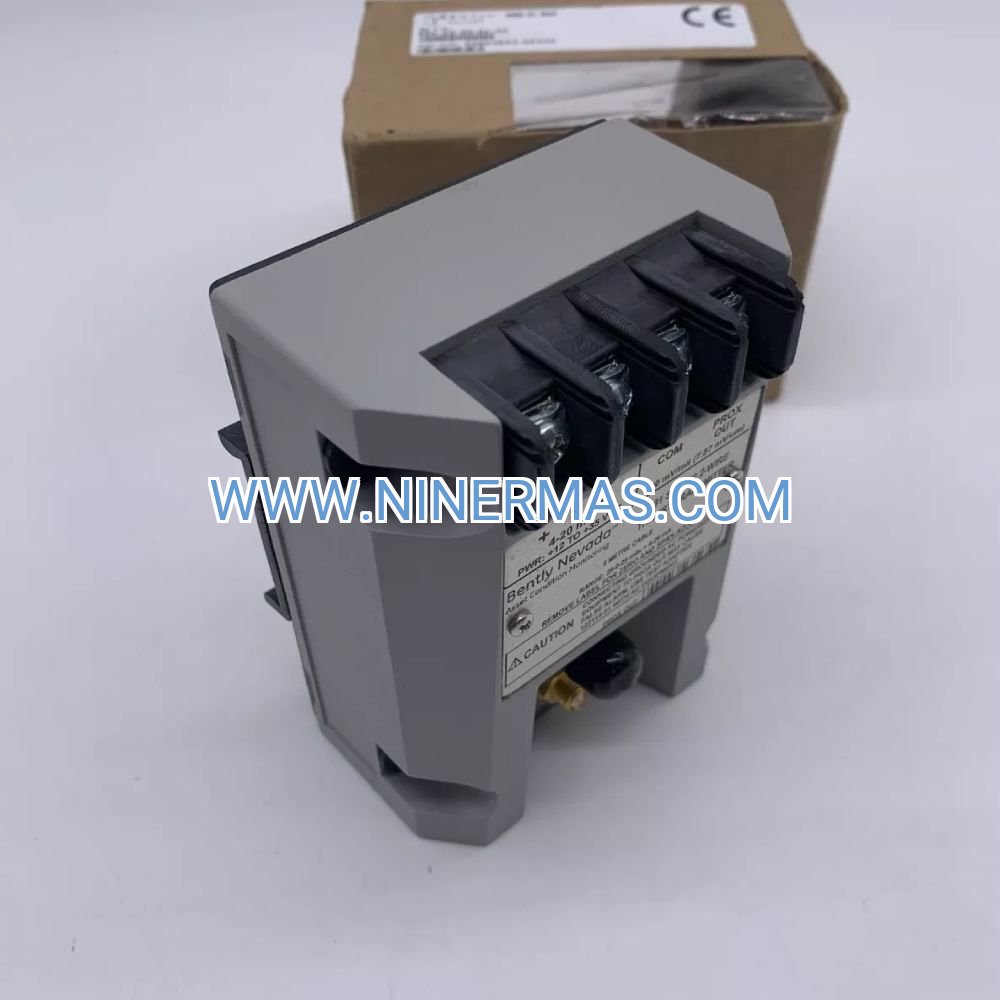
A: This transducer operates with Bently Nevada 3300 XL proximitor modules such as the 330180 or 330980 series. The proximitor converts the transducer's variable inductance signal into a calibrated DC voltage output proportional to gap distance (typically -7.87 V/mm). The proximitor also provides the high-frequency excitation signal required for eddy current sensing. Ensure your proximitor module is configured for 8mm probe diameter.
Q: Is field recalibration necessary after installation?
A: Factory calibration is performed against standard 4140 steel targets and remains valid for the transducer's service life under normal conditions. However, field verification of gap voltage during commissioning is recommended to confirm proper installation and target material compatibility. If your shaft material differs significantly from 4140 steel (such as aluminum, titanium, or austenitic stainless steel), custom calibration against your actual target material may be necessary to maintain specified accuracy within ±1% of full scale.
Q: What is the maximum cable length between the transducer and proximitor module?
A: The integral armored cable on this transducer has a fixed length specified by the part number suffix. When combined with appropriate Bently Nevada extension cables, total system length can reach approximately 9 meters (30 feet) while maintaining signal integrity and specified accuracy. Longer cable runs may introduce signal degradation, increased noise susceptibility, and calibration errors. For installations requiring greater distances, consider proximitor modules with extended cable capability or signal repeater options.
Q: Can this transducer operate in hazardous area classifications (Class I Div 1/2 or ATEX zones)?
A: The transducer itself is a passive sensor and can be installed in hazardous areas when used with appropriately certified proximitor modules and barriers. The complete system (transducer + proximitor + barrier) must be evaluated for hazardous area compliance. Consult Bently Nevada's hazardous area installation guidelines and work with certified instrumentation engineers to ensure proper intrinsically safe or explosion-proof system design for your specific classification requirements.
Q: How do I determine the correct installation gap for optimal performance?
A: The linear measurement range for this transducer is 0.5 to 2.0 mm (20 to 80 mils). For optimal performance and maximum dynamic range, install the transducer at the mid-range gap of approximately 1.25 mm (50 mils) when the shaft is at rest. This provides equal measurement capability for shaft movement toward and away from the probe face. Use the proximitor's gap voltage output during installation to verify proper positioning: -10V typically corresponds to the mid-range gap for standard calibration.
Request Technical Consultation & Quotation
To receive a detailed system recommendation, technical specification review, or project quotation, please provide our application engineering team with the following information:
- Equipment Details: Machine type (turbine, compressor, pump, motor), manufacturer, model number, and operating speed (RPM)
- Monitoring Objectives: Radial vibration, axial position, shaft runout, or comprehensive multi-point monitoring
- Installation Environment: Operating temperature range, chemical exposure, moisture/contamination levels, hazardous area classification (if applicable)
- System Architecture: Existing monitoring system (if any), proximitor modules, rack configuration, and communication protocol requirements
- Shaft Specifications: Diameter, material composition, surface finish, and accessible mounting locations
- Project Timeline: Required delivery date, installation schedule, and commissioning support needs
Our engineering team will respond within 24 business hours with a customized solution including transducer selection verification, compatible system components, installation recommendations, and commercial quotation.
© 2026 NINERMAS COMPANY LIMITED. All rights reserved.
Original Source: https://ninermas.com
Contact: sale@ninermas.com | +0086 187 5021 5667

Contact Info
-
Address:22 / F, South Wo Hang building, 148 Wing Lok Street, Sheung Wan, Western District, Hong Kong
-
Phone:+8618750215667
-
Email: