


Description
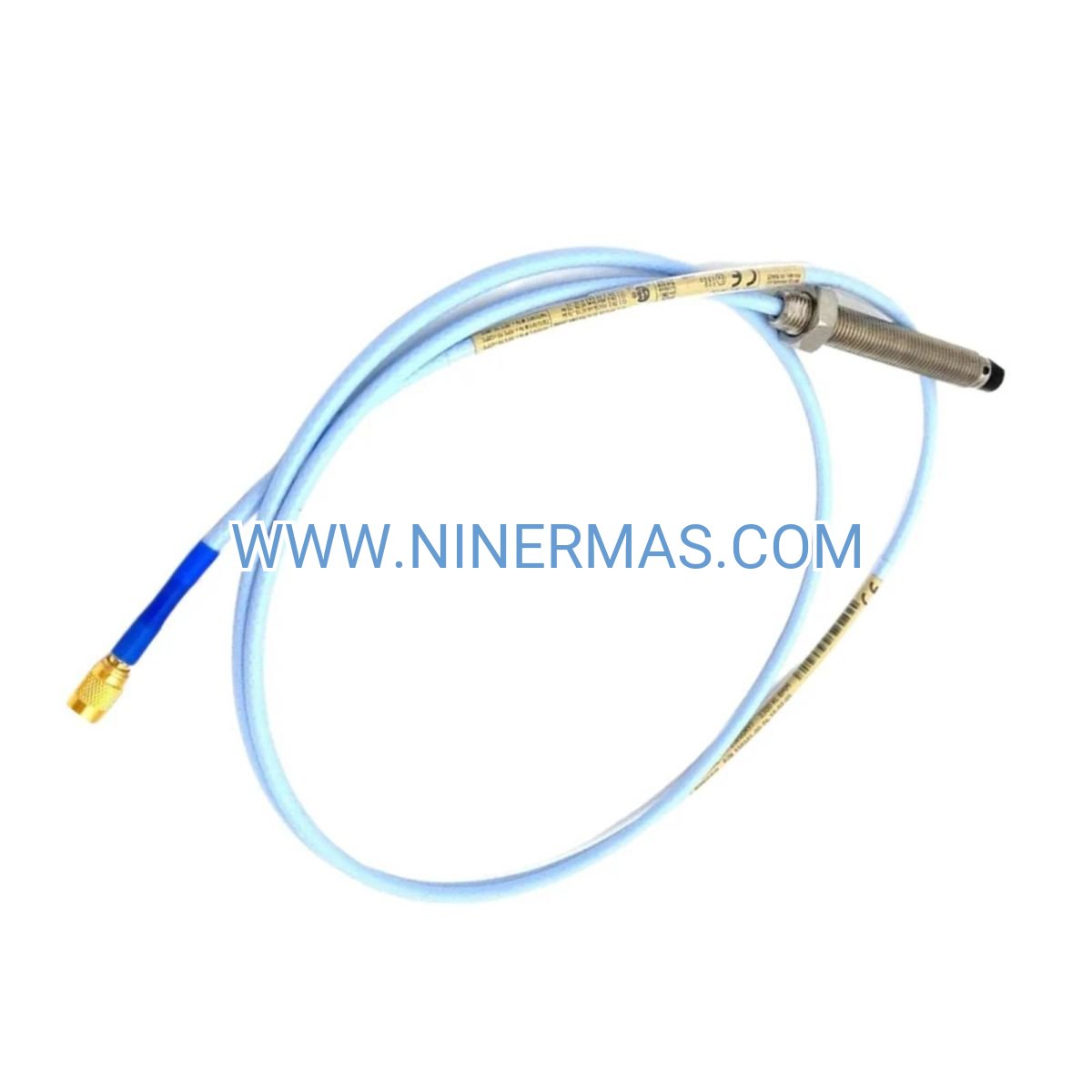
8mm Proximity Probe for Turbomachinery Vibration Monitoring (Industrial-Grade Sensor System)
The Bently Nevada 330140-08-20-12-05-00 is an industrial-grade 8mm proximity probe designed for continuous shaft position and vibration monitoring in critical rotating machinery. Through eddy current sensing technology and precision-engineered construction, this sensor achieves real-time displacement measurement, vibration analysis, and predictive maintenance capabilities for mission-critical equipment.
Engineered for power generation plants, petrochemical facilities, oil & gas processing units, and heavy industrial installations where equipment reliability directly impacts production uptime. This probe addresses common challenges including undetected bearing wear, shaft misalignment, rotor imbalance, and catastrophic machinery failure by providing early warning signals through continuous condition monitoring.
Built on proven 3300 XL platform architecture with field-validated performance across thousands of installations worldwide, this proximity sensor delivers exceptional linearity, temperature stability, and electromagnetic immunity. Suitable for design engineers, maintenance teams, instrumentation contractors, and plant reliability managers seeking standardized monitoring solutions with customizable configurations. Contact our application engineers for system integration guidance and technical specifications tailored to your machinery profile.
Core Capabilities & Technical Advantages
- Precision Eddy Current Sensing
Non-contact measurement technology utilizing high-frequency electromagnetic fields to detect shaft displacement with ±1% linearity across the full 0-2.0mm (0-80 mils) sensing range, eliminating mechanical wear and drift associated with contact-type sensors. - Wide-Bandwidth Frequency Response
Captures vibration signatures from DC to 10 kHz (-3dB point), enabling detection of slow-roll runout, synchronous vibration, subsynchronous instabilities, and high-frequency bearing defects within a single sensor installation. - Extended Temperature Performance
Operates reliably across -40°C to +105°C ambient conditions with minimal sensitivity drift, suitable for steam turbine casings, compressor housings, and outdoor installations without supplementary environmental protection. - Ruggedized Industrial Construction
Stainless steel housing with hermetically sealed electronics withstands shock loads up to 100g, vibration exposure to 10g RMS, and corrosive atmospheres typical of chemical processing and offshore platforms. - System-Level Compatibility
Seamless integration with Bently Nevada 3300 XL proximitor modules, 3500 rack monitoring systems, and System 1 condition monitoring software, supporting both legacy installations and modern DCS/SCADA architectures. - Field-Serviceable Design
Standardized 5/8-18 UNF-2A thread mounting with multiple cable length options facilitates installation in confined spaces, hot-swap replacement during planned outages, and retrofit applications without machinery modifications.
Industrial Application Scenarios
This proximity probe serves critical monitoring functions across industries where rotating equipment reliability determines operational safety and economic performance:
- Steam & Gas Turbine Generator Sets
Monitors journal bearing clearances, thrust position, differential expansion, and rotor eccentricity in utility-scale power generation units, preventing blade rubs, bearing failures, and catastrophic rotor-to-stator contact events. - Centrifugal & Axial Compressor Trains
Tracks shaft radial vibration and axial float in multi-stage compression systems for natural gas pipelines, air separation plants, and refrigeration cycles, enabling early detection of surge conditions and mechanical seal degradation. - High-Speed Pumps & Motor-Driven Equipment
Provides continuous surveillance of boiler feed pumps, charge pumps, and critical process pumps in refineries and chemical plants, where unplanned shutdowns result in production losses exceeding equipment replacement costs. - Industrial Gearboxes & Reduction Drives
Measures input/output shaft displacement in heavy-duty gearboxes serving mills, crushers, and conveyor systems, identifying gear tooth wear, coupling misalignment, and lubrication deficiencies before catastrophic failure. - Aerospace Test Stands & R&D Facilities
Supports precision measurement requirements in jet engine test cells, turbine development rigs, and high-speed rotor dynamics research where data accuracy and repeatability are paramount.
Technical Specifications & Selection Parameters
To ensure optimal performance and compatibility, the following specifications define the operational envelope and interface requirements for system design:
| Parameter | Specification |
|---|---|
| Probe Diameter | 8mm (0.315 inch) |
| Linear Sensing Range | 0 to 2.0mm (0 to 80 mils) |
| Frequency Response | DC to 10 kHz (-3dB) |
| Operating Temperature | -40°C to +105°C (-40°F to +221°F) |
| Thread Configuration | 5/8-18 UNF-2A external thread |
| Cable Options | Standard lengths: 1m, 5m, 9m (custom available) |
| Output Signal Range | -1 to -24 Vdc (linear with gap) |
| Target Material | Ferromagnetic steel (4140, 4340 preferred) |
| Housing Material | 300 Series stainless steel |
| Environmental Rating | IP65 (with mating proximitor) |
| Shock Resistance | 100g, 11ms half-sine pulse |
| Vibration Resistance | 10g RMS, 10-2000 Hz |
Selection Guidance: When specifying this proximity probe, consider the following application parameters: shaft diameter and surface finish (Ra ≤ 1.6 μm recommended), maximum shaft runout and vibration amplitude, installation space constraints and probe mounting orientation, cable routing distance to proximitor location, ambient temperature extremes and potential thermal transients. For installations requiring hazardous area certification, extended cable lengths beyond 9 meters, or non-standard target materials (aluminum, titanium, Inconel), consult with application engineers to validate system performance and obtain calibration data specific to your configuration.
Advanced Integration Capabilities
Beyond standalone vibration measurement, this proximity probe supports comprehensive machinery protection and diagnostic workflows:
- Multi-Channel Synchronous Monitoring: Deploy in XY radial pairs or combined radial-axial configurations for complete shaft motion analysis, orbit plotting, and phase-resolved vibration vectors.
- Keyphasor Reference Integration: Synchronize with once-per-revolution tachometer signals for order tracking, balancing calculations, and transient startup/shutdown analysis.
- Automated Alarm & Shutdown Logic: Interface with Bently Nevada 3500 rack systems to implement API 670 compliant protection schemes with configurable alert/danger setpoints and voting logic.
- Predictive Analytics & Trending: Stream continuous data to System 1 or third-party condition monitoring platforms for machine learning-based anomaly detection, remaining useful life estimation, and maintenance optimization.
- Retrofit & Upgrade Pathways: Maintain backward compatibility with legacy 3300 NSv and 7200 series proximitors while enabling migration to modern digital monitoring architectures.
Delivery, Quality Assurance & Technical Support
Lead Times: Standard catalog configurations (1m, 5m cable lengths) typically ship within 3-5 business days from regional distribution centers. Custom cable lengths, special thread configurations, or high-temperature variants require 2-3 weeks manufacturing lead time. Expedited processing available for emergency outage support.
Quality Certification: Each proximity probe undergoes 100% factory testing including linearity verification, frequency response validation, and temperature cycling per Bently Nevada QA protocols. Shipments include individual calibration certificates traceable to NIST standards, installation drawings with dimensional tolerances, and material certifications for pressure equipment compliance.
Warranty Coverage: 18-month warranty from shipment date covering material defects and workmanship failures under normal operating conditions. Warranty excludes damage from improper installation, electrical overstress, or operation beyond published specifications.
Technical Resources: Comprehensive documentation package includes installation manual with torque specifications and gap setting procedures, electrical interconnection diagrams for proximitor pairing, target material sensitivity curves for non-standard shaft materials, and troubleshooting flowcharts for common field issues. Remote engineering support available via phone/email during business hours; on-site commissioning and training services offered on project basis.
Frequently Asked Questions (FAQ)
Q: What proximitor module is required to operate this 8mm proximity probe?
A: This probe pairs with Bently Nevada 3300 XL proximitor modules (part number 330180 series for standard applications, 330780 series for high-temperature environments). The proximitor provides -24 Vdc excitation, signal conditioning, and buffered outputs compatible with monitoring systems. One proximitor is required per probe; XY radial monitoring configurations need two proximitors.
Q: Can this proximity probe measure both radial vibration and axial shaft position simultaneously?
A: A single probe measures displacement in one direction only. Radial vibration monitoring typically requires two probes mounted 90° apart (XY configuration) to capture full orbit information. Axial position measurement uses a separate probe oriented perpendicular to the shaft end face or thrust collar. Complete machinery monitoring systems often deploy 4-8 probes per bearing location.
Q: What is the minimum and maximum shaft diameter this 8mm probe can monitor?
A: Recommended minimum shaft diameter is 25mm (1 inch) to avoid curvature effects on linearity. Maximum diameter is unlimited for radial installations. For shafts below 25mm, consider 5mm diameter probes (330105 series). Probe tip-to-shaft gap should be maintained at 1.0mm ± 0.5mm (40 mils ± 20 mils) for optimal linearity.
Q: How does shaft surface finish and material affect measurement accuracy?
A: Surface roughness (Ra) should be ≤ 1.6 μm (63 μin) for best accuracy. Rougher surfaces increase electrical runout (ERO) which appears as false vibration. Target material must be ferromagnetic steel; aluminum and stainless steel (300 series) are not suitable. Different steel alloys require specific calibration curves—factory calibration assumes 4140/4340 steel; field calibration needed for other materials.
Q: Is this proximity probe suitable for hazardous area installations requiring ATEX or IECEx certification?
A: Standard catalog probes are not intrinsically safe certified. For Zone 1/Division 1 hazardous locations, specify Bently Nevada 330104 series probes with blue-band certification markings and pair with approved barriers or isolated proximitors. Consult factory for current certification status and application-specific approvals.
Q: What cable length should I specify, and can cables be field-shortened or extended?
A: Select cable length to minimize excess coiling while allowing service loop for maintenance access. Standard lengths are 1m (junction box mounting), 5m (typical machinery installations), and 9m (large turbines). Cables must NOT be cut, spliced, or extended in the field—doing so voids calibration and warranty. The probe-cable-proximitor forms a matched system; cable length affects electrical characteristics and calibration constants.
Request Technical Consultation & Custom Configuration
For application-specific recommendations, system integration support, or custom configurations beyond standard catalog offerings, please provide the following information to our engineering team:
- Equipment type and model (turbine, compressor, pump, motor, gearbox)
- Shaft diameter, material grade, and surface finish specification
- Operating speed range (minimum, normal, maximum RPM)
- Expected vibration amplitudes and frequency content
- Ambient temperature range and environmental conditions
- Mounting constraints (available space, orientation, accessibility)
- Cable routing distance and proximitor location
- Integration requirements (monitoring system model, I/O specifications)
- Quantity required and project timeline
Our application engineers will provide detailed probe selection validation, mounting hardware recommendations, system architecture drawings, and project-specific pricing within 24-48 hours of inquiry submission.
© 2026 NINERMAS COMPANY LIMITED. All rights reserved.
Original Source: https://ninermas.com
Contact: sale@ninermas.com | +0086 187 5021 5667

Contact Info
-
Address:22 / F, South Wo Hang building, 148 Wing Lok Street, Sheung Wan, Western District, Hong Kong
-
Phone:+8618750215667
-
Email:
