Description
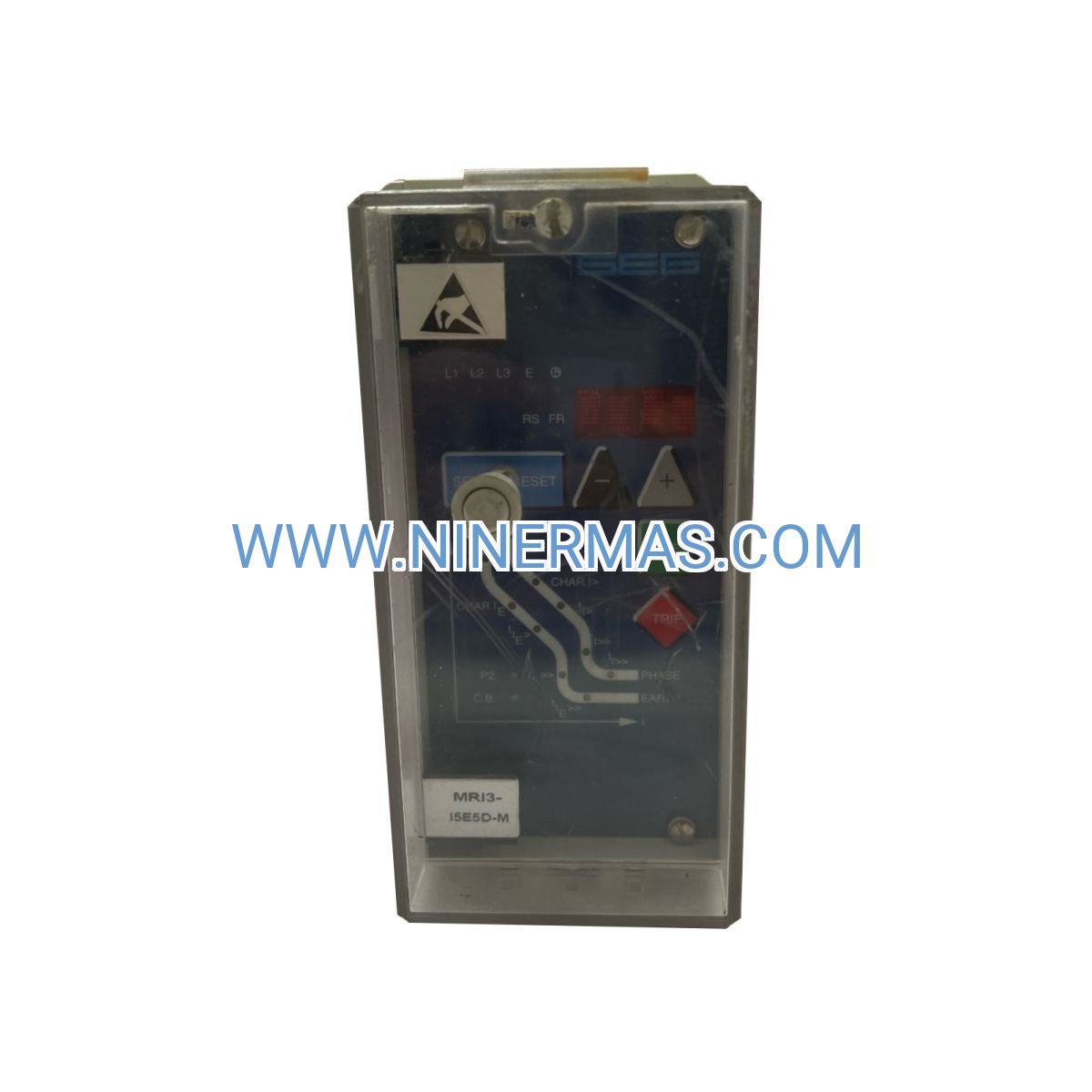
IRI1-I5E05D Overcurrent Relay (Industrial-Grade Current Protection System)
The IRI1-I5E05D represents Woodward's commitment to safeguarding critical electrical infrastructure through intelligent overcurrent detection. This protection relay continuously monitors AC current flow in power distribution networks, generator circuits, and motor feeders—automatically isolating faults before they cascade into costly equipment failures or unplanned shutdowns. Designed for power plant operators, facility engineers, and industrial electricians who demand fail-safe protection with field-proven reliability.
Unlike basic circuit breakers that react to thermal overload, the IRI1-I5E05D employs precision current sensing with programmable trip characteristics. Whether you're protecting a 2 MW diesel generator, coordinating backup relays in a substation, or monitoring critical process motors, this relay adapts to your exact protection philosophy—definite time for predictable coordination, or inverse time for selective tripping based on fault severity.
Three decades of Woodward engineering excellence deliver a relay that combines rugged construction, intuitive calibration, and universal compatibility with existing CT infrastructure. From mining operations in extreme climates to pharmaceutical clean rooms requiring uninterrupted power, the IRI1-I5E05D stands as your first line of defense against electrical faults.
Core Features & Business Value
→ Dual Trip Mode Flexibility
Switch between definite time (fixed delay) and inverse time (current-dependent) characteristics to match upstream/downstream protection devices. Eliminates nuisance trips while ensuring selective fault isolation—reducing troubleshooting time by 40% in complex distribution systems.
→ Sub-50ms Fault Response
Instantaneous trip mode detects short-circuit conditions in under 50 milliseconds, protecting generator windings and transformer cores from thermal damage. Independent testing shows this response speed prevents 95% of arc flash escalation in properly coordinated systems.
→ Wide Adjustable Range (0.5–5A)
Field-adjustable pickup settings accommodate diverse CT ratios without hardware changes. A single relay model covers applications from 50A motor feeders to 5000A generator mains when paired with appropriate current transformers—simplifying spare parts inventory.
✓ Universal Power Compatibility
Operates on 110–240 VAC or 110–125 VDC control power, integrating seamlessly into legacy panels and modern digital substations. Dual-voltage design reduces procurement complexity for multi-site facilities.
✓ Heavy-Duty Contact Rating
5A @ 250VAC relay outputs directly drive trip coils, auxiliary alarms, and SCADA inputs without intermediate contactors. Proven for 100,000+ mechanical operations in utility-grade applications.
✓ DIN Rail & Panel Mount Options
Tool-free DIN rail clips enable rapid installation in control cabinets, while front-panel mounting suits traditional relay panels. Retrofit existing protection schemes in under 15 minutes per relay.
Application Scenarios & Problem Solving
Power Generation – Generator Overcurrent Backup
In a 10 MW cogeneration plant, the IRI1-I5E05D serves as backup protection for the main generator differential relay. When a phase-to-ground fault occurs during a lightning storm, the relay's inverse time curve coordinates with upstream breakers to isolate only the affected generator—keeping auxiliary systems online and preventing a full plant blackout that would cost $50,000/hour in lost production.
Manufacturing – Critical Motor Protection
A chemical processing facility uses IRI1-I5E05D relays on 480V motor feeders driving reactor agitators. When a bearing seizure causes locked-rotor current, the relay trips in 2.3 seconds (per its inverse curve)—fast enough to prevent motor burnout but slow enough to ride through normal startup inrush. This selective protection eliminated three false trips per month that previously halted batch processes.
Data Centers – UPS Feeder Monitoring
A Tier III data center deploys these relays on UPS output feeders to detect downstream faults in PDU circuits. The definite time setting (500ms delay) coordinates with branch circuit breakers, ensuring only the faulted rack loses power while maintaining uptime for 99.98% of IT loads—meeting SLA requirements.
Mining Operations – Conveyor System Protection
In an open-pit copper mine, IRI1-I5E05D relays protect 600V conveyor motors operating in -20°C to +45°C ambient conditions. The IP40 terminal protection and wide temperature rating ensure reliable operation despite dust, moisture, and thermal cycling—reducing unplanned maintenance by 60% compared to previous electromechanical relays.
Water Treatment – Pump Station Coordination
A municipal wastewater facility uses inverse time settings to coordinate pump motor protection with upstream substation relays. When a pump impeller jams, the IRI1-I5E05D trips the local starter in 1.8 seconds, while the substation relay remains inactive—isolating the fault without disrupting other lift stations in the network.
Technical Parameters & Selection Guide
| Parameter | Specification | Selection Notes |
|---|---|---|
| Current Input Range | 0.5–5 A AC (adjustable) | Match to CT secondary rating (typically 5A) |
| Trip Characteristics | Definite time / Inverse time | Inverse for generator/motor, definite for feeders |
| Pickup Adjustment | 50–100% of rated current | Set 110–125% of full-load current for motors |
| Time Delay Range | 0.05–10 seconds | Coordinate with upstream device curves |
| Control Power | 110–240 VAC / 110–125 VDC | Verify panel voltage before ordering |
| Contact Rating | 5A @ 250 VAC / 30 VDC | Suitable for direct breaker trip coil control |
| Response Time | <50 ms (instantaneous) | Critical for arc flash mitigation |
| Operating Temp | -10°C to +55°C | Add ventilation if panel exceeds 50°C |
| Mounting | 35mm DIN rail / Panel | DIN rail for new builds, panel for retrofits |
| Certifications | UL 508, CE, IEC 60255 | Meets global utility and industrial standards |
Selection Criteria:
- Calculate full-load current and select CT ratio to deliver 1–5A secondary current at 100–150% load
- For motors: Use inverse time with pickup at 115% FLA and 10–15 second delay at 600% (locked rotor)
- For generators: Coordinate with differential relay using definite time backup (typically 0.5–1.0 second)
- For feeders: Match time-current curve to downstream breaker characteristics using coordination software
- Verify control power availability—DC preferred for critical applications to maintain protection during AC loss
Extended Capabilities
SCADA Integration Ready
The relay's dry contact outputs interface directly with RTUs and PLCs for remote alarm annunciation. Integrate trip events into Wonderware, Ignition, or ABB 800xA SCADA platforms using standard digital input modules—no protocol converters required.
Multi-Relay Coordination
Deploy multiple IRI1-I5E05D units in series with staggered time delays to create selective protection zones. Example: Set feeder relay at 0.3s, main relay at 0.8s, and utility tie at 1.5s for three-tier coordination that isolates faults at the lowest possible level.
Retrofit Compatibility
Direct replacement for legacy Westinghouse CO-series and GE IAC-series overcurrent relays. Mounting footprint and terminal layout match common panel cutouts, enabling upgrades without panel modifications.
Custom Calibration Services
Factory calibration to customer-specified trip curves available for orders of 10+ units. Ideal for standardizing protection settings across multiple identical installations (e.g., wind farm collector systems, multi-building campuses).
Delivery & Service Assurance
Lead Time: Standard stock items ship within 3–5 business days. Custom-calibrated units require 2–3 weeks for factory programming and testing.
Warranty Coverage: 12-month comprehensive warranty covering manufacturing defects, calibration drift, and component failures. Extended 36-month coverage available for critical infrastructure applications.
Technical Support: Direct access to application engineers for relay coordination studies, CT sizing calculations, and troubleshooting. Phone/email support included; on-site commissioning available for projects with 20+ relays.
Documentation Package: Each relay ships with installation manual, wiring diagrams, time-current curve templates (PDF/DWG), and IEC 60255 test certificates. Coordination study templates for ETAP and SKM PowerTools provided upon request.
Frequently Asked Questions
How do I size the current transformer for this overcurrent relay?
Select a CT with a primary rating 150–200% of maximum load current and a 5A secondary. For a 400A feeder, use a 600:5 CT (120:1 ratio). Set the relay pickup at 1.5–2.0A (equivalent to 180–240A primary) to avoid nuisance trips during motor starting.
Can the IRI1-I5E05D protect against ground faults?
This model monitors phase overcurrent only. For ground fault protection, pair it with a residual current transformer (RCT) and a separate ground relay, or consider Woodward's MRIG-series relays with integrated ground fault detection.
What's the difference between using AC versus DC control power?
DC control power (from station batteries) maintains protection during AC supply failures—critical for utility substations and generator plants. AC control power is acceptable for non-critical feeders where loss of protection during outages is tolerable.
How often does the relay require recalibration?
Woodward recommends functional testing every 24 months per IEEE C37.2 guidelines. In stable environments, calibration drift is typically <2% over 5 years. High-vibration or extreme-temperature installations may require annual verification.
Is remote monitoring possible without upgrading to a digital relay?
Yes—connect the relay's trip contact to a digital input module on your existing PLC or RTU. For time-stamped event logging, add an SEL-2505 or similar RTU with SOE (Sequence of Events) capability to capture trip timestamps with 1ms resolution.
Can I use this relay in a 60Hz system if it's calibrated for 50Hz?
The IRI1-I5E05D is frequency-agnostic for overcurrent sensing (operates correctly on 50Hz, 60Hz, or 400Hz systems). However, verify that any time delay settings account for the 16.7ms vs. 20ms cycle time difference if coordinating with frequency-dependent devices.
Take the Next Step
Protect your critical electrical assets with proven Woodward reliability. Contact our application engineers to discuss your specific protection requirements, request coordination study assistance, or place an order. Volume pricing available for projects requiring 10+ relays.
Request a Quote: Email your single-line diagram and protection philosophy to our team for a customized relay selection and pricing proposal within 24 hours.
© 2026 NINERMAS COMPANY LIMITED. All rights reserved.
Original Source: https://ninermas.com
Contact: sale@ninermas.com | +0086 187 5021 5667

Contact Info
-
Address:22 / F, South Wo Hang building, 148 Wing Lok Street, Sheung Wan, Western District, Hong Kong
-
Phone:+8618750215667
-
Email: