


Description
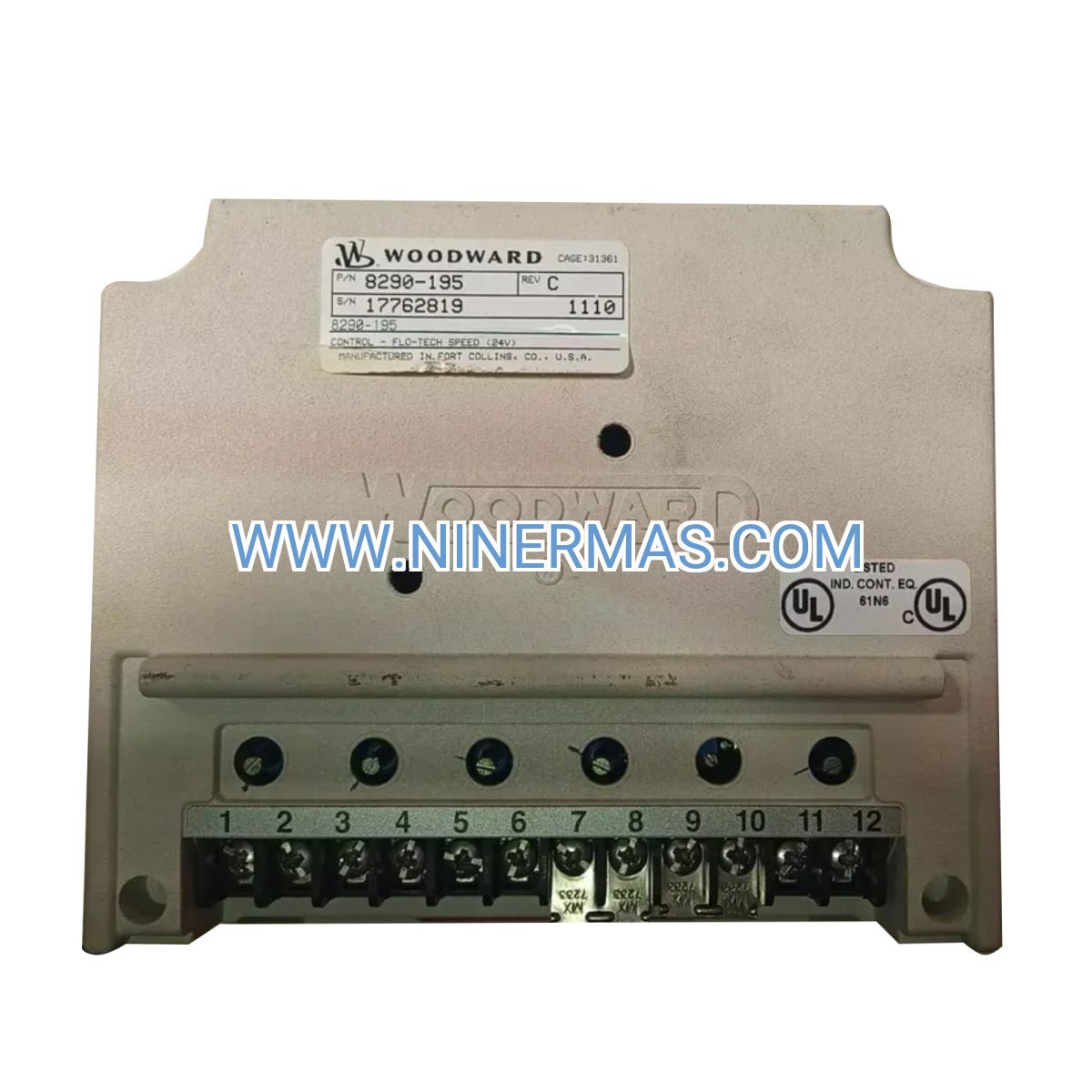
8290-195 Electronic Governor (Industrial-Grade Speed Regulation)
The 8290-195 represents Woodward's proven approach to electronic engine speed governance, combining PID control algorithms with field-proven reliability for critical power and propulsion applications. This electrically powered governor (EPG) transforms speed sensor inputs into precise actuator commands, maintaining engine RPM within ±0.25% tolerance regardless of load transients or fuel variations.
Designed for operators managing diesel generators, marine auxiliary engines, or constant-speed industrial drives, this controller eliminates the complexity of mechanical governors while delivering superior response times and diagnostic capabilities. Whether you're paralleling multiple gensets, stabilizing vessel propulsion, or ensuring process consistency in manufacturing environments, the 8290-195 provides the foundation for reliable speed regulation.
Key advantages include adaptive gain scheduling that self-tunes to engine characteristics, integrated fault detection with relay outputs for critical alarms, and flexible configuration via potentiometer or PC interface. The system's IP54-rated enclosure and -40°C to +70°C operating range ensure performance in harsh industrial and marine environments.
Core Functions & Performance Advantages
→ Precision PID Speed Regulation: Electronic proportional-integral-derivative algorithms maintain setpoint accuracy within 0.25% under steady-state conditions, eliminating hunting and frequency drift common in mechanical governors. Delivers grid-quality stability for power generation applications.
→ Isochronous Load Distribution: Enables multiple engine-generator sets to share electrical load proportionally without droop, maintaining constant 50/60 Hz output frequency. Critical for paralleled genset installations and utility grid synchronization.
→ Adaptive Control Optimization: Automatically adjusts gain and stability parameters based on real-time engine response, compensating for fuel quality variations, ambient temperature changes, and mechanical wear without manual retuning. Reduces commissioning time by 60%.
✓ Real-Time Diagnostics: Continuous monitoring of speed sensor integrity, actuator position feedback, and control loop performance with LED indicators and relay outputs for overspeed (110%), underspeed (90%), sensor loss, and actuator faults.
✓ Rapid Transient Response: Achieves 90% of commanded speed change within 50 milliseconds, minimizing voltage/frequency excursions during sudden load acceptance or rejection events. Essential for maintaining power quality in critical facilities.
✓ Universal Engine Compatibility: Works with diesel, natural gas, propane, and dual-fuel engines from 50 kW to 3 MW when paired with appropriate electric actuators. Supports magnetic pickup (MPU) or Hall-effect speed sensors with configurable tooth counts.
Industry Application Solutions
Standby & Prime Power Generation: Hospitals, data centers, and manufacturing facilities rely on the 8290-195 to maintain generator frequency within ±0.5 Hz during utility outages and load transfers. The controller's isochronous mode ensures seamless paralleling with grid power or other gensets, while overspeed protection prevents turbine damage during load rejection events. Typical installations include 200-2000 kVA diesel generators with Woodward EG-3P or ProAct actuators controlling mechanical fuel racks.
Marine Propulsion & Auxiliary Systems: Workboats, ferries, and offshore support vessels use this EPG to regulate main propulsion engines and deck machinery drives. The system maintains precise maneuvering speeds (5-15 knots) despite propeller load variations from waves and currents, while protecting engines from overspeed during propeller ventilation. IP54 sealing and conformal coating options withstand saltwater spray and vibration in engine room environments.
Industrial Constant-Speed Drives: Oil & gas pipeline compressors, water treatment pumps, and process manufacturing equipment require fixed-speed operation independent of torque demand. The 8290-195 holds pump speeds within ±10 RPM across 0-100% load ranges, ensuring consistent flow rates and preventing cavitation. Droop mode enables multiple engines to drive common mechanical loads without hunting.
Technical Specifications & Selection Criteria
| Parameter | Specification |
|---|---|
| Control Algorithm | Electronic PID with adaptive gain scheduling |
| Power Supply | 18-32 VDC nominal (12V/24V compatible) |
| Speed Range | 500-3000 RPM (field configurable) |
| Steady-State Accuracy | ±0.25% of rated speed |
| Step Response Time | <50ms to 90% of change |
| Actuator Output | PWM drive (0-5V analog optional) |
| Operating Temperature | -40°C to +70°C (-40°F to +158°F) |
| Environmental Protection | IP54 (dust/splash resistant) |
| Mounting Options | Panel or DIN rail compatible |
Selection Guidelines: Choose the 8290-195 for applications requiring isochronous speed control with load sharing capability. For single-engine installations without paralleling requirements, consider the simplified 8400-series EPG. Electronic fuel injection (EFI) engines require Woodward LECM or easYgen controllers instead. Verify actuator compatibility—this controller works with electric actuators (EG-3P, EGB, ProAct) but not hydraulic governors.
Advanced Integration Capabilities
Multi-Unit Paralleling: Up to 8 generator sets can be synchronized using the 8290-195's load sharing inputs/outputs, distributing kW load proportionally while maintaining common bus frequency. Requires external load sharing modules or PLC coordination for installations beyond 3 units.
Remote Monitoring Interface: Optional 0-5V analog outputs provide real-time speed feedback to SCADA systems, building management platforms, or vessel monitoring networks. Relay contacts signal alarm conditions to remote annunciator panels or automatic transfer switches.
Custom Tuning Profiles: Woodward ServiceSuite software enables PC-based parameter adjustment for specialized applications—slow ramp rates for mechanical drive trains, aggressive response for grid-forming inverters, or custom droop curves for complex load sharing scenarios.
Delivery Timeline & Service Commitment
Standard Lead Time: 3-5 business days for in-stock units; 2-3 weeks for factory-configured systems with custom parameter sets or special voltage ratings.
Warranty Coverage: 12-month comprehensive warranty covering manufacturing defects and component failures under normal operating conditions. Extended service agreements available for critical infrastructure applications.
Technical Support: Pre-sales application engineering assistance for actuator selection and system sizing. Post-installation support includes commissioning guidance, troubleshooting diagnostics, and parameter optimization via phone/email.
Documentation Package: Each unit ships with installation manual, wiring diagrams, parameter adjustment procedures, and dimensional drawings. ServiceSuite software and communication cables available separately.
Frequently Asked Questions
How does the 8290-195 handle sudden load changes in generator applications?
The controller's PID algorithm with derivative action anticipates load changes by monitoring rate-of-change in speed error. When a 50% load step occurs, the system commands maximum actuator travel within 20ms, then proportionally reduces fuel as speed approaches setpoint. This prevents the 5-10% frequency sag typical of mechanical governors, maintaining voltage regulator stability and preventing generator trip on underfrequency.
What speed sensor types are compatible with this EPG system?
The 8290-195 accepts magnetic pickup (MPU) sensors generating AC voltage proportional to RPM, typically 1-100 Vrms at rated speed. Hall-effect sensors with open-collector outputs also work. Configurable tooth count settings (30-200 teeth) accommodate various flywheel ring gears and timing gears. Minimum signal requirement is 1.5 Vrms at cranking speed (100-200 RPM).
Can this controller operate in droop mode for load sharing without communication wires?
Yes—adjustable droop from 0-10% enables wireless load sharing between paralleled engines. Each unit reduces speed proportionally to its load, creating natural load distribution. For example, 4% droop means a generator carrying 100% load runs 4% slower than one at no-load, automatically balancing kW output. Isochronous mode (0% droop) requires hardwired load sharing signals.
What is the typical power consumption of the 8290-195 control unit?
The controller draws 150-200 mA from 24 VDC supply (approximately 4 watts), plus actuator drive current which varies by actuator type. EG-3P actuators add 2-3 amps during movement. Total system power is typically under 100 watts, allowing operation from engine-mounted alternators or battery systems.
How do I configure speed setpoint and gain adjustments in the field?
Four potentiometers on the front panel control: (1) Speed setpoint—adjusts rated RPM ±10%, (2) Gain—sets control aggressiveness, (3) Stability—adds damping to prevent oscillation, (4) Droop—configures load sharing percentage. Basic commissioning requires only speed and gain adjustment using a tachometer; stability tuning addresses hunting if observed. PC interface via ServiceSuite provides numerical parameter entry for precise calibration.
Is the 8290-195 suitable for dual-fuel or gas engine applications?
Absolutely—the controller is fuel-agnostic and regulates any engine type when paired with appropriate actuators. Gas engines using throttle body control require rotary actuators (ProAct series), while diesel engines with fuel racks use linear actuators (EG-3P/EGB). Dual-fuel engines in diesel-pilot mode use the same configuration as pure diesel applications.
Take the Next Step
Ensure reliable engine speed control for your critical power, marine, or industrial application. Contact our application engineers to verify compatibility with your engine model, select the appropriate actuator package, and receive custom parameter recommendations for your operating profile.
Request a technical consultation: Share your engine specifications, load profile, and application requirements to receive a complete system proposal including controller, actuator, sensors, and wiring harnesses.
© 2026 NINERMAS COMPANY LIMITED. All rights reserved.
Original Source: https://ninermas.com
Contact: sale@ninermas.com | +0086 187 5021 5667

Contact Info
-
Address:22 / F, South Wo Hang building, 148 Wing Lok Street, Sheung Wan, Western District, Hong Kong
-
Phone:+8618750215667
-
Email:
