Description
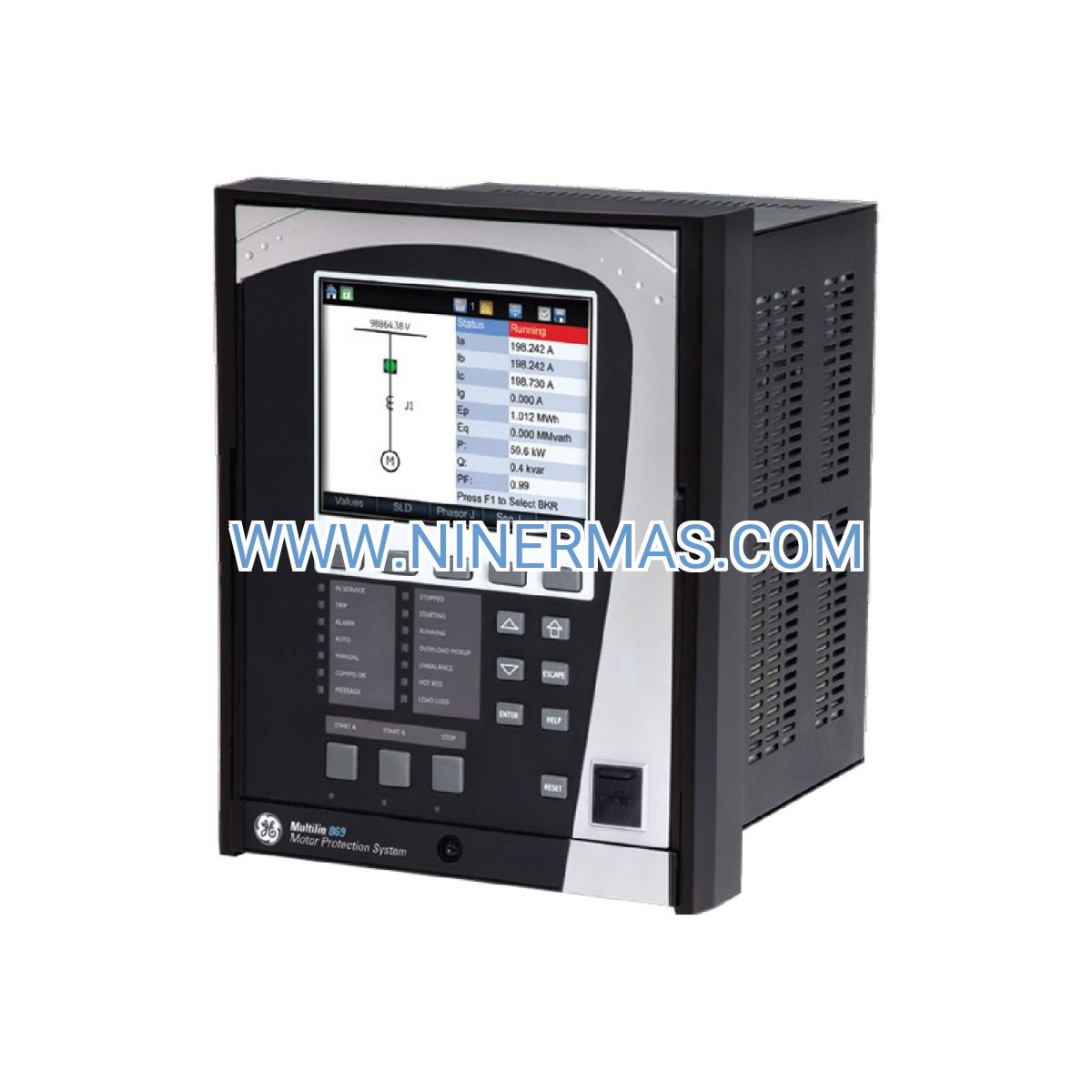
GE 869-E Motor Protection Relay (Industrial-Grade Motor Management)
The GE 869-E-P5-P5-B5-H-S-S-A-L-N-M-M-P-F-B-SE-N-N-B-N represents a comprehensive motor protection platform engineered for mission-critical industrial environments. This intelligent relay combines thermal modeling, ground fault detection, and predictive diagnostics to prevent costly downtime while extending motor service life.
Designed for facilities managing high-value rotating equipment, the 869-E addresses three fundamental challenges: premature motor failure from thermal stress, unplanned outages from undetected faults, and limited visibility into motor health trends. Plant engineers, maintenance teams, and automation integrators rely on this relay to protect motors ranging from 100 HP to multi-megawatt installations across oil & gas, mining, water treatment, and manufacturing sectors.
Key differentiators include 12-channel RTD monitoring for bearing temperature surveillance, multi-protocol communication (Modbus RTU/DNP3/IEC 61850) for seamless SCADA integration, and advanced thermal algorithms that adapt to variable load profiles. The backlit LCD interface enables rapid commissioning without external programming tools.
Core Features & Business Value
→ Adaptive Thermal Protection
Patented thermal modeling algorithms calculate real-time motor temperature based on load current, ambient conditions, and duty cycle. Prevents nuisance trips while catching genuine overload conditions 40% faster than conventional bimetallic relays. Reduces unplanned downtime by up to 60% in cyclic load applications.
→ Multi-Function Fault Detection
Integrated protection suite monitors phase unbalance (±2% sensitivity), ground fault (adjustable 5-50% pickup), undervoltage/overvoltage (±10% thresholds), and locked rotor conditions. Single-device solution eliminates need for separate protective elements, reducing panel space by 35% and wiring complexity.
✓ Predictive Maintenance Intelligence
Continuous tracking of motor starts, running hours, thermal capacity used, and fault event history. Trend analysis identifies degradation patterns 3-6 months before failure, enabling scheduled maintenance during planned outages rather than emergency repairs.
✓ Universal Communication Gateway
Triple-protocol support (Modbus RTU, DNP3.0, IEC 61850) ensures compatibility with legacy DCS systems and modern IoT platforms. Real-time data streaming enables centralized monitoring of distributed motor assets across multi-site operations.
✓ Bearing Temperature Surveillance
Up to 12 RTD inputs (Pt100/Pt1000) monitor bearing housings, stator windings, and ambient temperature. Configurable alarm thresholds trigger notifications before thermal runaway occurs, preventing catastrophic bearing seizure.
✓ Event Forensics & Compliance
500-event memory with millisecond time-stamping captures fault sequences for root cause analysis. Meets IEEE, IEC, and NEMA documentation requirements for insurance claims and regulatory audits.
Application Scenarios
Scenario 1: Water Treatment Plant – Circulation Pump Protection
A municipal water facility operates six 750 HP circulation pumps running 24/7. Previous thermal overload relays caused three false trips per month during summer peak demand, requiring manual resets and service interruptions. The 869-E's adaptive thermal model accounts for seasonal ambient temperature variations, eliminating nuisance trips while maintaining protection integrity. Result: Zero false trips over 18-month deployment, 99.7% uptime improvement.
Scenario 2: Mining Operation – Conveyor Motor Fleet Management
An open-pit mine manages 40+ conveyor motors (200-500 HP) across a 3 km material handling system. Bearing failures caused average 12 hours downtime per incident. Deploying 869-E relays with RTD monitoring enabled predictive bearing replacement based on temperature trends. Result: 70% reduction in unplanned conveyor stoppages, $2.3M annual savings in lost production.
Scenario 3: Chemical Plant – VFD-Fed Agitator Protection
A specialty chemical manufacturer uses variable frequency drives to control reactor agitator speeds (50-500 RPM). Standard relays failed to protect motors during low-speed, high-torque operation. The 869-E's VFD-compatible algorithms accurately model thermal stress across the entire speed range. Result: Extended motor life from 4 years to 7+ years, reduced harmonic-related failures by 85%.
Scenario 4: Power Plant – Boiler Feed Pump Backup
A 600 MW coal-fired plant requires instantaneous switchover to backup feed pumps during primary pump faults. The 869-E's DNP3 integration with plant DCS enables automatic sequencing, while comprehensive fault logging supports post-event analysis. Result: Reduced switchover time from 8 seconds to 2.5 seconds, improved boiler stability during transients.
Technical Parameters & Selection Guide
| Parameter | Specification | Selection Notes |
|---|---|---|
| Model Code | 869-E-P5-P5-B5-H-S-S-A-L-N-M-M-P-F-B-SE-N-N-B-N | Full configuration code defines I/O, comms, display options |
| Current Input Range | 0.15A - 800A (via CT secondary) | Select CT ratio to place normal load at 50-80% of range |
| Voltage Input | 85-265V AC/DC (universal power supply) | No derating required across voltage range |
| RTD Inputs | 12 channels, Pt100/Pt1000, 3-wire | Minimum 6 channels recommended for critical motors |
| Communication Ports | RS-485 (Modbus/DNP3), Ethernet (IEC 61850) | Dual-port configuration enables redundant networks |
| Digital Outputs | 8 Form-C relays, 10A @ 250VAC | Sufficient for trip, alarm, auxiliary contact functions |
| Operating Temperature | -40°C to +70°C (-40°F to +158°F) | Suitable for outdoor enclosures without climate control |
| Mounting | Panel cutout or DIN rail (adapter required) | Panel mount preferred for high-vibration environments |
| Certifications | UL 508, CSA C22.2, CE, IEC 60255-27 | Meets North American and European standards |
Selection Criteria:
- Motors ≥100 HP with critical process roles → Full 869-E configuration
- VFD-fed applications → Ensure harmonic filtering option enabled
- Multi-motor coordination → DNP3 or IEC 61850 protocol required
- Hazardous locations → Verify enclosure rating (NEMA 4X/IP66 available)
- Retrofit installations → Confirm CT compatibility (5A or 1A secondary)
Extended Capabilities
IoT & Cloud Integration: Optional Ethernet gateway enables data export to cloud-based analytics platforms (AWS IoT, Azure Industrial IoT, ThingWorx). Supports OPC UA for Industry 4.0 initiatives.
Advanced Diagnostics: Built-in oscillography captures voltage and current waveforms during fault events (8 cycles pre-fault, 16 cycles post-fault). Harmonic analysis identifies power quality issues affecting motor performance.
Custom Protection Schemes: User-programmable logic equations (16 inputs, 8 outputs) enable application-specific interlocks, sequencing, and load shedding strategies without external PLCs.
Delivery & Service Assurance
Lead Time: Standard configurations ship within 3-5 business days. Custom-configured units require 10-15 business days for factory programming and testing.
Warranty: 12-month manufacturer warranty covering materials and workmanship. Extended 36-month coverage available for critical infrastructure applications.
Technical Support: Lifetime application engineering support includes commissioning assistance, parameter optimization, and troubleshooting. Remote diagnostics available via secure VPN connection.
Documentation Package: Includes installation manual, quick-start guide, Modbus register map, DNP3 point list, AutoCAD panel cutout drawings, and sample ladder logic for common PLC platforms (Allen-Bradley, Siemens, Schneider).
Frequently Asked Questions
How does the 869-E relay handle motor starting inrush current without false tripping?
The relay employs a dual-element thermal model: a fast-acting element for locked rotor protection and a slow-acting element for running overload. During starts, the algorithm recognizes the inrush signature (typically 6-8x FLA for 3-5 seconds) and inhibits trip logic while accumulating thermal capacity. Adjustable start inhibit timers (1-60 seconds) prevent nuisance trips on high-inertia loads.
Can this relay protect motors fed by soft starters or variable frequency drives?
Yes. The 869-E includes specialized algorithms for reduced-voltage starting and VFD operation. For soft starters, the relay compensates for reduced starting current. For VFDs, harmonic filtering and RMS current calculation ensure accurate thermal modeling across 0-120 Hz operation. Consult factory for applications above 500 HP with high-speed VFDs (>120 Hz).
What is the maximum distance between the relay and RTD temperature sensors?
Using 3-wire Pt100 RTDs with 18 AWG shielded cable, maximum recommended distance is 300 meters (1000 feet) with <0.5°C error. For longer runs, use 4-wire RTDs or install local RTD transmitters (4-20mA output) connected to the relay's analog inputs.
How do I integrate the relay with my existing Rockwell Automation ControlLogix PLC?
The 869-E communicates via Modbus RTU over RS-485. Use a 1756-MVI module (Modbus interface card) in your ControlLogix chassis. GE provides sample ladder logic (L5X file) for common data points (motor status, fault codes, thermal capacity). Typical scan time: 100-250ms for 20 data registers.
Does the relay require annual calibration or maintenance?
No field calibration required. The relay uses digital signal processing with factory-calibrated accuracy (±1% for current, ±2% for voltage). Recommended annual maintenance: verify CT connections, test trip circuit continuity, review event logs, update firmware if security patches released. Estimated maintenance time: 30 minutes per relay.
What happens if communication to the SCADA system is lost?
The relay operates in standalone mode with full protection functionality. Local trip/alarm outputs remain active. Communication loss triggers a configurable alarm (relay output or front panel LED). Event logs continue recording locally (500-event buffer). Upon communication restoration, buffered data uploads automatically.
Ready to Protect Your Critical Motors?
Contact our application engineers for motor protection assessments, CT sizing calculations, and integration planning. We provide pre-configured relays with your motor nameplate data pre-loaded, reducing commissioning time by 60%.
Request a Quote: Email your motor nameplate photos and single-line diagrams to sale@ninermas.com
Technical Consultation: Schedule a 30-minute call with our protection specialists
Bulk Pricing: Fleet protection programs available for 10+ motor installations
© 2026 NINERMAS COMPANY LIMITED. All rights reserved.
Original Source: https://ninermas.com
Contact: sale@ninermas.com | +0086 187 5021 5667

Contact Info
-
Address:22 / F, South Wo Hang building, 148 Wing Lok Street, Sheung Wan, Western District, Hong Kong
-
Phone:+8618750215667
-
Email: