Description
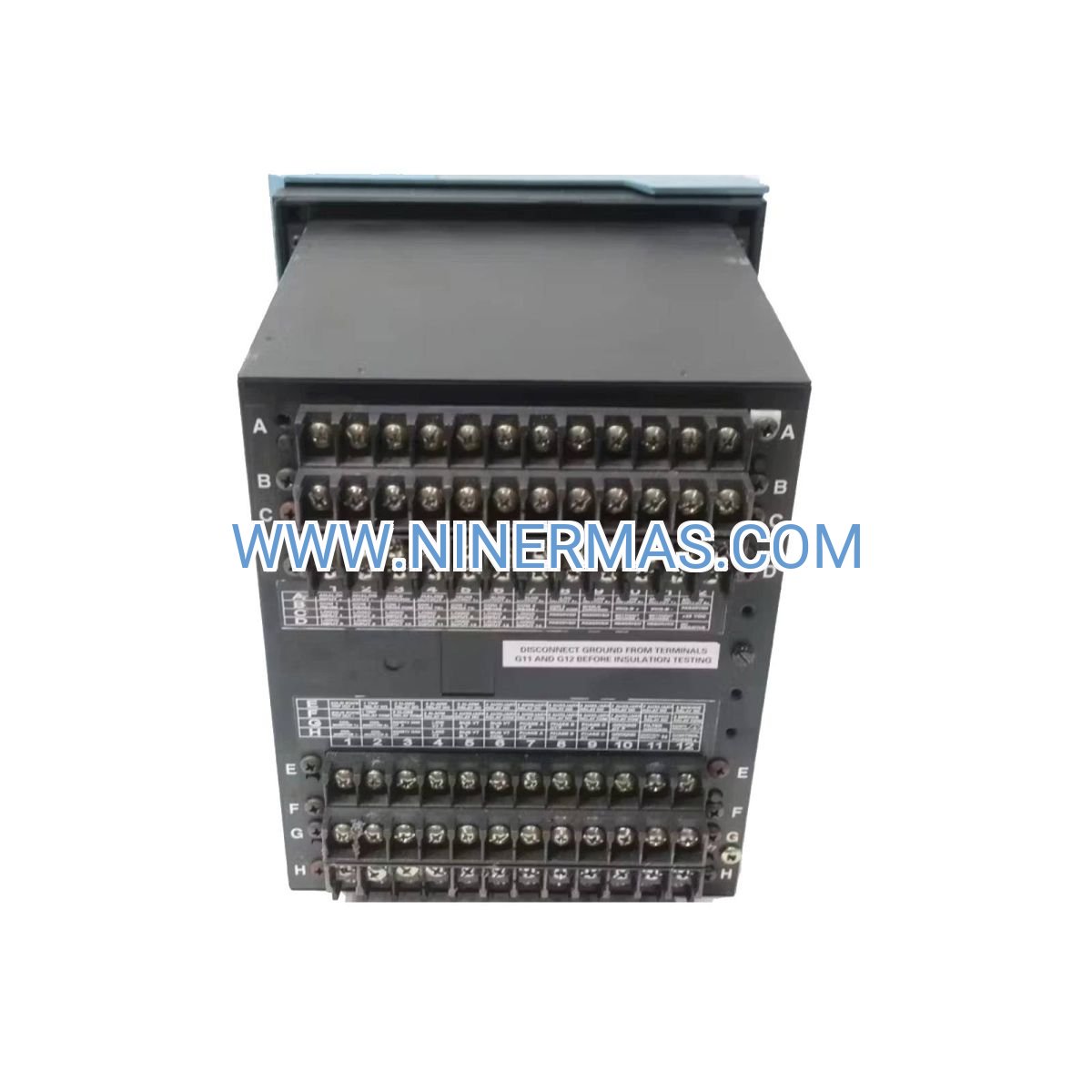
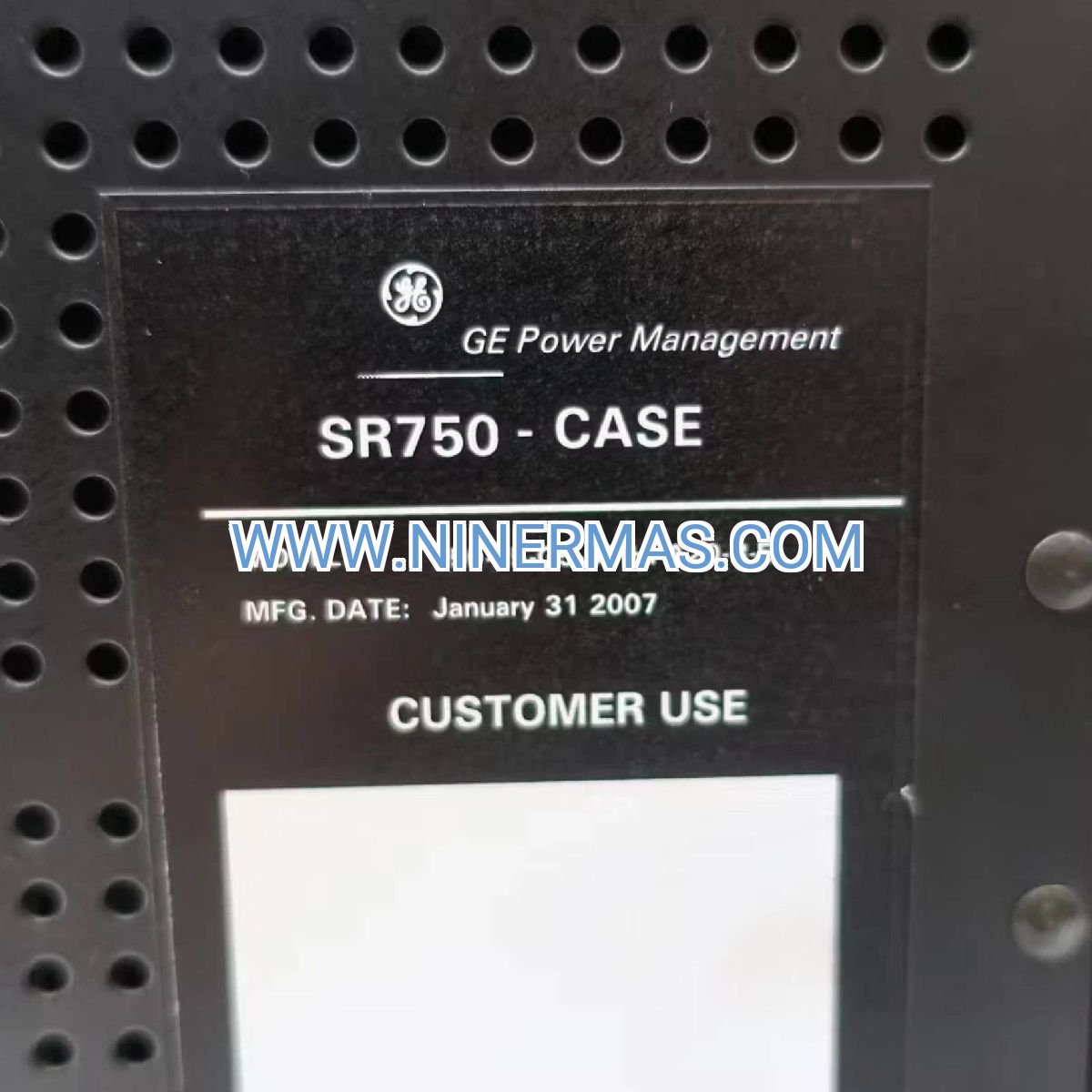
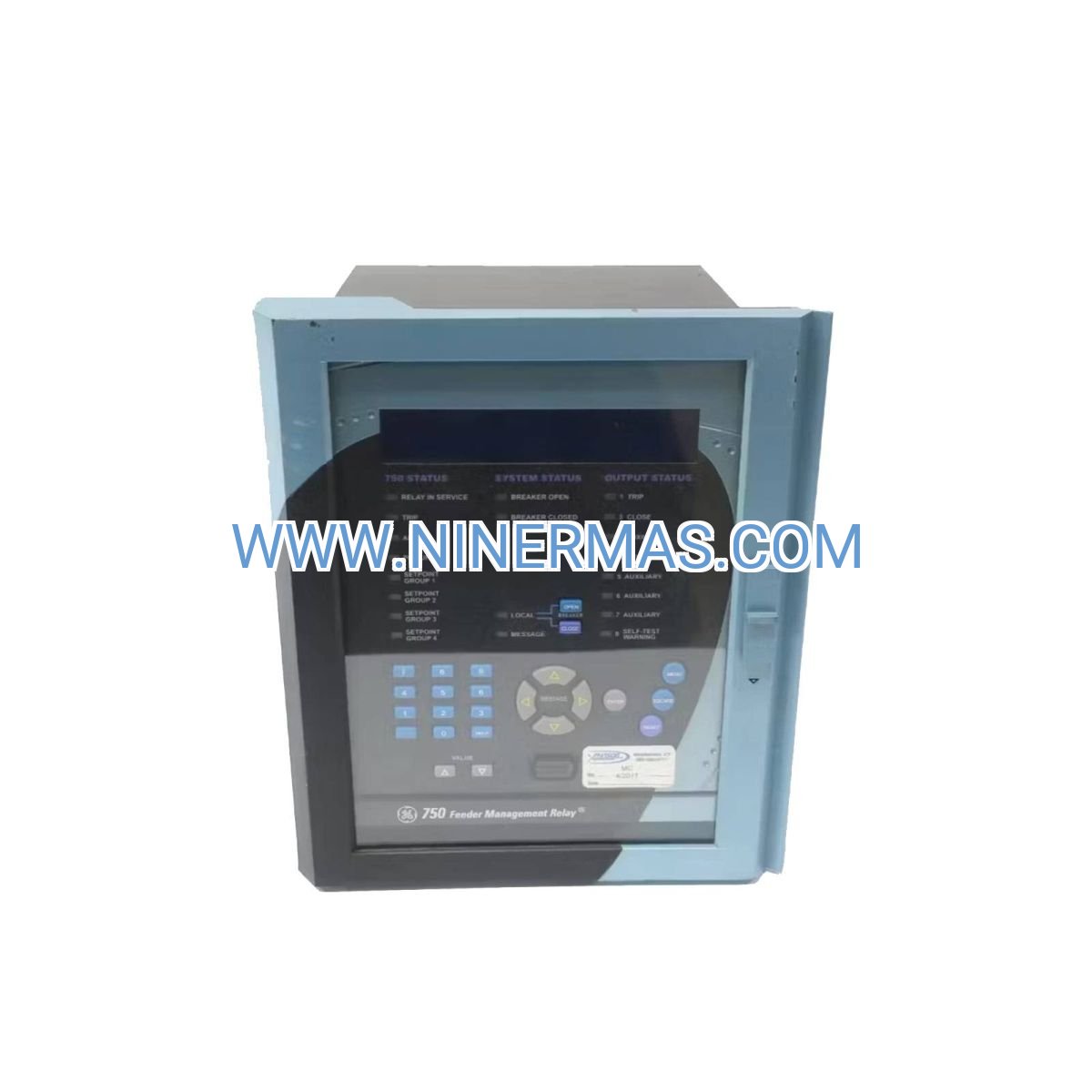
GE 750 Feeder Management Relay (Industrial-Grade Overcurrent Protection System)
The GE 750-P5-G5-S5-HI-A20-R-E Feeder Management Relay is an industrial-grade digital protection and control device designed for distribution feeder applications. Through advanced microprocessor-based protection algorithms, PLC-style programmable logic, and multi-protocol communication interfaces, it delivers comprehensive overcurrent protection, directional fault detection, precise power metering, and intelligent control automation.
Suitable for utility distribution substations, industrial power distribution networks, commercial building electrical systems, and renewable energy collection points, this relay addresses critical challenges including voltage fluctuations, fault isolation delays, inadequate power quality monitoring, insufficient coordination with upstream/downstream devices, and limited remote monitoring capabilities.
Built on proven GE Multilin architecture with field-tested reliability, the 750-P5-G5-S5-HI-A20-R-E offers flexible configuration options, extensive I/O expandability (20 configurable outputs), multi-protocol support (Modbus RTU/TCP, DNP3, IEC 61850), and intuitive HMI operation. Ideal for consulting engineers, EPC contractors, system integrators, and facility maintenance teams. Contact our application engineers for customized protection schemes and technical specifications.
Core Functions & Advantages
Comprehensive Multi-Element Protection
Integrates phase overcurrent (50/51), ground overcurrent (50N/51N), directional overcurrent (67/67N), voltage protection (27/59), and frequency protection (81U/81O) in a single platform. Definite-time, inverse-time (IEC/IEEE curves), and instantaneous characteristics provide coordinated protection with upstream circuit breakers and downstream fuses, minimizing nuisance trips while ensuring rapid fault clearing.
Intelligent Directional Discrimination
Directional overcurrent elements utilize voltage and current phase relationships to determine fault direction, enabling selective tripping in loop-fed, parallel-feeder, and network distribution systems. Prevents unnecessary outages on healthy feeders and supports complex protection coordination schemes in meshed networks.
Revenue-Grade Power Metering
Class 0.2 accuracy metering captures real-time and demand values for voltage, current, active/reactive/apparent power (kW/kVAR/kVA), energy (kWh/kVARh), power factor, frequency, and harmonic distortion (THD). Supports load profiling, demand management, power quality analysis, and energy cost allocation without additional metering devices.
Flexible Programmable Logic & I/O
20 configurable digital outputs enable custom control schemes including automatic transfer switching, load shedding, generator synchronization, breaker failure protection, and zone-selective interlocking. User-programmable logic equations (similar to PLC ladder logic) allow site-specific automation without external controllers.
Multi-Protocol SCADA Integration
Dual Ethernet ports with Modbus TCP, DNP3.0, and IEC 61850 support seamless integration with legacy RTU-based SCADA systems and modern substation automation platforms. RS485 serial port provides backup communication path. Supports redundant network topologies (PRP/HSR) for mission-critical applications.
Advanced Fault Recording & Diagnostics
High-resolution waveform capture (up to 64 samples/cycle) records pre-fault, fault, and post-fault conditions for detailed event analysis. Sequence-of-events (SOE) recording with 1ms resolution aids post-mortem investigation. Oscillography files export in COMTRADE format for analysis in third-party software.
User-Friendly Configuration & Monitoring
Enhanced graphical HMI displays real-time metering, protection status, alarm conditions, and single-line diagrams. Front-panel configuration reduces commissioning time. Remote configuration via GE EnerVista software enables centralized setting management across multiple relays. Password-protected access levels ensure cybersecurity compliance.
Typical Application Scenarios
This relay is engineered for environments demanding high reliability, precise protection coordination, and comprehensive monitoring capabilities, particularly in:
Utility Distribution Substations & Secondary Networks
Protects medium-voltage (4.16kV to 34.5kV) distribution feeders in utility substations serving residential, commercial, and light industrial loads. Directional overcurrent protection coordinates with reclosers and sectionalizers for selective fault isolation. Supports automatic restoration schemes in loop-fed secondary networks, minimizing customer outage duration.
Industrial Manufacturing & Process Facilities
Safeguards critical feeders supplying production lines, motor control centers, and process equipment in automotive, chemical, food processing, and semiconductor manufacturing plants. Power quality metering identifies voltage sags, harmonics, and unbalance conditions affecting sensitive equipment. Programmable outputs interface with DCS/PLC systems for coordinated shutdown sequences during fault conditions.
Commercial Buildings & Data Centers
Manages multiple distribution feeders in high-rise buildings, shopping centers, hospitals, and mission-critical data centers. Implements sophisticated load shedding strategies during utility supply interruptions. Coordinates with automatic transfer switches (ATS) and emergency generators. Metering data supports tenant billing and energy management systems (EMS) integration.
Renewable Energy & Microgrid Systems
Deployed at solar farm inverter collection points, wind turbine substations, and microgrid interconnection points. IEC 61850 GOOSE messaging enables high-speed peer-to-peer communication for islanding detection and anti-islanding protection. Supports bidirectional power flow monitoring in grid-tied and islanded operation modes.
Mining, Oil & Gas, and Marine Applications
Operates reliably in harsh environments (-40°C to +85°C) typical of mining operations, offshore platforms, and marine vessels. Conformal-coated circuit boards resist moisture, dust, and corrosive atmospheres. Supports redundant power supplies (DC/AC) for maximum availability in remote locations with unstable utility power.
Technical Parameters & Selection Guide
To facilitate engineering design and equipment selection, we provide standardized configuration options and customization capabilities to match specific project requirements.
| Parameter | Specification |
|---|---|
| Model Code | 750-P5-G5-S5-HI-A20-R-E |
| Current Input Range | 5A nominal (P5), 1A optional, 0.2–40× rated continuous |
| Voltage Input Configuration | Wye or Delta (G5), 50–240V AC phase-neutral |
| Digital Outputs | 20 Form-C contacts (A20), 7A @ 250V AC/DC continuous |
| Digital Inputs | 16 optically isolated, 24–250V DC/AC |
| Communication Interfaces | Dual Ethernet (HI), RS485 serial, rear-mounted (R) |
| Supported Protocols | Modbus RTU/TCP, DNP3.0, IEC 61850 Ed.1/Ed.2 |
| Display & HMI | Enhanced graphical LCD (E), 240×128 pixels, backlit |
| Power Supply Range | 90–300V DC or 70–265V AC, 50/60Hz, <25W |
| Operating Temperature | -40°C to +85°C (-40°F to +185°F) |
| Enclosure Rating | IP20 (front), IP10 (rear), NEMA 1 equivalent |
| Mounting Options | Panel (vertical), 19" rack, DIN rail adapter available |
| Dimensions (H×W×D) | 210mm × 175mm × 250mm (8.27" × 6.89" × 9.84") |
| Compliance Standards | IEC 60255, IEEE C37.90, ANSI C37.2, UL/cUL listed |
| Setting Groups | 6 independent groups, switchable via HMI/SCADA/DI |
| Event Records | 1024 SOE, 64 fault reports, 10 oscillography files |
Selection Recommendations: When specifying the GE 750 relay, consider the following project parameters: maximum fault current magnitude (for CT ratio selection), system voltage level and configuration (wye/delta), required protection functions per utility/facility standards, number of control outputs needed for breaker control and auxiliary functions, SCADA protocol requirements, environmental conditions (temperature, humidity, altitude), and panel space constraints. For complex applications involving generator synchronization, arc flash reduction, or microgrid control, consult our application engineers who can recommend optimal configuration and provide coordination study support.
Extended Capabilities & Integration
Breaker Monitoring & Diagnostics: Tracks circuit breaker operations, accumulated contact wear, and trip coil supervision. Predictive maintenance algorithms estimate remaining breaker life based on interrupting duty and operating cycles.
Arc Flash Mitigation: High-speed instantaneous overcurrent elements (operating in <20ms) reduce incident energy levels. Maintenance mode settings temporarily lower pickup thresholds during live work. Zone-selective interlocking (ZSI) via digital I/O or GOOSE messaging minimizes arc flash boundaries.
Cybersecurity Features: Role-based access control (RBAC) with password protection, encrypted communication (TLS/SSL), audit logging of configuration changes, and compliance with NERC CIP and IEC 62351 standards for critical infrastructure protection.
Synchrophasor Measurement (Optional): Time-synchronized phasor measurement (IEEE C37.118) enables wide-area monitoring, oscillation detection, and post-disturbance analysis when equipped with GPS/IRIG-B time synchronization.
Delivery, Service & Quality Assurance
Lead Time: Standard catalog configurations ship within 3–5 business days from regional distribution centers. Custom-configured units (non-standard I/O, special firmware, factory testing) require 2–3 weeks. Expedited processing available for emergency replacements.
Warranty Coverage: All GE 750-P5-G5-S5-HI-A20-R-E relays include a comprehensive 12-month manufacturer warranty covering defects in materials and workmanship. Extended warranty programs (up to 5 years) available for critical applications.
Technical Support Services: Our application engineering team provides pre-sales consultation, protection coordination studies, relay setting calculations, commissioning assistance (remote or on-site), and post-installation troubleshooting. Training programs available for maintenance personnel covering relay operation, setting philosophy, and diagnostic procedures.
Documentation Package: Each relay ships with complete technical documentation including installation manual, operation & maintenance guide, protection function descriptions, communication protocol implementation guides, electrical connection diagrams (AC/DC wiring, CT/VT connections), and dimensional drawings. EnerVista configuration software and IEC 61850 ICD files available for download.
Factory Testing & Certification: All units undergo rigorous factory acceptance testing (FAT) including protection element calibration, timing verification, communication interface validation, and environmental stress screening. Test reports and calibration certificates available upon request for quality assurance documentation.
Frequently Asked Questions (FAQ)
Q: How does the GE 750 feeder relay integrate with existing substation SCADA systems?
A: The relay's dual Ethernet ports support simultaneous Modbus TCP, DNP3.0, and IEC 61850 communication, allowing seamless integration with both legacy RTU-based SCADA and modern IEC 61850 substation automation systems. The RS485 serial port provides a backup communication path. Configuration is performed via GE EnerVista software, which includes protocol mapping tools and SCADA point lists. For IEC 61850 systems, the relay includes a pre-configured ICD (IED Capability Description) file compatible with major substation configuration tools (e.g., ABB PCM600, Siemens DIGSI, SEL AcSELerator).
Q: What is the maximum number of feeders that can be controlled by a single relay?
A: The GE 750-P5-G5-S5-HI-A20-R-E is designed as a single-feeder protection device with three-phase current and voltage inputs. However, the 20 configurable outputs enable control of multiple circuit breakers in applications such as bus-tie schemes, automatic transfer switching, or dual-breaker configurations. For multi-feeder substations, deploy one relay per feeder with peer-to-peer communication (IEC 61850 GOOSE) for interlocking and load management.
Q: What energy savings can be achieved, and what factors influence efficiency gains?
A: While the relay itself is a protection device (not a variable frequency drive), its advanced metering and load management capabilities enable energy optimization strategies. Power quality monitoring identifies inefficient loads (low power factor, harmonic distortion), demand metering supports peak shaving programs, and programmable load shedding reduces demand charges. Facilities implementing relay-based load management typically achieve 5–15% reduction in electrical operating costs through improved power factor, reduced demand charges, and optimized equipment utilization. Actual savings depend on tariff structure, load characteristics, and operational practices.
Q: What are the environmental requirements for installation? What is the enclosure protection rating?
A: The relay operates reliably in ambient temperatures from -40°C to +85°C without derating, suitable for outdoor substations, industrial environments, and climate-controlled facilities. The front panel meets IP20 (finger-safe, protected against solid objects >12mm), while the rear terminals are IP10 (protected against hand contact). For harsh environments requiring higher ingress protection, install the relay in a NEMA 4/4X or IP54-rated panel enclosure. Conformal coating on circuit boards provides additional protection against humidity, dust, and corrosive atmospheres in mining, marine, and chemical processing applications. Altitude rating: up to 2000m without derating; consult factory for high-altitude installations.
Q: Does the relay support remote monitoring and data acquisition? Which protocols are compatible?
A: Yes, comprehensive remote monitoring is supported via Modbus RTU/TCP, DNP3.0 (Level 2 compliant), and IEC 61850 (MMS, GOOSE, SV). Real-time data accessible remotely includes metering values (V, I, kW, kVAR, kVA, PF, Hz), protection element status, alarm conditions, breaker position, and event logs. Historical data (demand profiles, energy accumulation, fault records) can be retrieved on-demand or via periodic polling. The relay supports unsolicited reporting (DNP3 Class 0/1/2/3 events, IEC 61850 buffered/unbuffered reports) for efficient bandwidth utilization. SCADA integration typically requires configuration of communication parameters (IP address, slave ID, baud rate) and mapping of data points to SCADA tags using EnerVista software.
Q: Can this relay be used for arc flash reduction applications? How is it implemented?
A: Absolutely. The relay supports multiple arc flash mitigation strategies: (1) High-speed tripping: Instantaneous overcurrent elements operate in <20ms (1.2 cycles @ 60Hz), significantly reducing incident energy compared to time-delayed protection. (2) Maintenance mode: Temporarily lowers protection pickup settings during live work, enabling faster fault clearing. (3) Zone-selective interlocking (ZSI): Coordinates with upstream/downstream devices via hardwired digital I/O or IEC 61850 GOOSE messaging to ensure only the nearest protective device trips, minimizing arc flash boundaries. (4) Light-based arc flash detection: Digital inputs can interface with optical arc flash sensors for ultra-high-speed tripping (<4ms). Implementation requires coordination study to verify selective operation and compliance with NFPA 70E / IEEE 1584 arc flash hazard analysis.
Request Technical Consultation & Quotation
To receive a customized protection scheme design, relay setting calculations, or project quotation, please provide the following information to our application engineering team:
- Project Overview: Facility type (utility substation, industrial plant, commercial building, renewable energy site), project timeline, and key stakeholders
- Electrical System Data: System voltage level (kV), fault current magnitude (kA symmetrical), CT/VT ratios, feeder configuration (radial, loop, network)
- Protection Requirements: Required protection functions per utility/facility standards, coordination with existing devices, arc flash reduction needs
- Control & Automation: Number of circuit breakers, automatic transfer schemes, load shedding requirements, generator synchronization
- Communication & Integration: SCADA protocol requirements, network architecture (fiber/copper, redundancy), cybersecurity compliance (NERC CIP, IEC 62351)
- Environmental Conditions: Ambient temperature range, altitude, humidity, exposure to dust/corrosive atmospheres
Our engineers will respond within 24 hours with technical recommendations, application notes, and commercial quotation. For urgent inquiries or emergency replacement requirements, contact our technical hotline for immediate assistance.
© 2026 NINERMAS COMPANY LIMITED. All rights reserved.
Original Source: https://ninermas.com
Contact: sale@ninermas.com | +0086 187 5021 5667

Contact Info
-
Address:22 / F, South Wo Hang building, 148 Wing Lok Street, Sheung Wan, Western District, Hong Kong
-
Phone:+8618750215667
-
Email: