


Description
1394-AM75 High-Performance Servo Axis Controller (Industrial-Grade Motion Solution)
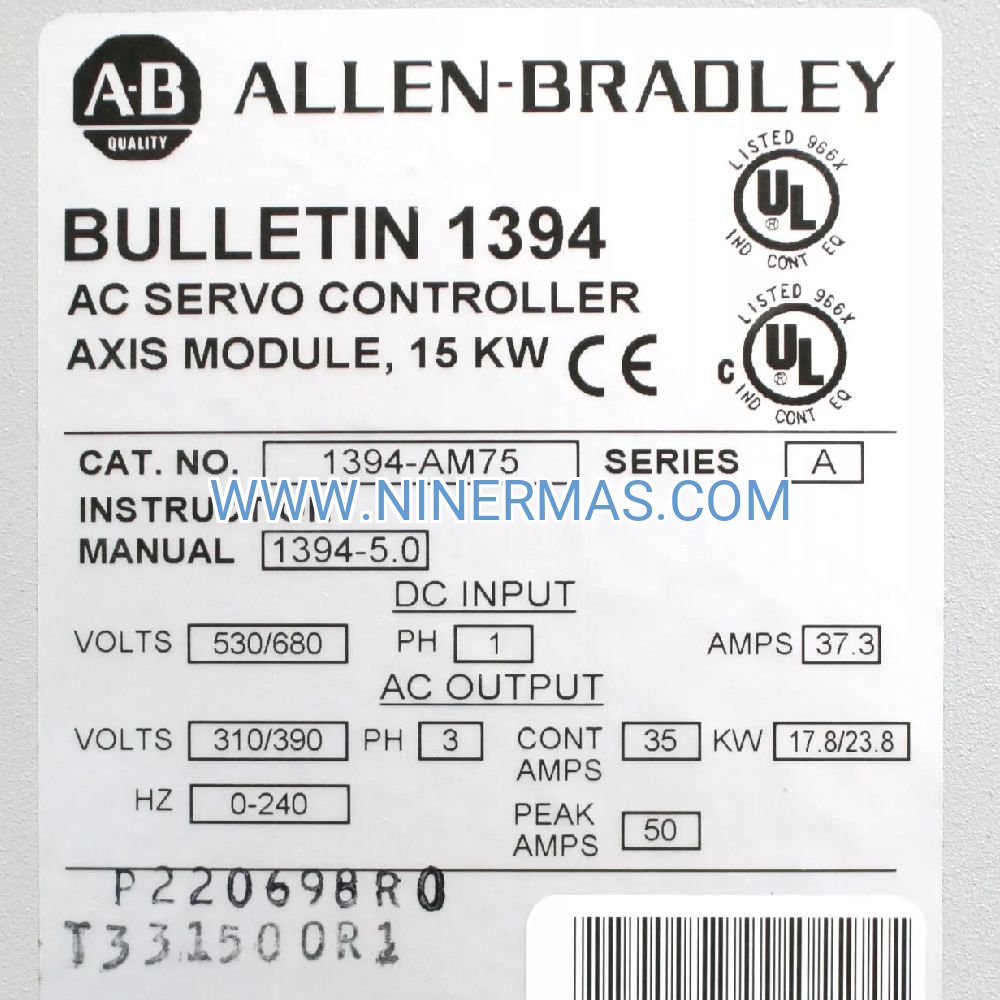
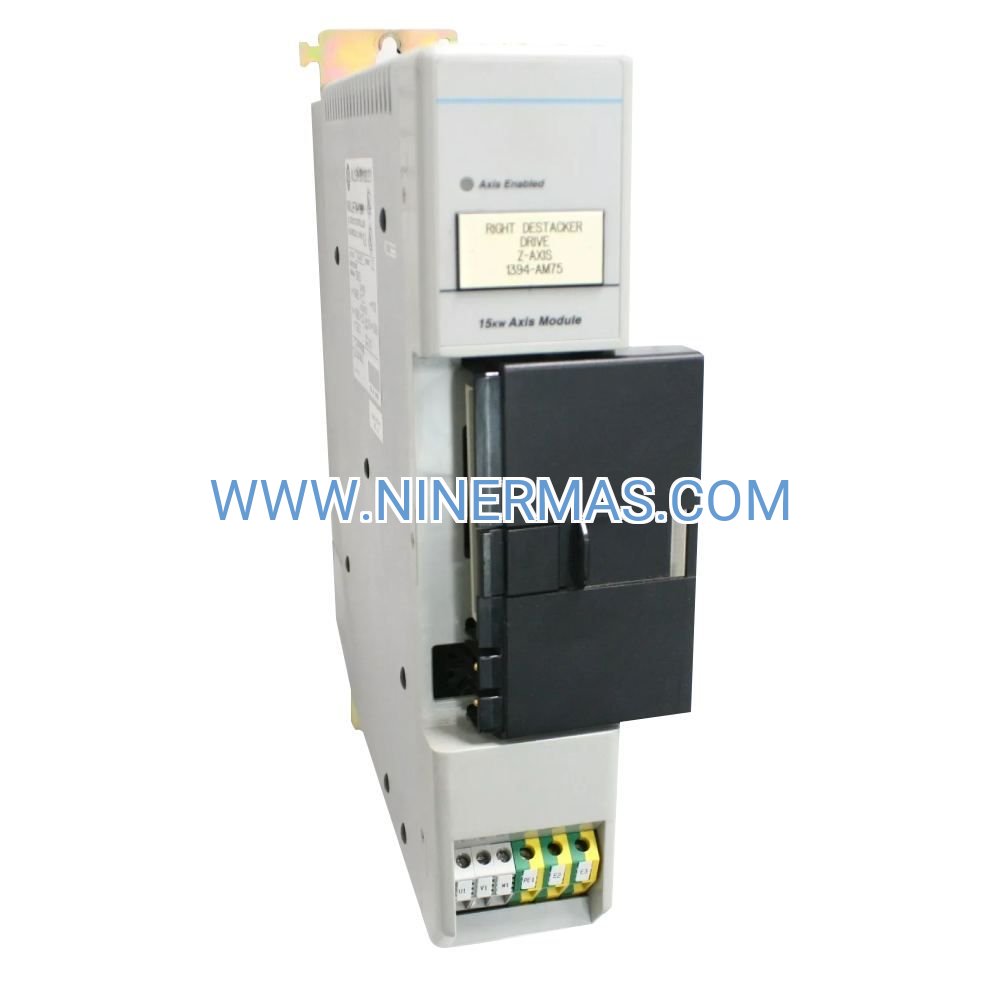
Engineered for mission-critical automation environments, the 1394-AM75 servo axis controller stands as a powerhouse solution within the Allen-Bradley 1394 Turbo platform. Delivering a robust 35 amperes of continuous three-phase output, this module transforms demanding motion challenges into precise, repeatable performance across heavy-duty industrial machinery.
Manufacturing operations requiring exceptional torque density—from high-tonnage injection molding to rapid metal forming—depend on controllers that never compromise between power delivery and positioning accuracy. The AM75 addresses this need through advanced IGBT power electronics paired with intelligent thermal management, enabling sustained high-current operation while maintaining sub-micron resolution control.
Whether you're synchronizing multi-axis packaging lines at 500 meters per minute or controlling press brake back gauges with ±0.05° repeatability, this controller provides the foundation for world-class motion system performance. Discover how 35A of intelligent servo power can elevate your automation outcomes.
Core Capabilities & Technical Advantages
The 1394-AM75 integrates six critical performance dimensions into a single compact module:
→ 35A Continuous Power Delivery: Sustains full-rated current at 40°C ambient with intelligent derating to 28A at 55°C, ensuring consistent torque output across varying thermal conditions. Peak capability reaches 105A for two-second bursts, providing 300% overload capacity for acceleration-intensive applications.
→ Ultra-High Resolution Feedback Processing: Native 24-bit encoder support delivers 16.7 million counts per revolution, enabling positioning accuracy down to 0.00002° mechanical rotation. Compatible with incremental, absolute (EnDat/BiSS/Hiperface), and resolver feedback technologies for maximum system flexibility.
→ 500Hz Velocity Loop Bandwidth: Industry-leading control bandwidth eliminates following errors during rapid direction changes and high-acceleration profiling. Position loop extends to 150Hz for applications demanding both speed and precision, such as flying shear operations and electronic camming.
→ Adaptive Load Compensation: Real-time disturbance observer automatically compensates for friction variations, cogging torque, and external forces without manual tuning intervention. Self-learning acceleration feedforward adapts to load inertia changes across 10:1 ratios while maintaining ±2 encoder count following error.
→ Four-Quadrant Regenerative Operation: Returns 100% of braking energy to the DC bus, dramatically reducing regeneration resistor sizing requirements. Supports bus voltages up to 680VDC for maximum motor voltage utilization and extended field-weakening range.
→ Multi-Mode Control Architecture: Seamlessly switches between torque, velocity, position (absolute/incremental), and electronic camming modes. Execute 256-segment cam profiles with cubic spline interpolation for smooth follower motion in converting and packaging applications.
Industrial Application Scenarios
Injection Molding & Plastics Processing
Drive 50-ton toggle mechanisms and 200mm screw assemblies with 0.01mm position repeatability. The AM75's high continuous current rating eliminates thermal derating during extended production runs, while adaptive feedforward compensation maintains consistent shot-to-shot quality despite material viscosity variations. Medical-grade part manufacturers achieve cavity pressure control within ±0.5% using torque mode operation.
Metal Forming & Fabrication
Control press brake back gauges, turret punch presses, and tube bending equipment requiring 5000Nm peak torque delivery. Angular positioning accuracy of ±0.05° ensures bend angle repeatability across thousands of cycles. Resonance suppression filters eliminate mechanical vibration from 5Hz to 2kHz without sacrificing the 500Hz velocity bandwidth needed for rapid tool positioning.
High-Speed Packaging & Converting
Synchronize registration rollers, rotary cutters, and web tension zones at line speeds exceeding 500 meters per minute. Electronic camming with on-the-fly profile modification enables product changeovers without mechanical adjustments. Flying shear applications achieve ±0.1mm cut accuracy through 125-microsecond deterministic update rates across multi-axis coordination.
Extrusion & Continuous Process Lines
Maintain ±0.2% speed regulation across haul-off drives, winders, and downstream cutters to ensure uniform product thickness and dimensional consistency. The load observer function automatically compensates for roll diameter changes and material property variations, eliminating the manual gain scheduling required by conventional controllers.
Material Testing & Laboratory Equipment
Provide precise force control for universal testing machines applying up to 500kN tensile loads. Torque mode operation with 0.01% accuracy enables ASTM-compliant stress-strain characterization. Position control supports cyclic fatigue testing with sub-micron displacement resolution over millions of cycles.
Technical Parameters & Selection Criteria
| Parameter | Specification | Selection Notes |
|---|---|---|
| Continuous Output Current | 35A RMS @ 40°C 28A RMS @ 55°C | Derate 20% for ambient temperatures above 40°C or restricted airflow installations |
| Peak Current Capability | 105A for 2 seconds | Size for continuous torque requirements; peak handles acceleration transients |
| Output Voltage Range | 0-460V AC (3-phase) | Matches motor rated voltage; supports field weakening to 2× base speed |
| DC Bus Input | 324-680V DC | Requires 1394-SJT22 (22kW) or dual SJT10 (20kW) system power modules |
| PWM Switching Frequency | 5kHz standard 2.5-10kHz configurable | Higher frequencies reduce motor audible noise; lower frequencies improve efficiency |
| Control Loop Update Rate | 125 microseconds (8kHz) | Deterministic across up to 8 axes in single chassis |
| Speed Regulation Accuracy | ±0.01% of rated speed | With encoder feedback; ±0.1% in sensorless mode |
| Position Resolution | 24-bit (16,777,216 counts/rev) | Supports incremental, absolute, and resolver feedback types |
| Efficiency | >95% at nominal load | Reduces cooling requirements and energy costs vs. older drive technologies |
| Power Dissipation | 280W typical at rated load | Plan for 400 CFM minimum airflow through chassis |
| Operating Temperature | 0°C to 55°C | Install in climate-controlled enclosure for extended component life |
| Vibration Resistance | 2G per IEC 60068-2-6 | Suitable for machine-mounted installations with proper shock isolation |
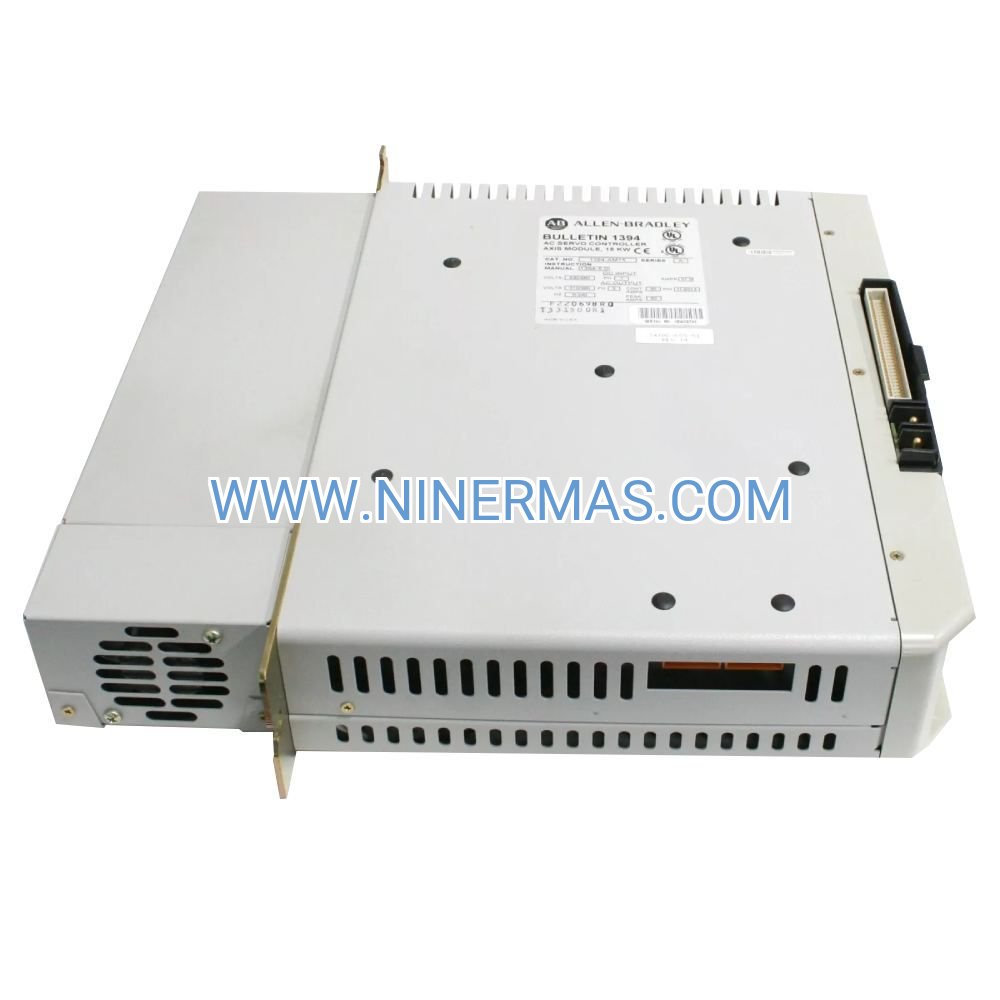
| Dimensions (W×H×D) | 100 × 198 × 175 mm | Requires vertical orientation; maintain 100mm spacing between AM75 modules |
| Weight | 2.1 kg (4.6 lbs) | Chassis mounting hardware included |
Motor Compatibility: Drives Allen-Bradley MP-Series and F-Series brushless servo motors from 5kW to 22kW continuous power rating. Optimal performance with 5:1 motor-to-load inertia ratio; acceptable range 3:1 to 15:1 with adaptive tuning enabled.
Selection Guidelines: Choose AM75 when continuous torque requirements exceed AM50 (25A) capacity or when peak torque demands exceed 75A. For applications requiring >70A continuous, parallel two AM75 modules. Consider AM04 (4.5A) or AM18 (12A) for lower-power axes to optimize system cost.
Advanced Integration & Connectivity Options
The 1394-AM75 operates within a comprehensive motion ecosystem designed for seamless automation integration:
System Architecture: Mounts in 1394 modular chassis alongside system power modules (SJT series), gateway modules (GM04), and additional axis modules. Proprietary 12Mbps backplane communication ensures deterministic 125-microsecond update rates across up to 30 axes per system.
Controller Connectivity: Interfaces with ControlLogix, CompactLogix, SLC 500, and PLC-5 platforms through 1394-GM04 gateway module. Supports DeviceNet, ControlNet, EtherNet/IP, and Modbus TCP protocols via appropriate communication adapters, enabling integration with third-party HMI and SCADA systems.
Programming Environment: Configure and tune via Motion Analyzer 2.0 software featuring real-time oscilloscope displays, Bode plot frequency analysis, and auto-tuning wizards. Save axis parameters, cam profiles, and tuning gains to non-volatile storage for rapid machine replication and disaster recovery.
Safety Integration: Safe Torque Off (STO) function certified to IEC 61800-5-2 SIL 2, Performance Level d (PLd), Category 3 enables integration with safety PLCs and emergency stop circuits without external contactors. Dual-channel architecture ensures safe state even under single-fault conditions.
Diagnostic Connectivity: Multi-color status LED provides at-a-glance operational status (green=ready, yellow=warning, red=fault). 32-event fault history log with timestamps enables root cause analysis of intermittent issues. Real-time monitoring displays motor current, bus voltage, junction temperature, and power dissipation at 1kHz update rate.
Commissioning Best Practices & Performance Optimization
Installation Requirements:
- Install in climate-controlled enclosure with minimum 400 CFM forced airflow through chassis
- Maintain 100mm spacing between AM75 modules; avoid installing adjacent to lower-power modules
- Use shielded motor power cable rated 600V, 50A continuous; maximum length 75 meters at 5kHz PWM
- Route encoder cables in separate conduit from motor power; use twisted-pair shielded cable with 120Ω termination
- Establish single-point ground at drive chassis with <0.1Ω earth impedance
Tuning Methodology:
- Begin with velocity loop bandwidth of 200Hz; increase to 500Hz for stiff mechanical couplings
- Set position loop proportional gain for 100Hz bandwidth; add derivative gain to limit overshoot below 5%
- Enable velocity feedforward at 80-95% of theoretical value for improved tracking during constant-velocity moves
- Activate acceleration feedforward for point-to-point applications; self-learning algorithm adapts to load inertia
- Use Bode plot analysis to identify mechanical resonances; apply notch filters at resonant frequencies
- Set load observer bandwidth to 50% of velocity loop bandwidth for optimal disturbance rejection
Performance Verification: Following commissioning, verify ±2 encoder count following error during trapezoidal moves at maximum programmed acceleration. Confirm position settling time <10 milliseconds after motion complete. Validate torque ripple <5% of rated through oscilloscope current monitoring.
Delivery Timeline & Comprehensive Service Support
Standard Lead Time: In-stock units ship within 1-2 business days via expedited carrier. Custom configurations (special firmware, extended temperature rating) require 2-3 weeks for factory preparation and testing.
Warranty Coverage: 24-month comprehensive warranty covers materials, workmanship, and component failures under normal operating conditions. Extended warranty programs available for critical applications requiring 5-year coverage.
Technical Support: Access to motion control specialists with average 15+ years servo system experience. Support includes pre-sales application engineering, commissioning assistance, performance optimization, and troubleshooting. Remote diagnostic capabilities via VPN connection to customer equipment.
Documentation Package: Each unit includes installation manual, quick-start guide, wiring diagrams, and safety certification documents. Downloadable resources include Motion Analyzer software, firmware updates, application notes, and tuning guides.
Training Resources: On-site commissioning training available for multi-axis systems. Web-based training modules cover installation, configuration, tuning, and troubleshooting. Annual regional workshops provide hands-on experience with advanced features.
Frequently Asked Questions
What motor power ratings are compatible with the 1394-AM75 servo controller?
The AM75 drives Allen-Bradley MP-Series and F-Series brushless servo motors ranging from 5kW to 22kW continuous power output. Motor selection depends on application torque and speed requirements rather than drive current rating alone. For optimal efficiency, match motor continuous current rating to drive continuous current capability (35A). Consult motor torque-speed curves to verify adequate torque margin at required operating speeds.
How does the regenerative braking capability reduce system costs?
Four-quadrant operation returns 100% of braking energy to the DC bus rather than dissipating it through external resistors. In applications with frequent deceleration cycles (packaging, material handling), this can reduce regeneration resistor sizing by 60-80% and eliminate forced-air cooling requirements for resistor banks. Energy recovery also lowers facility electrical consumption by 15-25% in typical duty cycles compared to resistor-only braking.
Can multiple AM75 modules be paralleled for higher current applications?
Yes, two AM75 modules can be paralleled to deliver 70A continuous output for ultra-high-torque motors. Parallel operation requires identical firmware versions, matched motor cable lengths (within 5%), and activation of current-sharing algorithms in Motion Analyzer software. This configuration is common in large injection molding machines, heavy-duty extruders, and test stands requiring >30kW motor power.
What encoder types are supported for position feedback?
The AM75 accepts incremental encoders (differential line driver, 5V single-ended), absolute encoders (EnDat 2.2, BiSS-C, Hiperface DSL), and resolvers (brushless, transformer-coupled). Maximum encoder line count is 16,777,216 lines per revolution (24-bit resolution). For applications requiring absolute position retention through power cycles, specify EnDat or BiSS absolute encoders with battery-backed position memory.
How is the 500Hz velocity loop bandwidth achieved?
High bandwidth results from the combination of 8kHz control loop update rate (125-microsecond cycle time), advanced current loop algorithms with 25-microsecond response time, and optimized IGBT switching characteristics. Mechanical system stiffness is equally critical—coupling resonances below 500Hz will limit achievable bandwidth regardless of drive capability. Use Bode plot analysis to verify mechanical system supports target bandwidth before aggressive tuning.
What maintenance is required for long-term reliability?
Monthly: Clean chassis air filters and verify fan operation. Quarterly: Inspect motor and encoder cable shield connections. Annually: Perform infrared thermal scan of power terminals and bus bars to detect loose connections. DC bus electrolytic capacitors are rated for 10-year life at 40°C; plan replacement at 7-year intervals for 24/7 operation. Typical mean time between failures (MTBF) exceeds 150,000 hours with proper preventive maintenance.
Take the Next Step Toward Precision Motion Control
Transform your high-power motion challenges into competitive advantages with the 1394-AM75 servo axis controller. Our motion specialists are ready to discuss your specific application requirements, recommend optimal system configurations, and provide detailed technical specifications.
Contact our team today: Share your torque, speed, and positioning accuracy requirements to receive a customized motion system proposal within 24 hours. Request a demonstration unit for proof-of-concept testing in your facility, or schedule a technical consultation to explore advanced features like electronic camming and multi-axis coordination.
© 2026 NINERMAS COMPANY LIMITED. All rights reserved.
Original Source: https://ninermas.com
Contact: sale@ninermas.com | +0086 187 5021 5667
PDF Specification
Download PDF file here:
Click to Download PDF

Contact Info
-
Address:22 / F, South Wo Hang building, 148 Wing Lok Street, Sheung Wan, Western District, Hong Kong
-
Phone:+8618750215667
-
Email:
