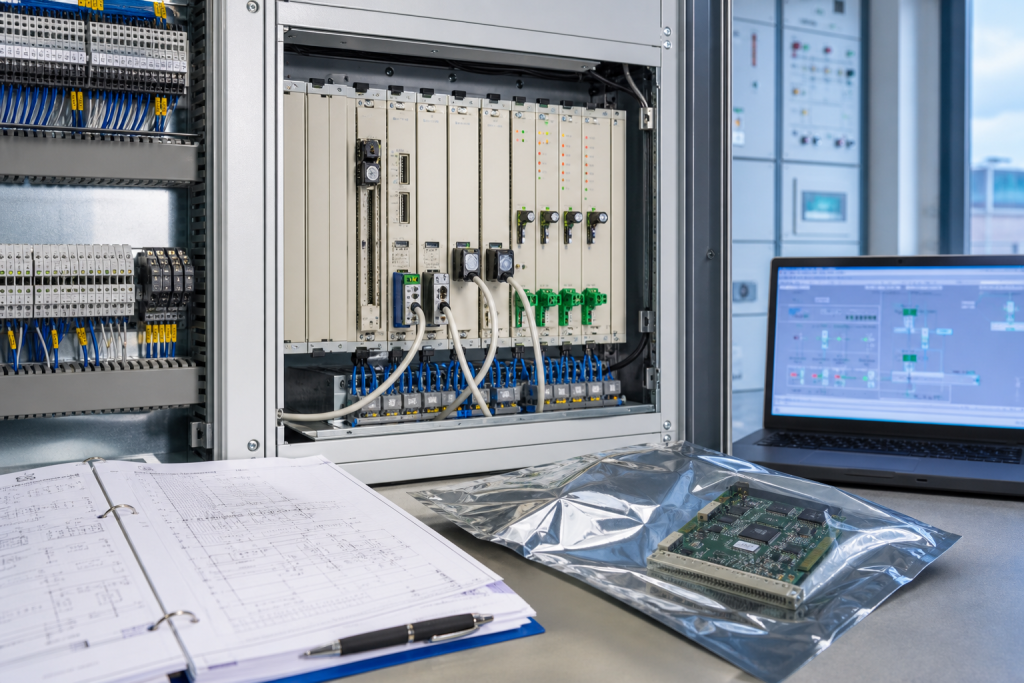
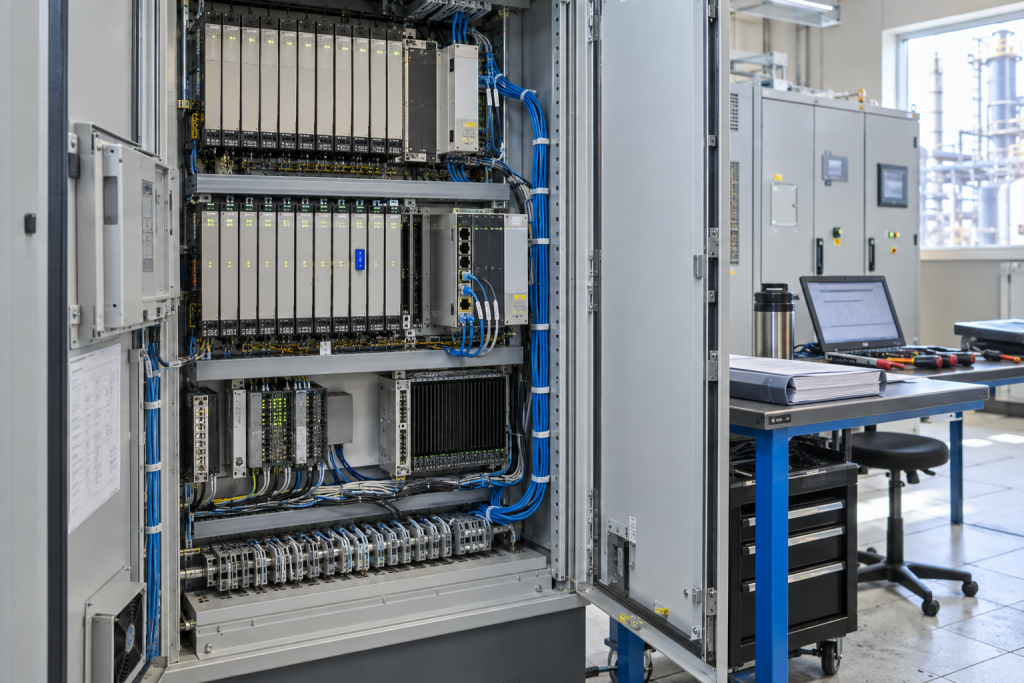
A stepwise DCS evolution project rarely starts with a clean drawing set. It usually starts with a cabinet that has been modified across several shutdowns, cable tags that use old plant names, and a network fault that appears only when a node is disturbed. For an ABB Bailey INFI 90 installation, those details are not administrative clutter. They decide whether a replacement module restores communication or creates a second problem.
ABB has long described Harmony and INFI 90 evolution as a staged process rather than a forced rip-and-replace exercise. That is useful guidance, but it also raises the standard for spare records. A plant that intends to preserve proven control logic while evolving selected nodes must know exactly which communication path, cable set, power arrangement, and controller generation is installed today.
Treat The Network Drawing As An Installed-Asset Record
Begin at the cabinet, not at the catalog. Record the node name, cabinet and rack position, transfer-module identity, neighboring communication modules, power-supply family, cable origin and destination, connector orientation, grounding arrangement, and every active or abnormal LED. Mark which process units depend on that path and whether another route provides redundancy.
The published ABB INIIT13 INFI-NET transfer module is relevant because transfer hardware sits at an architectural boundary. The full label and surrounding rack context matter more than the family name alone. Photos should show the front, side label, connector face, keying, and the modules immediately above and below it.
Cable Evidence Is Part Of Module Compatibility
Older DCS networks often accumulate cable substitutions, repaired connectors, and undocumented routing changes. A module can pass a bench check yet fail in the plant because the cable assembly, shield treatment, connector pinning, or physical strain differs from the expected arrangement. Cable continuity alone does not prove that the installed path is suitable for a controlled restart.
For that reason, the ABB Bailey NKTU02-30 cable assembly should be evaluated as part of the communication path, not as a generic accessory. Capture both end connectors, length, routing, bend damage, locking hardware, and any plant-specific adapter before requesting a spare.
Separate Recovery Stock From Evolution Stock
An emergency recovery spare is selected to restore the known configuration with the smallest controlled change. Evolution stock supports an approved architecture change and may require different engineering tools, configuration conversion, network hardware, or test procedures. Mixing those two purposes creates ambiguous acceptance criteria and often leaves stores holding an item that no one is authorized to install.
Label each spare record with its intended use: direct recovery, temporary bridge, test bench, or approved evolution stage. Add the controller and software baseline that the plant expects to support. If a replacement is proposed rather than a like-for-like part, require a written list of changed interfaces and a rollback plan before purchase approval.
Build A Shutdown Test Around Process Consequence
A network module test is not complete when its LEDs turn green. The acceptance plan should confirm node visibility, communication stability, controller status, time synchronization where applicable, point quality, operator displays, alarms, trends, and the response of representative loops. Select test points from different I/O areas so that a partial communication loss is not mistaken for full recovery.
Keep the first energization controlled. Verify cabinet power and grounding before seating legacy electronics, inspect backplane connectors, and compare switch or jumper positions with the removed unit. After communication returns, monitor error counters and intermittent alarms long enough to expose connector or cable problems that appear only after vibration or temperature change.
What Procurement Should Put In The RFQ
A useful RFQ contains the full part number, revision or suffix, quantity, acceptable condition, cabinet role, photos, cable requirements, failure symptom, required delivery date, destination, and acceptance evidence. State whether the offer must include test results, connector hardware, cables, or exchange conditions. Avoid the phrase “or equivalent” unless engineering has defined what equivalence means.
For long-lived DCS platforms, provenance and condition language deserve attention. New surplus, refurbished, repaired exchange, tested used, and untested used are different risk categories. Ask what was tested, on what fixture or system, and whether the serial and revision shown in the offer will be the item shipped.
The Practical Decision Gate
Before releasing an order, ask three people to sign off on different questions. Maintenance confirms that the offered hardware and cables match the cabinet evidence. Controls engineering confirms architecture, configuration, and test implications. Operations confirms the outage window and the process checks needed for return to service. This small separation of duties catches assumptions that a single urgent buyer may miss.
The result should be a decision, not just a quotation: buy a direct spare, repair the failed unit, qualify an evolution component, or hold the purchase until the installed record is improved. That decision can then be reused for similar nodes instead of being rediscovered during the next fault.
FAQ
Can an INFI 90 communication module be selected by base model only?
No. The complete part identity, revision, rack role, connector arrangement, neighboring hardware, and installed network path should be checked before approval.
Why photograph the cable if the module is the suspected failure?
A damaged, mis-keyed, repaired, or incorrectly routed cable can reproduce the same communication symptom and can also damage confidence in a good replacement module.
Should recovery spares and migration hardware share one stock record?
They should be separated by intended use and acceptance method. A direct-recovery spare and an evolution-stage component may require different engineering authority and test plans.
What proves that the node is ready to return to service?
Stable communication, healthy controller and module diagnostics, valid point quality, correct HMI and alarm behavior, representative loop checks, and operations signoff provide stronger evidence than LEDs alone.
Send NINERMAS the complete ABB Bailey labels, cabinet and connector photos, cable details, network role, required condition, and shutdown date. We can help turn that evidence into a focused INFI 90 spare-parts inquiry.
© 2026 NINERMAS. All rights reserved. Official Website: https://NINERMAS.com Inquiry: sale@NINERMAS.com | WhatsApp/Tel: +86 187 5021 5667
Next Step
Move the research into a cleaner RFQ.
Send the part number, quantity, condition expectation, destination, and timing details so the sourcing team can reply with better availability and lead-time context.