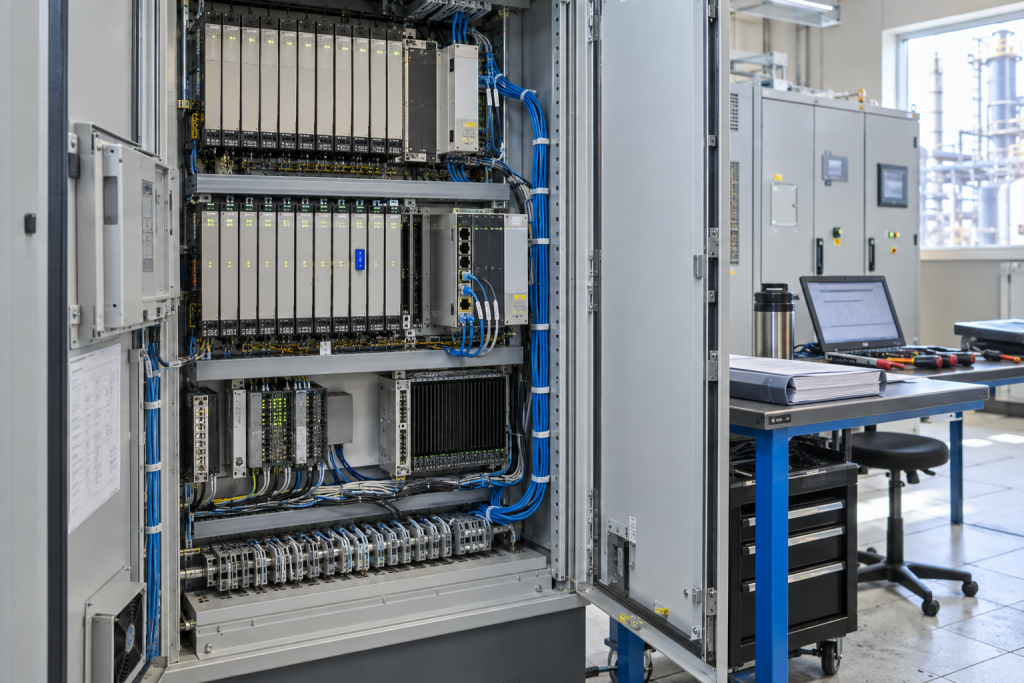

A Yokogawa CENTUM migration rarely starts on the day capital approves a new system. In most plants, it starts earlier, when a RIO bus node becomes unstable and the maintenance team has to decide whether one more interface spare is enough to protect production.
NINERMAS readers often support older DCS cabinets that remain reliable until a cable, interface card, power path, or remote I/O node starts to lose evidence. The practical question is not whether modernization is coming; it is how to keep the plant recoverable while that modernization is prepared.
Map The RIO Boundary Before Buying
Record the cabinet, node address, RIO bus path, power supply, slot location, adjacent I/O, diagnostic messages, cable condition, and the process area affected by the communication loss.
When the installed evidence points to an interface-side problem, the live Yokogawa AIP512 RIO bus interface is the product match that belongs in the RFQ discussion.
If a paired or supporting board is involved, include the Yokogawa AIP171 S2 service-ready spare part only where its installed role is documented by photos and cabinet records.
Why Migration Evidence Belongs In A Spare RFQ
A spare can restore a node today, but the difficulty of finding a correct interface is also useful evidence for the future migration file.
Ask engineering to attach loop criticality, cabinet photos, bus topology, I/O count, and known weak points so purchasing can see whether the order is emergency recovery, inventory coverage, or a bridge to migration.
Suppliers should be asked for actual photos, condition, tested status, connector state, packaging, and any limits around firmware, revision, or accessories.
Acceptance Should Prove Communication And Process Impact
After replacement, verify node visibility, module diagnostics, I/O values, alarm clearance, operator display status, and at least one controlled process-function check.
If the fault remains, review bus cable continuity, termination, power quality, adjacent module seating, grounding, and controller configuration before rejecting the spare.
Store all photos, test notes, product links, and migration implications with the spare record so the next outage does not start from zero.
Procurement Notes For Yokogawa RIO Support
Send node photos, interface labels, bus cable evidence, affected I/O list, required condition, and the maintenance-window deadline.
Do not treat a RIO bus spare as a generic board order; the installed node role and cable path decide whether the spare can be accepted.
For substitutes, require review of connectors, revision, node behavior, software impact, and rollback plan before approving shipment.
The strongest spare request begins with installed evidence, not a catalog guess. A buyer should send the part number, revision or suffix, cabinet location, live function, connected accessories, visible fault behavior, and the acceptance test that will decide whether the plant can return the item to service.
For mature PLC, DCS, SIS, drive, robot, machinery-protection, and communication platforms, several modules can look interchangeable at a distance. Firmware, terminal base, keying, communication option, cable type, memory, power supply, mounting depth, and project configuration can all change the result.
Photographs still matter. Front labels, side labels, connector faces, screw terminals, cable tags, slot position, LED state, and nearby modules often reveal details that a short purchase request misses. Good photos also reduce the chance that a supplier quotes a similar but unusable item.
Condition language should be practical and unambiguous. Factory sealed, new surplus, refurbished, repaired exchange, tested used, and untested used parts carry different risk. Ask what was tested, which accessories are included, and which checks remain the plant responsibility.
A useful RFQ separates hardware identity from system readiness. The supplier can confirm the spare, test evidence, packaging, and dispatch limits. The plant still owns project loading, firmware review, parameter transfer, calibration, proof testing, communication checks, and final operating approval.
Receiving inspection should repeat the same discipline used during sourcing. Compare the delivered item with the approved photos, check connector damage, verify accessory scope, record packaging condition, and decide whether the part is ready for stores, bench test, or immediate installation.
For urgent downtime, define the fallback path before the purchase order is released. If the first spare fails acceptance, the team should know whether to reinstall the old item, try a repaired exchange, isolate a noncritical function, or move directly toward a migration decision.
The same evidence also helps lifecycle planning. Scarce offers, weak test records, missing accessories, and repeated substitutions are not just purchasing annoyances; they are practical signals that a platform needs better stores coverage or a controlled modernization plan.
Good sourcing discipline does not slow a shutdown. It reduces vague follow-up questions and lets the supplier respond with exact stock, tested condition, realistic dispatch timing, and clear limitations while maintenance still has time to plan.
If the spare is bought for inventory rather than immediate installation, keep the evidence with the stores record. A critical spare without photos, revision notes, and test expectations simply moves uncertainty from today to the next outage.
Multi-site groups should standardize the evidence format while allowing different acceptance rules. A utility unit, safety shutdown loop, batch reactor, turbine train, robot cell, or packaging line may each justify a different tolerance for condition and testing.
The best teams also record what was not verified. If firmware, settings, project backup, calibration, communication schedule, or field proof testing remains open, write it down so nobody mistakes hardware arrival for system readiness.
FAQ
What must match on a Yokogawa RIO interface spare?
Match the exact interface identity, node role, cable path, cabinet position, revision evidence, and the acceptance test used by the plant.
Why mention migration in a spare-parts article?
Because sourcing difficulty, missing accessories, and weak test evidence are real signals for DCS lifecycle planning.
What should procurement send with the RFQ?
Send labels, node photos, bus path evidence, affected loop list, condition requirement, and the required recovery date.
What proves the spare worked?
Restored node visibility, clean diagnostics, valid I/O values, cleared alarms, and an approved process-function check.
Send NINERMAS the Yokogawa cabinet photos, RIO interface labels, cable path evidence, affected I/O list, and recovery deadline. We can help prepare a focused CENTUM spare RFQ.
© 2026 NINERMAS. All rights reserved. Official Website: https://NINERMAS.com Inquiry: sale@NINERMAS.com | WhatsApp/Tel: +86 187 5021 5667
Next Step
Move the research into a cleaner RFQ.
Send the part number, quantity, condition expectation, destination, and timing details so the sourcing team can reply with better availability and lead-time context.