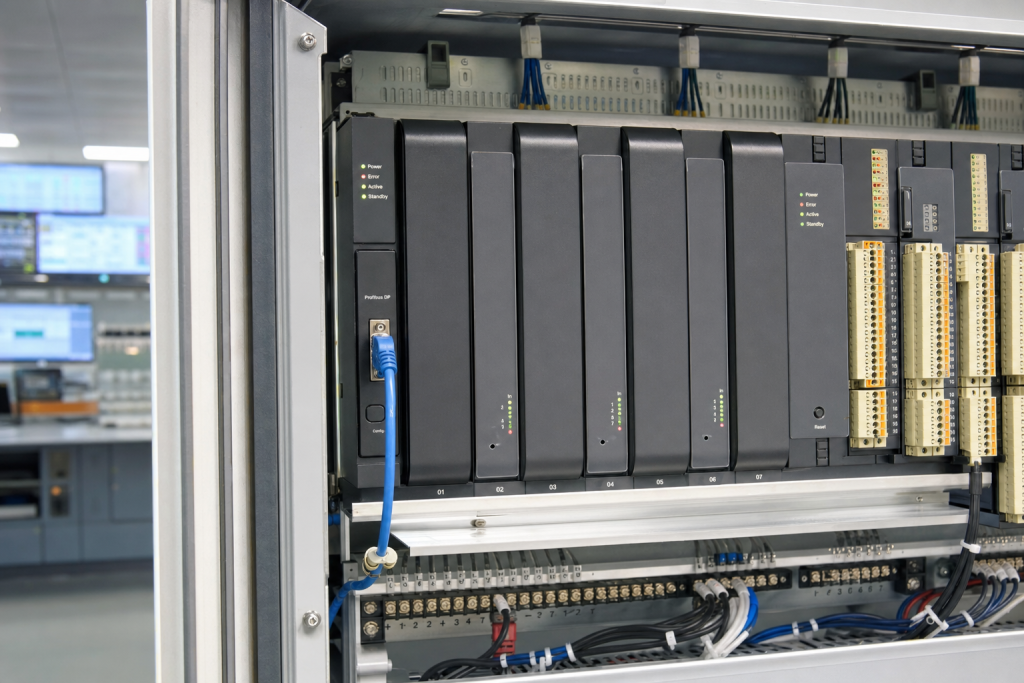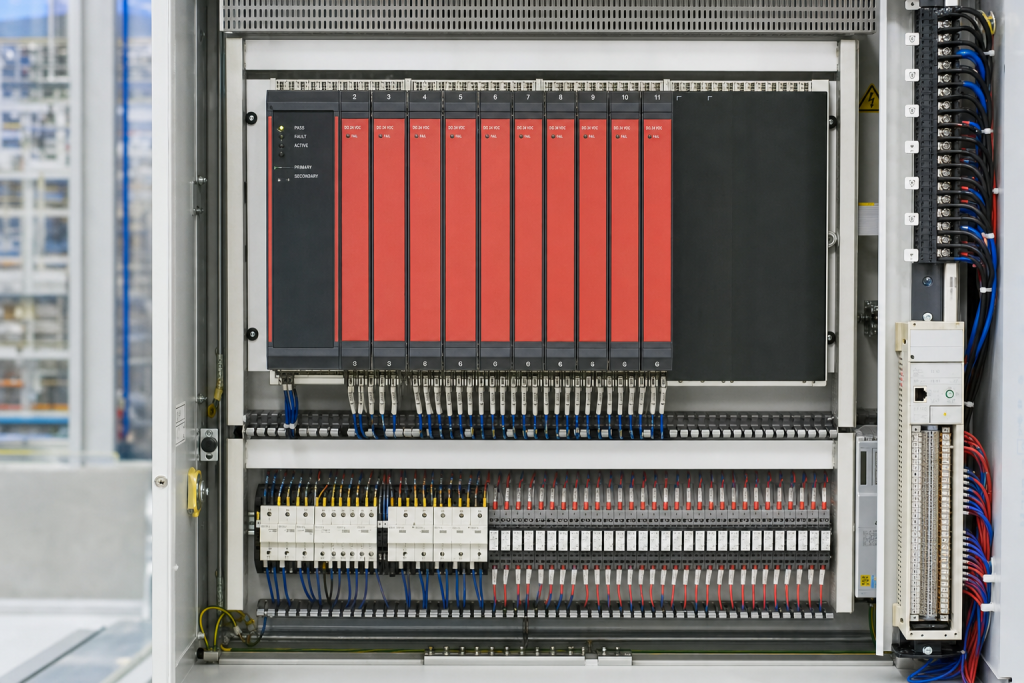
A control cabinet can appear healthy until one 24 VDC supply drops out and several devices disappear at once. The resulting fault is often described as a PLC problem, an I/O problem, or a network problem even when the first recovery question should be about power quality and power distribution. A spare plan that names only the controller misses the common dependency underneath it.
For maintenance and procurement teams, power supply redundancy is a practical evidence problem. The installed voltage, current margin, wiring arrangement, protection devices, terminal layout, and restart behavior all decide whether a replacement can restore the cabinet without adding a second fault.
Start with the cabinet power path
Map the path from incoming supply to the DC power supply, distribution terminals, fuses, UPS or redundancy module, PLC rack, remote I/O, network switch, HMI, and field devices. A 24 VDC label alone does not prove that two supplies are interchangeable.
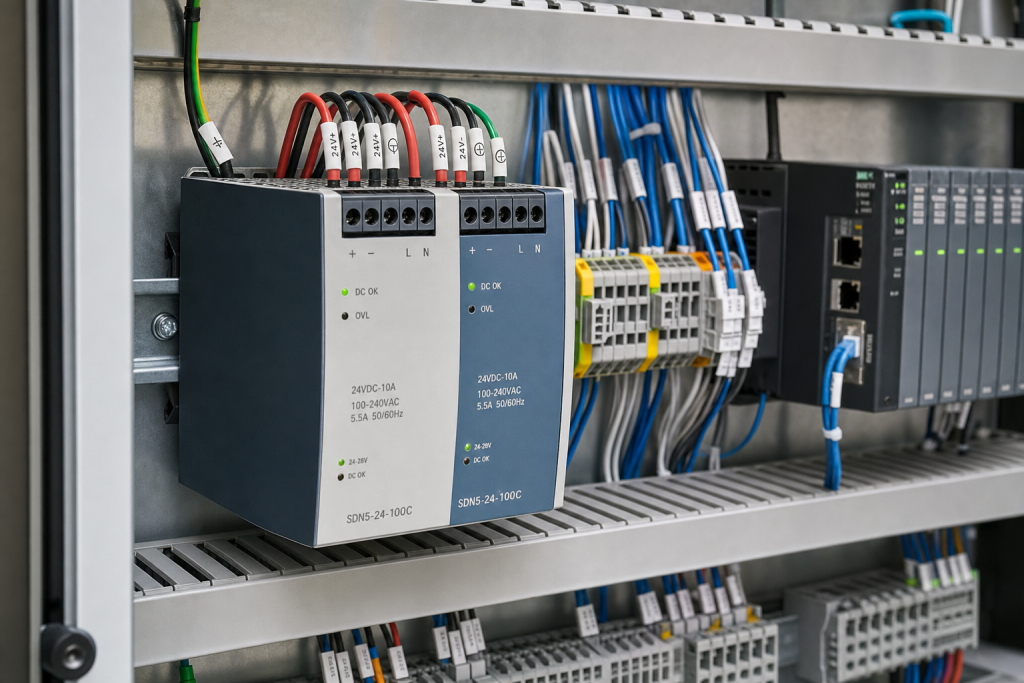
The live Emerson SDN5-24-100C DIN rail power supply is a useful catalog reference for an RFQ, but the installed load and mounting arrangement still need to be checked. Record whether the supply is single, parallel, redundant, or feeding a protected branch.
Photograph the model label, input and output terminals, selector settings, DIN rail position, adjacent protection, wire sizes, and outgoing distribution. Include the cabinet context so a supplier can see whether the item is a complete replacement or only one part of a larger power path.
Check load and restart behavior
Review normal load, startup load, spare capacity, and the devices that must restart together. Some cabinets remain partially alive during a supply fault, creating misleading symptoms. The spare record should identify which alarms, I/O groups, communication devices, and operator displays depend on the supply.
If a second supply is used for redundancy, document the redundancy module, current sharing, alarm contact, and isolation behavior. Replacing one supply with a visually similar unit can change fault reporting or overload behavior.
For an RFQ, state whether the plant needs an exact replacement, a tested equivalent, or a possible upgrade. A quote should identify voltage, current, input range, terminal arrangement, mounting, condition, test evidence, and accessory scope.
Acceptance is a power-quality check
After replacement, verify output voltage under load, polarity, alarm contacts, branch protection, restart sequence, and cabinet communication. Do not close the work order because the green LED is on; prove that the dependent controller and field devices recover as expected.
Keep a spare status such as exact, conditional, bench-tested, or engineering review required. That label prevents a power supply with unknown load margin from being treated as ready stock during a night callout.
A small evidence pack with photos, measured values, approved substitute notes, and the final receiving record makes the next sourcing cycle faster and reduces the chance of replacing the wrong layer of the cabinet.
Build the RFQ around the installed function
A useful spare request begins with the installed function, not only a familiar brand name. State what the device does, where it sits, what it connects to, and what failure would stop or blind the process. Then add the exact label, revision, connector view, power information, accessory scope, condition requirement, destination, and required date. This gives procurement and engineering the same starting point.
Separate an exact replacement from a possible substitute, repair exchange, bench item, and migration candidate. These options may all be commercially useful, but they do not carry the same approval burden. An exact spare may support a short outage window. A substitute may need wiring changes, parameter review, software work, or a production trial before it can be counted as recovery stock.
The product references in this article are live catalog examples, not permission to skip engineering checks. Compare the product page with the installed label and the plant record. If a suffix, connector, voltage, protocol, firmware family, or mechanical interface differs, keep the item conditional until the responsible engineer closes that gap.
Receiving inspection should repeat the evidence used for the RFQ. Photograph the received label, packaging, connectors, terminals, mounting features, and included accessories. Record what was checked and what remains unknown. A clean-looking item is not automatically a field-ready spare, and an item that powers up is not automatically accepted by the control or protection function.
Keep the approved catalog and RFQ reference with the maintenance record, but do not let a catalog title replace the installed evidence. The useful record is the combination of model, function, interface, condition, test requirement, and decision owner. That combination remains valuable even when the next supplier uses a different description for the same hardware family.
Review the spare before the maintenance window, not only after a failure. Confirm that the item is still physically present, that packaging and accessories are intact, that the backup or test procedure is available, and that the responsible engineer is still named. Small changes in wiring, software ownership, or cabinet layout can make an old spare conditional without anyone updating the shelf record.
When a substitute is considered, write down the exact gap it is intended to close and the evidence needed to approve it. This may include a drawing comparison, firmware review, bench test, dimensional check, secondary injection test, communication test, or production trial. A short approval checklist is easier to review than a vague statement that the substitute is equivalent.
The final decision should be visible to stores, procurement, maintenance, and operations. Use plain status labels such as exact replacement, approved substitute, repair exchange, bench-only, or engineering review required. Clear status prevents a useful but conditional item from being pulled as if it were already approved for a live plant function.
FAQ
What should be matched on a 24 VDC power supply?
Match input range, output voltage, current capacity, terminals, mounting, protection behavior, alarm contacts, and the installed load profile.
Is a higher-current supply always a safe substitute?
No. Wiring, protection, redundancy behavior, dimensions, output characteristics, and engineering approval still need to be checked.
What photos help with an RFQ?
Send the label, terminals, DIN rail context, adjacent fuses or redundancy modules, wiring, and the cabinet devices powered by the unit.
How should a spare be accepted?
Check output under load, polarity, alarms, branch protection, restart behavior, and recovery of the connected control devices.
Send NINERMAS the cabinet power photos, installed label, load concerns, and outage deadline. We can help structure a power-spare RFQ around the actual recovery path.
© 2026 NINERMAS. All rights reserved. Official Website: https://NINERMAS.com Inquiry: sale@NINERMAS.com | WhatsApp/Tel: +86 187 5021 5667
Next Step
Move the research into a cleaner RFQ.
Send the part number, quantity, condition expectation, destination, and timing details so the sourcing team can reply with better availability and lead-time context.