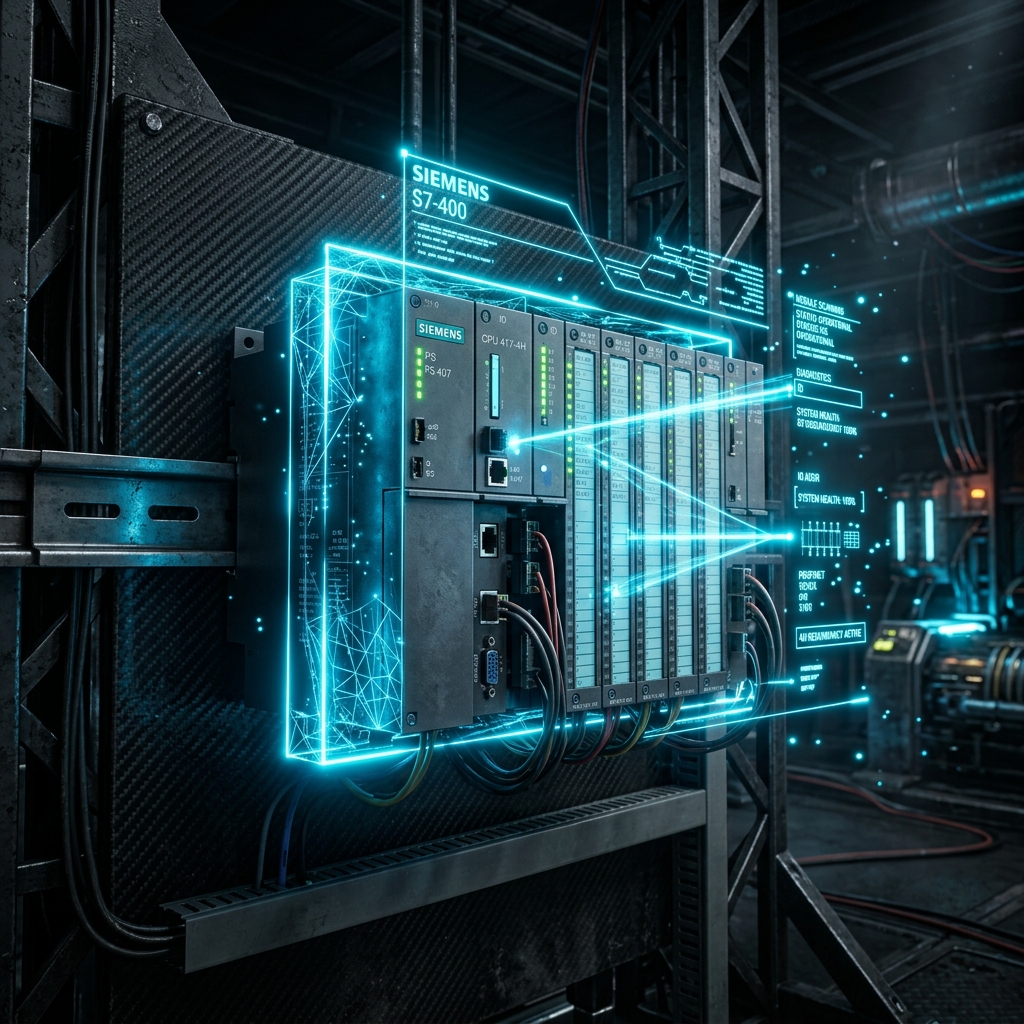
The industrial automation world is currently buzzing with the commercial rollout of the Siemens Eigen Engineering Agent in mid-2026. This purpose-built AI for automation engineering marks a fundamental shift from human-assisted ‘copilots’ to autonomous execution. Siemens reports efficiency gains of up to 50% in engineering workflows, a staggering figure for any plant manager. However, as an expert with over 20 years in the field—spanning from the early days of STEP 7 to the current TIA Portal ecosystem—I see a hidden paradox: as our engineering tools leap forward into the age of AI, our legacy hardware fleets are being pushed faster into the shadow of obsolescence.
The reality is that while the Eigen Engineering Agent is a masterpiece of modern software, its brilliance is optimized for the latest S7-1500 and ET 200SP architectures. For the thousands of facilities still relying on the ‘old reliable’ SIMATIC S7-300 and S7-400 platforms, this AI revolution is actually an ‘Obsolescence Accelerator.’ Today, we will explore why the rise of industrial AI makes your legacy spare parts strategy more critical than ever before.
The Widening Tech Debt Gap
Every time a new, AI-driven engineering tool is released, the ‘technical debt’ of maintaining older logic increases. The Eigen Engineering Agent is designed to automate the generation of code, documentation, and even hardware configurations—but it does so within the context of modern standards. If your facility is still running on an S7-300 CPU 315-2 DP, you are operating in a world that these new AI agents barely ‘understand’ in their native language.
This creates a significant support risk. As younger engineers enter the workforce trained on AI-autonomous tools, their ability to troubleshoot manual, LAD/STL-based logic in a legacy environment diminishes. When a failure occurs, the pressure to upgrade becomes immense. However, full-scale migrations are rarely feasible in a single budget cycle. To bridge this gap, you must ensure that your hardware layer is rock-solid. Having an original, verified IM 360 rack expansion module ready for immediate swap-out is the only way to hold the line while you plan your transition to an AI-ready architecture.
Why S7-400H is Still the Backbone in 2026
Despite the hype surrounding AI-managed distributed systems, the core of many critical process industries remains the S7-400H redundant series. These ‘big iron’ controllers handle high-availability tasks that many smaller, newer units still struggle to replicate in sheer processing volume and reliability. I recently consulted for a refinery where they were attempting to use AI agents to optimize their control loops, but the underlying hardware was a 15-year-old S7-400 CPU 412-3H.
The conflict is clear: you have 2026-level software running on 2010-level silicon. While the S7-400 is incredibly robust, its aging power supplies and backplanes are the ‘Achilles heel’ of your high-tech ambitions. In an era where downtime can cost $50,000 per hour, a failure in a redundant IM 153-2 interface module can crash the very system you are trying to optimize with AI. Procurement managers must stop viewing legacy spares as ‘obsolete stock’ and start viewing them as the ‘uptime insurance’ for their digital transformation projects.
Strategic Stockpiling in the Age of AI
In mid-2026, we are seeing a shift in the supply chain. OEMs are focusing their production capacity on the components that support their new AI initiatives, which means the production of legacy S7-300 and S7-400 parts is being deprioritized. This is the ‘Quiet Phase-Out.’ If you wait for a critical failure to search for an original, new-in-box module, you will find yourself at the mercy of lead times that can span months or ‘refurbished’ hardware with zero technical pedigree.
My recommendation is pragmatic: audit your legacy fleet today. Identify the single points of failure that the Siemens Eigen Engineering Agent cannot fix—the physical hardware. Sourcing verified, original spares from a technical partner who understands the nuance of the S7-400 backplane or the S7-300 memory card is no longer optional. In 2026, the real winners in industrial automation won’t just be those with the smartest AI; they will be those whose physical foundations are built to last through the transition.
Frequently Asked Questions
1. Does the Siemens Eigen Engineering Agent support legacy S7-300/400 code generation?
While Eigen can analyze legacy code, its autonomous execution and optimization features are primarily targeted at TIA Portal V20+ and the S7-1500 family. It is an accelerator for modernization, not a long-term maintenance tool for legacy hardware.
2. Should I immediately migrate my S7-300 fleet to S7-1500 because of AI trends?
Not necessarily. If your process is stable, a ‘Lifecycle Extension’ strategy is often more cost-effective. The key is to secure your hardware supply chain now before original spares become scarce.
3. Can I use the S7-400H for AI-driven process optimization?
Yes, provided you have modern communication gateways (like the CP 443-1) that can feed data to higher-level AI agents. However, the hardware itself remains ‘blind’ to AI; it simply executes the logic it is given.
4. How do I verify the integrity of Siemens spares in the secondary market in 2026?
Always look for original factory seals and matching firmware revisions. At NINERMAS, we use our 20+ years of technical experience to vet every component, ensuring it meets the rigorous standards required for industrial uptime.
Bridge the Gap Between Legacy and AI
Navigating the intersection of cutting-edge industrial AI and aging hardware infrastructure requires a partner who understands the technical heartbeat of your plant. Whether you are maintaining a legacy S7-400H installation or exploring the new world of the Eigen Engineering Agent, NINERMAS provides the original, verified spares you need to stay safe and productive. Contact our experts today to audit your critical spares and protect your facility against the tech debt of 2026.
© 2026 NINERMAS. All rights reserved. Official Website: https://NINERMAS.com Inquiry: sale@NINERMAS.com | WhatsApp/Tel: +86 187 5021 5667
Next Step
Move the research into a cleaner RFQ.
Send the part number, quantity, condition expectation, destination, and timing details so the sourcing team can reply with better availability and lead-time context.