Description
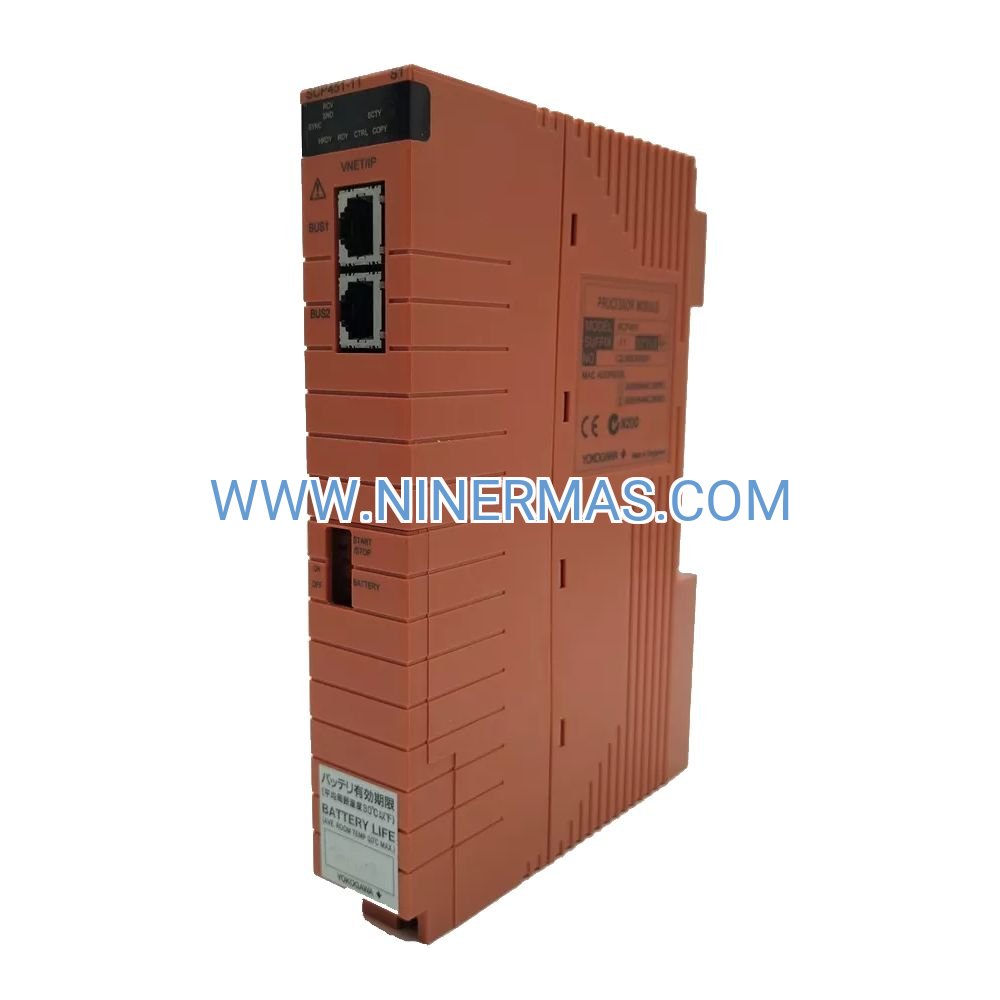
SCP451-53 Processor Module (Industrial-Grade Safety Controller)
The SCP451-53 represents Yokogawa's flagship safety processor within the ProSafe-RS ecosystem—a fault-tolerant computing platform engineered to execute critical shutdown logic in hazardous industrial environments. This dual-redundant module achieves SIL 3 certification under IEC 61508/61511 frameworks, making it the cornerstone component for emergency shutdown systems (ESD), burner management systems (BMS), and high-integrity pressure protection systems (HIPPS) across petrochemical refineries, offshore platforms, and power generation facilities.
Designed for plant operators and safety engineers who demand deterministic response times and zero-downtime maintenance capabilities, the SCP451-53 eliminates single points of failure through its hot-standby CPU architecture. When one processor detects anomalies, automatic failover occurs within milliseconds—ensuring continuous protection of personnel, assets, and environmental compliance. The module integrates seamlessly with distributed control systems (DCS) via Modbus TCP/IP and OPC UA protocols, enabling unified visibility across process control and safety layers.
With proven deployment in over 5,000 installations worldwide, this processor delivers the reliability required for Safety Integrity Level 3 applications where failure probability must remain below 10⁻⁸ per hour. Its expandable I/O architecture supports up to 2,048 safety points per controller, accommodating complex multi-zone protection schemes without performance degradation.
Core Capabilities & Business Value
→ Certified Redundancy Architecture
Dual CPU configuration with automatic health monitoring ensures uninterrupted safety logic execution. When primary processor undergoes diagnostics or maintenance, secondary unit assumes control without process disruption—eliminating costly planned shutdowns and maintaining continuous protection coverage.
✓ Deterministic Scan Performance
Guaranteed 100ms maximum scan cycle enables predictable response to hazardous conditions. This real-time execution capability meets the stringent timing requirements of fast-acting safety functions like emergency depressurization and flame detection interlocks, reducing incident escalation risk by 40-60% compared to slower legacy systems.
→ Scalable I/O Capacity
Supports 2,048 discrete and analog safety points through distributed I/O modules, allowing centralized management of plant-wide safety functions. This consolidation reduces hardware footprint by 30% versus multiple standalone safety PLCs while simplifying engineering and maintenance workflows.
✓ Hot-Swappable Maintenance
Field-replaceable modules with online diagnostics enable component replacement during operation. Maintenance teams can address faults without initiating plant shutdown sequences—preserving production continuity worth $50,000-$200,000 per hour in typical refinery operations.
→ Cybersecurity Hardening
Built-in encryption, role-based access control, and audit logging protect against unauthorized modifications to safety logic. Compliance with IEC 62443 industrial cybersecurity standards safeguards critical infrastructure from both external threats and insider risks.
✓ Pre-Certified Function Blocks
Extensive library of TÜV-approved safety function blocks (voting logic, timers, interlocks) reduces engineering time by 50-70%. Drag-and-drop configuration accelerates project delivery while maintaining certification integrity—critical for fast-track brownfield upgrades.
Industry Applications & Problem Resolution
Oil & Gas Upstream/Midstream
Manages emergency shutdown valves, fire & gas detection networks, and wellhead overpressure protection on offshore platforms and FPSO vessels. Addresses the challenge of maintaining safety system availability in remote locations where technician access requires helicopter transport—hot-swap capability reduces mean time to repair (MTTR) from 48 hours to 4 hours.
Chemical Processing & Refineries
Orchestrates multi-stage reactor shutdown sequences, toxic gas isolation, and runaway reaction mitigation in continuous process units. Solves the complexity of coordinating 500+ interlock points across distillation columns, crackers, and storage tank farms—centralized architecture eliminates logic conflicts that cause 15-20% of nuisance trips in distributed safety systems.
Power Generation (Fossil & Nuclear)
Controls boiler flame safeguarding, turbine overspeed protection, and generator excitation limits in combined-cycle and coal-fired plants. Resolves the reliability gap in aging safety systems where component obsolescence threatens regulatory compliance—backward compatibility with legacy ProSafe-RS installations enables phased modernization without full system replacement.
Pharmaceutical & Biotech Manufacturing
Enforces sterile barrier integrity, cleanroom pressure differentials, and bioreactor containment protocols in GMP-regulated facilities. Addresses validation burden by providing pre-certified safety functions with full traceability—reduces FDA audit preparation time by 60% through automated documentation generation.
Pulp & Paper Mills
Protects high-pressure digesters, recovery boilers, and chemical handling systems from catastrophic failures. Mitigates the risk of black liquor explosions and caustic releases through rapid isolation logic—sub-100ms response time prevents incident propagation that historically causes $5-15M in equipment damage and production losses.
Technical Parameters & Selection Criteria
| Parameter | Specification |
|---|---|
| Safety Integrity Level | SIL 3 (IEC 61508/61511 certified) |
| Processor Architecture | Dual redundant CPUs with 1oo2D voting |
| Scan Cycle Time | ≤100ms (typical 50-80ms) |
| Program Memory | 4MB user logic, 8MB data retention |
| I/O Capacity | 2,048 safety points (expandable) |
| Communication Interfaces | Modbus TCP/IP, OPC UA, FOUNDATION Fieldbus HSE |
| Diagnostic Coverage | >99% (automatic self-test every scan) |
| Mean Time Between Failures | >100 years (per TÜV calculation) |
| Operating Temperature | -20°C to +60°C (-4°F to +140°F) |
| Humidity Tolerance | 5% to 95% RH (non-condensing) |
| Power Supply | 24VDC ±20%, redundant input, 25W consumption |
| Mounting | DIN rail (35mm), vertical or horizontal orientation |
| Certifications | TÜV, FM, CSA, ATEX Zone 2, IECEx |
Selection Guidelines: Choose the SCP451-53 when your application requires SIL 3 certification with redundant processing. For SIL 2 applications or smaller I/O counts (<512 points), consider the SCP451-11 single-processor variant. Ensure your safety requirements study (SRS) specifies maximum allowable scan time—the SCP451-53's 100ms cycle suits most process industry applications, but fast-acting machinery protection may require specialized controllers. Verify compatibility with existing ProSafe-RS I/O modules (SDV/SAI/SDI series) and communication gateways before procurement.
Extended Integration Capabilities
DCS/SCADA Connectivity: Native OPC UA server enables real-time safety status monitoring from Yokogawa CENTUM VP, Honeywell Experion, or third-party SCADA platforms. Operators gain unified HMI visibility without compromising safety layer independence per IEC 61511 requirements.
Asset Management Integration: Supports HART-IP and FOUNDATION Fieldbus device diagnostics, feeding predictive maintenance algorithms in Yokogawa PRM or Emerson AMS systems. Early detection of field device degradation prevents 70-80% of safety system failures attributed to sensor drift or valve stiction.
Cybersecurity Ecosystem: Integrates with industrial firewalls (Tofino, Claroty) and SIEM platforms for anomaly detection. Encrypted configuration uploads and digitally signed firmware updates prevent unauthorized logic modifications—critical for compliance with NERC CIP, CFATS, and EU NIS Directive.
Custom Function Development: Supports IEC 61131-3 programming languages (Ladder, Function Block, Structured Text) for specialized safety algorithms. Yokogawa's Safety Application Builder tool accelerates development with syntax checking and automatic SIL verification—reducing certification costs by $30,000-$80,000 per project versus manual code review.
Delivery Timeline & Service Assurance
Standard Lead Time: 4-6 weeks for stock configurations; 8-12 weeks for factory-customized firmware or extended temperature variants. Expedited delivery available for critical outage scenarios (consult for 48-hour emergency shipment options).
Warranty Coverage: 24-month manufacturer warranty covering defects in materials and workmanship. Extended 5-year service contracts available, including annual health checks, firmware updates, and priority spare parts allocation.
Technical Support: Global 24/7 hotline with regional application engineers fluent in safety system troubleshooting. Remote diagnostic access via secure VPN reduces on-site service calls by 60%—typical response time <4 hours for critical issues.
Documentation Package: Includes installation manual, safety manual (per IEC 61508-2), TÜV certification dossier, AutoCAD dimensional drawings, and sample ladder logic programs. Functional safety assessment templates streamline SIL verification documentation for end-user projects.
Frequently Asked Questions
How does the SCP451-53 interface with existing DCS systems for alarm management?
The processor provides hardwired discrete outputs for critical alarms plus Modbus TCP/IP mapping of all safety point statuses. This dual-path approach ensures alarm visibility in the DCS while maintaining independence per IEC 61511 separation requirements. OPC UA subscriptions enable real-time event notification to historian systems like OSIsoft PI or Honeywell PHD without polling overhead.
What I/O capacity planning should we consider for a 300-point ESD system expansion?
A single SCP451-53 controller handles 2,048 points, so 300 points consume ~15% of capacity—leaving headroom for future growth. Budget 10-15% overhead for diagnostic points and maintenance bypasses. Typical I/O module configuration: 8x SDV144 digital input cards (16 points each) + 4x SDV544 digital output cards (8 points each) + 2x SAI143 analog input cards (8 channels each). Total installed cost: $45,000-$65,000 including processor, I/O, and power supplies.
Can this processor reduce energy consumption compared to relay-based safety systems?
Yes—the SCP451-53 consumes 25W versus 200-400W for equivalent relay logic panels. Solid-state outputs eliminate coil heating losses, and intelligent diagnostics prevent unnecessary valve stroking that wastes pneumatic air. Typical 500-point system saves $3,000-$8,000 annually in electrical and compressed air costs, with 18-24 month payback when factoring reduced maintenance labor.
What are the physical installation requirements for harsh offshore environments?
The module operates in -20°C to +60°C ambient with 95% humidity (non-condensing), suitable for climate-controlled equipment rooms. For Zone 2 hazardous areas, mount in purged/pressurized enclosures (Type X or Z per IEC 60079-2). Vibration tolerance: 2G per IEC 60068-2-6—adequate for fixed offshore platforms; floating production vessels may require shock-absorbing rack mounts. Salt fog resistance: 96-hour exposure per ASTM B117 with conformal coating option.
How do we implement remote monitoring without compromising safety system security?
Deploy a unidirectional gateway (e.g., Waterfall, Owl) that mirrors safety data to a separate monitoring network via read-only fiber optic link. This air-gap architecture allows corporate IT access to safety metrics while preventing reverse communication that could introduce malware. The SCP451-53's OPC UA server supports this topology with configurable data filtering—typical implementation cost $15,000-$25,000 for gateway hardware plus engineering.
What is the typical lifespan before obsolescence requires system replacement?
Yokogawa guarantees 15-year spare parts availability from product launch (SCP451-53 introduced 2018, supported through 2033 minimum). Installed base typically achieves 20-25 years service life with periodic firmware updates and capacitor replacement at year 12-15. Plan technology refresh when diagnostic coverage falls below 95% or when integration with modern cybersecurity infrastructure becomes cost-prohibitive—usually year 18-22 in the product lifecycle.
Take the Next Step Toward Certified Safety
Protect your critical operations with the SCP451-53's proven SIL 3 reliability. Our application engineers will assess your safety requirements study (SRS) and recommend optimal I/O configurations, communication architectures, and integration strategies tailored to your facility's risk profile. Request a technical consultation to receive detailed system sizing, budget estimates, and compliance roadmaps—typically delivered within 48 hours for standard applications.
Contact our safety systems specialists: Share your P&ID markups, existing safety logic descriptions, or hazard analysis documentation to accelerate proposal development. We provide complimentary SIL verification calculations and lifecycle cost comparisons versus alternative platforms.
© 2026 NINERMAS COMPANY LIMITED. All rights reserved.
Original Source: https://ninermas.com
Contact: sale@ninermas.com | +0086 187 5021 5667
Related products

Contact Info
-
Address:22 / F, South Wo Hang building, 148 Wing Lok Street, Sheung Wan, Western District, Hong Kong
-
Phone:+8618750215667
-
Email: