


Description
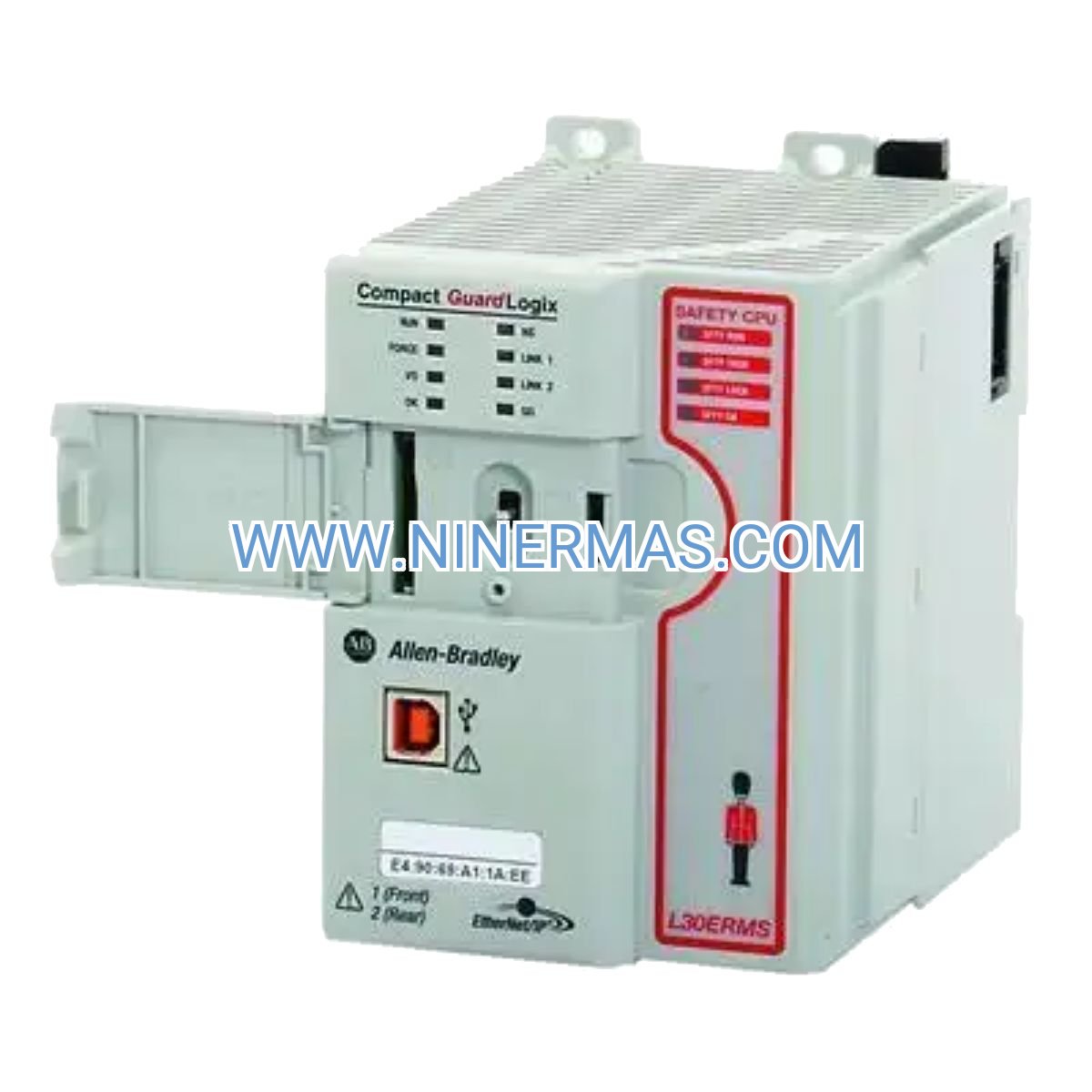
1769-L37ERMS GuardLogix Safety Controller (Industrial-Grade Programmable Logic Controller)
The 1769-L37ERMS is an industrial-grade programmable safety controller designed for mission-critical automation systems that demand both standard control and integrated safety functionality. Built on the CompactLogix platform, this GuardLogix controller combines 4MB of user memory with 1.5MB of dedicated safety memory, delivering the processing power needed for complex machine safety applications while maintaining seamless integration with existing control architectures.
Engineered for manufacturers who cannot compromise on safety compliance or operational uptime, the 1769-L37ERMS addresses the challenge of managing safety interlocks, emergency stops, and protective devices within a unified control framework. This controller eliminates the need for separate safety relay systems, reducing panel space, wiring complexity, and commissioning time by up to 40%.
Target users include automation engineers, machine builders, and plant managers in automotive assembly, packaging machinery, material handling, and process industries where SIL 3 / PLe safety ratings are mandatory. The dual EtherNet/IP ports enable flexible network topologies while the Studio 5000 programming environment provides a single development platform for both safety and standard logic—streamlining validation, reducing training costs, and accelerating time-to-market.
Core Features & Benefits
→ Dual-Memory Architecture: 4MB standard memory handles complex motion control, process logic, and HMI communications, while 1.5MB safety memory executes certified safety functions—enabling one controller to replace multiple devices and reduce BOM costs by 25-35%.
✓ SIL 3 / PLe / Category 4 Certification: Meets the highest industrial safety standards (IEC 61508, ISO 13849) for applications requiring functional safety validation, eliminating costly third-party safety systems and simplifying compliance documentation.
→ Integrated Dual EtherNet/IP Ports: Supports linear and Device Level Ring (DLR) topologies without external switches, reducing network infrastructure costs while providing deterministic communication for time-critical safety I/O with <10ms response times.
✓ Unified Programming Environment: Studio 5000 Logix Designer consolidates safety and standard logic development in a single project file, cutting programming time by 30% and eliminating version control issues between separate safety systems.
→ Scalable I/O Capacity: Supports up to 30 local CompactLogix modules plus unlimited distributed I/O via EtherNet/IP, allowing systems to grow from 128 to 4,000+ I/O points without controller replacement.
✓ Advanced Safety Instruction Set: Pre-validated safety function blocks for light curtains, safety mats, two-hand control, safe torque-off (STO), and emergency stop circuits reduce development time from weeks to days while ensuring code reliability.
Application Scenarios
Automated Assembly Lines: In automotive body shops, the 1769-L37ERMS manages robotic welding cells with integrated safety zones. When operators enter protected areas, the controller executes safe stop sequences while maintaining production data logging—eliminating the 15-20 second restart delays common with hardwired safety relays and improving OEE by 3-5%.
High-Speed Packaging Machinery: Pharmaceutical packaging lines use this controller to coordinate product flow with safety light curtains and interlocked access doors. The safety logic validates all protective devices in <8ms while standard logic manages servo drives, vision systems, and serialization—reducing machine footprint by 40% compared to separate safety PLC architectures.
Material Handling & AGV Systems: Distribution centers deploy the 1769-L37ERMS to control conveyor networks with safety scanners and emergency pull cords. The controller's dual Ethernet ports create redundant communication paths, ensuring that a single cable fault doesn't halt operations—a critical requirement for 24/7 facilities where downtime costs exceed $10,000/hour.
Process Industry Skid Systems: Chemical processing skids integrate this GuardLogix controller to manage both process control (temperature, pressure, flow) and safety instrumented functions (SIF) such as overpressure protection and emergency isolation valves. This consolidation reduces panel space by 60% and simplifies FAT/SAT validation procedures.
Machine Tool & Press Applications: Metal fabrication shops use the 1769-L37ERMS to control hydraulic presses with two-hand control stations and light curtain muting sequences. The safety memory stores certified logic that cannot be altered without password protection, satisfying OSHA and insurance requirements while the standard memory handles recipe management and production tracking.
Technical Parameters & Selection Guide
| Parameter | Specification | Application Impact |
|---|---|---|
| User Memory | 4MB standard / 1.5MB safety | Supports 100+ safety I/O points + complex motion control |
| Safety Rating | SIL 3, PLe, Category 4 | Qualifies for highest-risk machinery applications |
| Communication | Dual EtherNet/IP (10/100 Mbps) | Enables DLR topology, reduces switch requirements |
| Local I/O Capacity | 30 modules (1769 chassis) | Typical machine uses 12-18 modules, allows expansion |
| Scan Time | Configurable 1-500ms | Fast scans for high-speed packaging, slower for process |
| Operating Temp | 0-60°C (32-140°F) | Suitable for climate-controlled industrial environments |
| Certifications | UL, CSA, CE, API 670, ISO 20816 | Global compliance for multinational deployments |
| Programming | Studio 5000 Logix Designer v21+ | Requires software license, training investment |
Selection Criteria: Choose the 1769-L37ERMS when your application requires 50-150 safety I/O points and moderate standard I/O (up to 500 points). For smaller safety systems (20-50 points), consider the 1769-L30ERMS with 1MB/0.5MB memory. For larger systems exceeding 200 safety points, evaluate the ControlLogix GuardLogix platform (1756-L7xS series) which offers 5MB+ safety memory and redundancy options.
Extended Functions
IoT & Remote Monitoring Integration: The controller's EtherNet/IP interface connects to FactoryTalk View HMI systems and cloud-based analytics platforms via secure gateways. Real-time safety system diagnostics can be pushed to mobile devices, enabling predictive maintenance alerts when safety device response times drift outside acceptable ranges—preventing unplanned shutdowns.
Advanced Motion Coordination: When paired with 1769-SDN DeviceNet scanner or POINT I/O adapters, the 1769-L37ERMS coordinates up to 32 servo axes with integrated safety motion functions including Safe Torque Off (STO), Safely Limited Speed (SLS), and Safe Direction (SDI)—critical for collaborative robot applications.
Customization Options: OEM machine builders can leverage the controller's user-defined safety function blocks to create proprietary safety sequences that differentiate their equipment. Custom safety logic can be password-protected and compiled into Add-On Instructions (AOIs) for IP protection and simplified deployment across machine families.
Delivery & Service Assurance
Lead Time: Standard delivery is 3-5 business days for in-stock units via express courier (DHL, FedEx). Custom-configured controllers with pre-loaded firmware or project files ship within 7-10 business days. Expedited same-day shipping available for critical breakdown situations (additional fees apply).
Warranty Coverage: All 1769-L37ERMS controllers include a comprehensive 12-month warranty covering manufacturing defects, component failures, and firmware issues. Warranty includes advance replacement service—we ship a replacement unit before receiving the defective controller to minimize your downtime.
Technical Support: Our application engineers provide pre-sales consultation for system architecture design, I/O sizing, and network topology planning. Post-purchase support includes troubleshooting assistance, firmware upgrade guidance, and Studio 5000 programming tips via email, phone, or remote desktop sessions.
Documentation Package: Each controller ships with installation quick-start guide, safety validation checklist, and links to downloadable resources including user manuals (publication 1769-UM021), safety reference manual (1756-RM093), and sample safety programs. Certificate of conformity and calibration records available upon request for regulated industries.
Frequently Asked Questions
How does the 1769-L37ERMS compare to standalone safety relay systems?
Integrated GuardLogix controllers reduce panel space by 50-70% compared to modular safety relay systems, eliminate inter-device wiring, and provide superior diagnostics. While initial controller cost is higher ($3,000-4,000 vs. $800-1,200 for relay modules), total installed cost is typically 20-30% lower when factoring in engineering time, panel fabrication, and commissioning labor. Additionally, safety logic changes can be implemented via software updates rather than physical rewiring.
What are the power requirements and backup options for this safety controller?
The 1769-L37ERMS requires a 1769-PA2 or 1769-PA4 CompactLogix power supply (24VDC input, 2A or 4A output). For applications requiring battery backup during power failures, integrate an uninterruptible power supply (UPS) rated for 150W minimum. The controller's non-volatile memory retains programs and data during power loss, but active safety monitoring requires continuous power—UPS runtime of 15-30 minutes is typical for orderly shutdown sequences.
Can I retrofit this controller into existing CompactLogix systems without safety?
Yes, the 1769-L37ERMS is mechanically and electrically compatible with standard CompactLogix chassis and I/O modules. However, you must add safety-rated I/O modules (1769-IQ16S, 1769-OB16S, etc.) for safety functions and upgrade to Studio 5000 Logix Designer with GuardLogix safety instruction set. Existing standard I/O and programs can be reused, but safety logic must be developed separately and validated per IEC 61508 requirements. Budget 40-80 hours for safety system integration and validation testing.
What network bandwidth is needed for safety I/O communication?
CIP Safety protocol over EtherNet/IP requires deterministic bandwidth allocation. A typical safety system with 20-30 safety I/O modules consumes 15-25% of a 100Mbps Ethernet segment's bandwidth when configured for 10ms safety update rates. For systems with 50+ safety points or <8ms update requirements, implement a dedicated safety network segment or upgrade to Gigabit Ethernet infrastructure. Use Rockwell's Network Capacity Tool (NCT) for precise bandwidth calculations.
Is remote programming and monitoring of safety logic permitted?
Remote access to safety logic is allowed under IEC 61508 provided that secure authentication, encrypted communication (VPN), and audit logging are implemented. Studio 5000 supports remote programming via FactoryTalk Linx Gateway with role-based access control. However, final safety validation and commissioning must be performed on-site with physical verification of safety device functionality. Many jurisdictions require that safety logic modifications be approved by qualified safety engineers and documented in the safety validation report.
How do I handle safety controller firmware updates in production environments?
Firmware updates should be performed during scheduled maintenance windows using Studio 5000's ControlFLASH utility. Critical steps: (1) Back up current project and controller configuration, (2) Verify new firmware compatibility with installed I/O modules, (3) Test updated firmware in offline simulation or spare controller, (4) Perform firmware update with machine in safe state (lockout/tagout), (5) Re-validate safety functions per original validation protocol. Major firmware revisions may require re-certification—consult your safety validation documentation and local regulatory requirements before updating production safety systems.
Take the Next Step
Ready to integrate proven safety control into your automation system? Contact our application engineering team for a no-obligation consultation. We'll review your safety requirements, recommend the optimal GuardLogix configuration, and provide a detailed quotation including controller, I/O modules, and programming software. For urgent breakdown situations, ask about our 24-hour emergency replacement service.
Request a Quote: Email your machine specifications and safety I/O list to sale@ninermas.com
Technical Questions: Call +0086 187 5021 5667 (English/Mandarin support, Mon-Fri 8AM-6PM CST)
Documentation: Download datasheets, user manuals, and sample safety programs from our technical library
© 2026 NINERMAS COMPANY LIMITED. All rights reserved.
Original Source: https://ninermas.com
Contact: sale@ninermas.com | +0086 187 5021 5667
PDF Specification
Download PDF file here:
Click to Download PDFRelated products

Contact Info
-
Address:22 / F, South Wo Hang building, 148 Wing Lok Street, Sheung Wan, Western District, Hong Kong
-
Phone:+8618750215667
-
Email:
