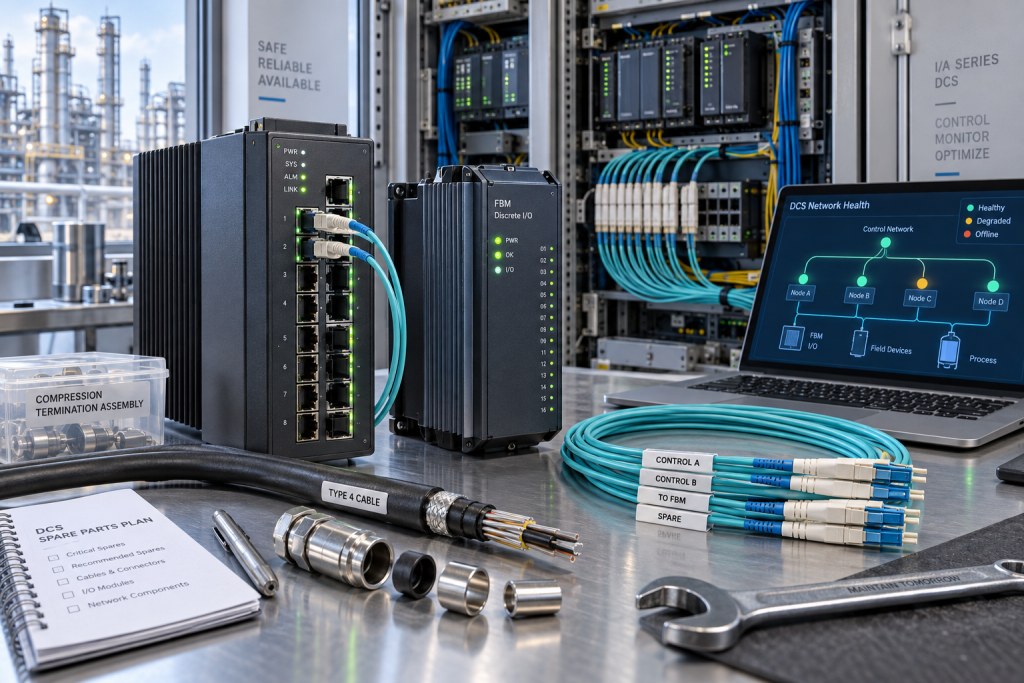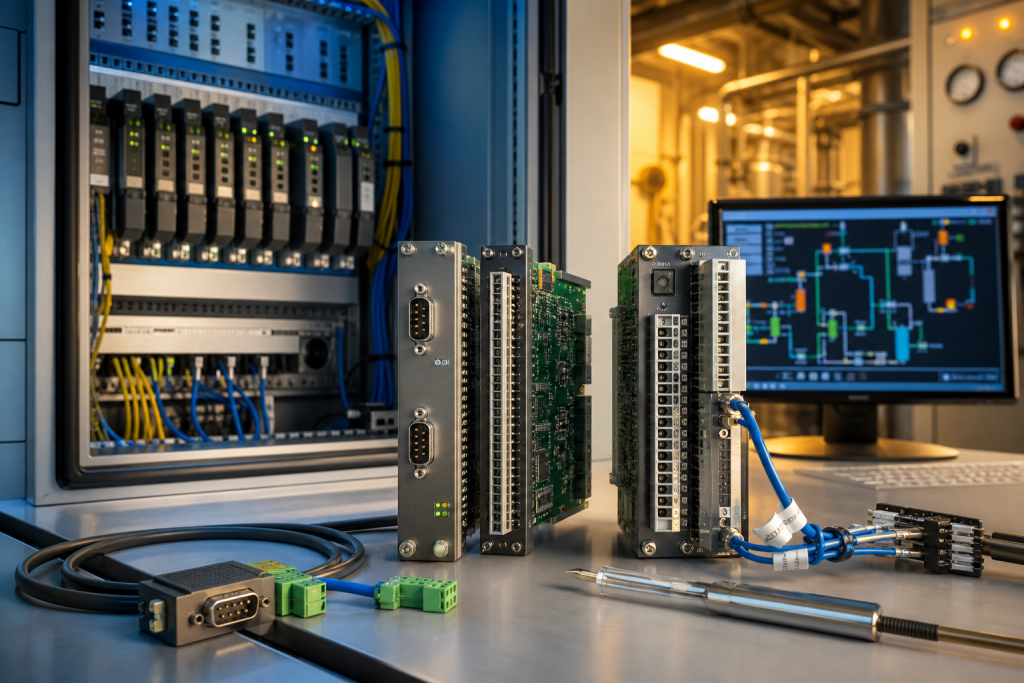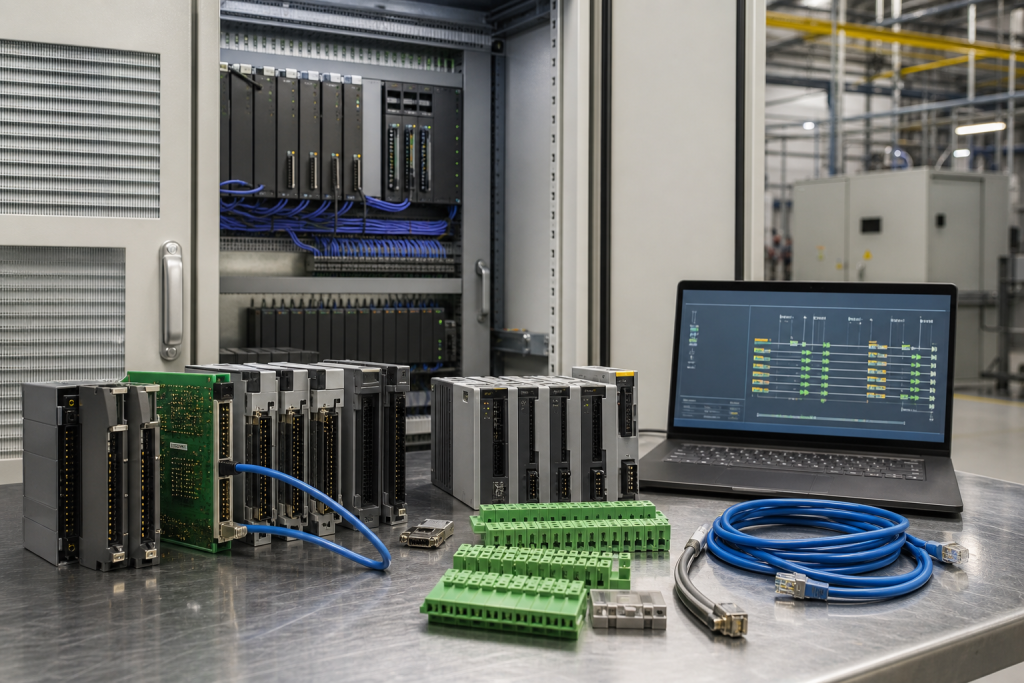
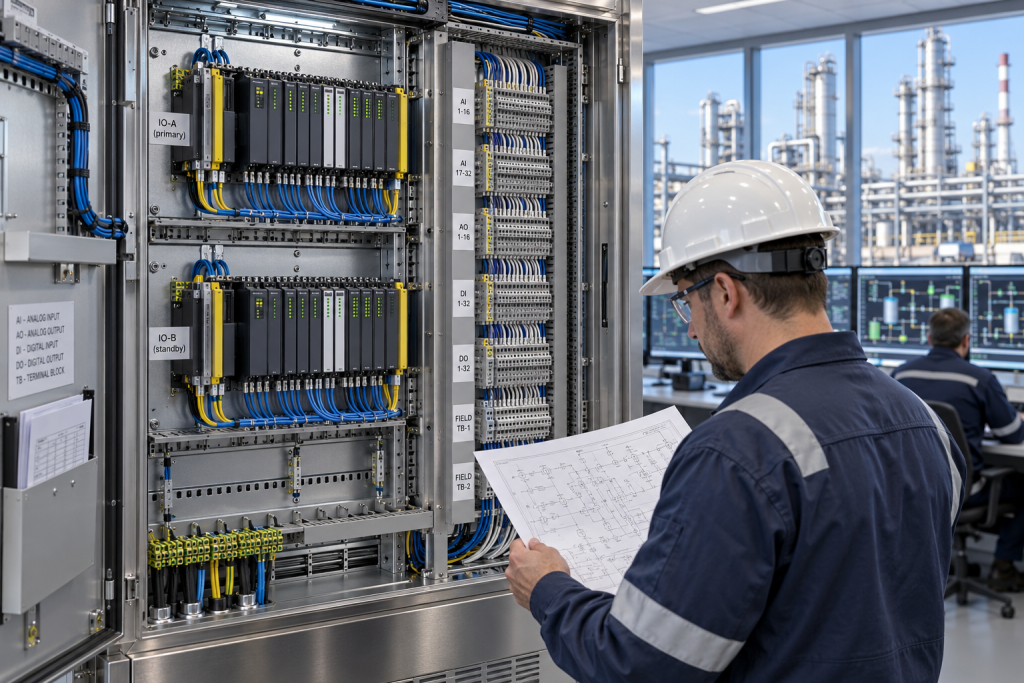
A process value that freezes, drifts, or drops out can send a maintenance team toward the I/O card almost immediately. That is understandable: the controller reports a channel fault, the operator sees a bad value, and the outage clock is already running. Yet an I/O module is only one point in a longer path that includes field power, device electronics, cable, marshalling, terminal connections, carrier, controller configuration, and the operator display. Replacing the card before establishing where the signal is lost can consume the outage window without fixing the loop.
This is particularly important on installed DeltaV systems, where a plant may have years of proven configuration and many modifications accumulated across project phases. The best spare decision starts with the loop, not the supplier catalog. Preserve enough evidence to distinguish a failed channel from a wiring, termination, field-device, or configuration problem.
Start with the loop record
Record the tag, service, signal type, channel number, module and carrier identity, cabinet, terminal block, controller, and the last time the value was known good. Photograph the faceplate, status LEDs, module label, terminal positions, and any maintenance bypass. Export the relevant event and diagnostic records before clearing alarms. Compare the live engineering configuration with the approved loop drawing and note any field changes that have not reached the drawing set.
For an analog input, capture the raw counts or engineering-unit value, loop current, transmitter status, and whether the problem follows the instrument or remains at the channel. For a digital input, record the wetting voltage, contact state, debounce or filtering, and the sequence of events. For an output, capture the commanded value, channel diagnostics, measured output current or voltage, and the actuator response. Do not infer a failed card from the faceplate alone.
Separate the field side from the controller side
Use the approved isolation and test procedure. Check field supply, fuse condition, grounding, shield termination, continuity, terminal tightness, and signs of heat or corrosion. Confirm whether neighboring channels share a common or supply. If several channels fail together, a shared power or terminal path becomes more plausible than multiple simultaneous module failures. If only one point is affected, compare it with a healthy channel of the same signal type and configuration.
Where safe and permitted, test the field device and cable independently from the controller input. Then test the channel using an approved simulator. A fault that follows the field device points toward the instrument or process connection; a fault that remains with a channel after a controlled substitution is stronger evidence for module or carrier investigation. Preserve the original wiring labels and return each connection exactly as found.
Define what the replacement must match
A spare request needs more than a family name. Include the complete part number, revision, signal class, channel density, terminal arrangement, carrier compatibility, installed firmware or system generation where relevant, and whether the point participates in a safety or regulatory function. State whether the requested condition is new, repaired, or tested used, and specify what test evidence is required. A substitution must be approved against the plant configuration rather than assumed from a similar product photograph.
The Emerson KJ2101X1-BA 12P2690X012 I/O interface is a published example of a DeltaV-related interface item. Before sourcing any interface or I/O spare, verify its actual position in the installed assembly, associated carrier and terminal path, and the signal function it supports. Request clear label photographs and a written condition statement; do not rely on a marketplace title as an engineering cross-reference.
Make the outage test observable
Before the shutdown, agree who owns the configuration backup, who authorizes the swap, what process state permits testing, and how the loop will be returned to service. Record the as-found condition, replacement serial or date code, terminal torque or inspection requirements, and the test instrument. At commissioning, verify channel diagnostics, raw and scaled values, alarm limits, controller logic response, historian update, operator indication, and final-element response where applicable.
For an output loop, prove the complete path rather than only forcing a value on a workstation. Confirm the output at the terminal, the device movement, feedback, interlocks, and the expected fail position. For an input loop, compare a calibrated stimulus with the displayed engineering value at multiple points across the operating range. Capture as-left results so the next shift can see what was actually demonstrated.
Do not close the work order just because the channel returned to normal. Observe the loop through a representative operating period, check for intermittent noise or drift, and review alarms for recurrence. Tag the removed component and retain it until the root-cause review decides whether it should be repaired, tested, or scrapped. A controlled failure record improves both the spare list and the next maintenance response.
Questions engineers ask before ordering
Does a bad DeltaV value prove the I/O card has failed?
No. The fault may be in field power, instrument, cable, terminal, carrier, configuration, or scaling. Test the path in sections and preserve diagnostics before replacing hardware.
What details should an urgent I/O RFQ include?
Send the complete part number and revision, system generation, signal type, channel role, installed carrier, condition expectation, quantity, required date, and label photographs.
Can we move a known-good channel to test the suspect module?
Only under an approved change and isolation procedure. Confirm signal compatibility, document the temporary change, and restore and verify the original configuration afterward.
What proves the loop is ready after a replacement?
Document channel diagnostics, calibrated input or output checks, logic and alarm behavior, field-device response, historian and operator indication, and the final restored process state.
Buy evidence, not just a part number
Good I/O spare planning turns an ambiguous alarm into a repeatable diagnostic and acceptance process. If a DeltaV point is unstable or a shutdown is approaching, send the module label, loop drawing, diagnostics, and required date to NINERMAS. We can help check the published part match and prepare a focused quotation without replacing the plant’s engineering approval process.
© 2026 NINERMAS. All rights reserved. Official Website: https://NINERMAS.com Inquiry: sale@NINERMAS.com | WhatsApp/Tel: +86 187 5021 5667
Next Step
Move the research into a cleaner RFQ.
Send the part number, quantity, condition expectation, destination, and timing details so the sourcing team can reply with better availability and lead-time context.