
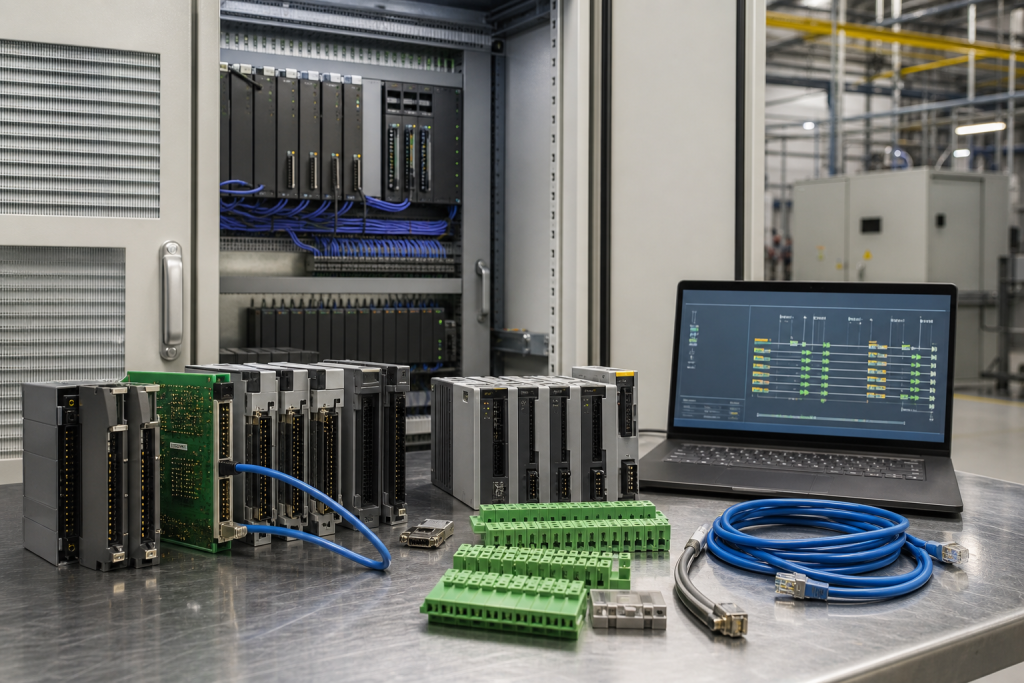
A DCS communication loss rarely announces itself as one clean hardware failure. A Yokogawa CENTUM node may show missing I/O, stale operator values, intermittent diagnostics, or a controller path that looks healthy until the process is placed under load. That is why a node-interface spare should be selected from the installed communication path, not from a short model description.
NINERMAS readers maintain systems where an old DCS cabinet can still run a profitable unit for years if the spare evidence is kept current. The practical question is not whether the platform is modern. It is whether maintenance can replace the right module, restore the right path, and prove the process values are credible after the change.
Map The Node Before Selecting Hardware
Record the cabinet, node, rack, interface role, power path, communication cable, paired I/O cards, firmware or revision evidence, terminal assemblies, process unit, alarm history, and the consequence of losing each connected signal.
The live Yokogawa SNT401-53 S1 node-interface reference is a product match for the communication side of the RFQ. Compare rack role, node addressing, connector condition, revision, and installed network path before approval.
Photograph module labels, side labels, rack slots, communication connectors, terminal blocks, cable tags, diagnostic LEDs, cabinet power, and workstation alarms. Export or capture the current node diagnostics while the failure evidence is fresh.
I/O Cards Shape The Recovery Test
A node interface can be replaced correctly while a downstream output card, terminal block, field supply, or cable fault remains unresolved. The recovery plan should include the I/O cards that define the process consequence.
The related Yokogawa SDV531-S13 S1 digital output reference shows why module-level spares should be tied to the field signals they support, not stored as anonymous cabinet parts.
Ask suppliers to separate exact replacement, tested exchange, repaired unit, refurbished stock, and substitute. Each option should state actual condition, included accessories, connector state, test scope, dispatch timing, and unresolved compatibility questions.
Acceptance Means Credible Process Values
After replacement, verify node recognition, communication status, I/O card diagnostics, power stability, bad-value flags, alarms, operator visibility, sequence permissives, and a controlled field or simulation test.
If the operator screen clears but a field value does not behave correctly, review terminal wiring, output load, field power, scaling, loop drawings, and the paired I/O card before signing off the node spare.
Store the spare record with photos, node map, I/O list, diagnostics, revision note, recovery test, and the controls engineer who approved the return to service.
What The RFQ Should Prove
Send the exact module label, rack and node photos, communication path, connected I/O list, terminal photos, condition requirement, test expectation, and outage deadline.
Ask for actual-item photos rather than relying only on a family name. In legacy DCS work, connectors, revision marks, and physical condition often decide whether the spare can be used quickly.
If the supplier proposes a substitute, require a clear explanation of what must be checked: firmware, rack compatibility, terminals, configuration, and the acceptance test that will prove credible process values.
The useful discipline is to keep identity, function, and approval separate. Identity says what the part is. Function says what the plant expects it to restore. Approval says who can accept the risk when one detail differs.
For older control systems, the cheapest mistake is usually made before the order: a photo is missing, a firmware note is assumed, a cable is treated as generic, or a tested exchange is compared with an untested used item. Those small gaps become expensive only when the cabinet is open.
Ask for actual-item photographs when the schedule is tight. Front labels, side labels, terminals, connectors, latch points, power markings, and accessory scope often reveal more than a polished catalog description.
The purchasing record should travel with the spare after it arrives. If the item goes into stores without the evidence that justified the purchase, the next maintenance team has to repeat the same work under worse conditions.
Do not let the word compatible replace engineering judgment. Compatible can mean electrically similar, physically similar, repairable, configurable, or only suitable after a migration review. Spell out which meaning applies.
A good spare plan also names the fallback. If the replacement fails bench checks or field acceptance, the plant should know whether it will reinstall the old item, use a repaired exchange, isolate a noncritical function, or escalate to a migration decision.
The article topic should also connect to real search intent. Maintenance engineers are usually not searching for theory; they are searching because a rack, network segment, safety channel, drive axis, or loop is already fragile. Write the RFQ around that pressure.
Condition language needs discipline. New surplus, factory sealed, refurbished, repaired exchange, tested used, and untested used items do not carry the same risk. A buyer should ask which condition is being offered before comparing lead time or price.
Accessory scope is another common trap. Terminal blocks, memory cards, SFP modules, connectors, mounting clips, cables, batteries, license media, and configuration files may be outside the base item. Name them early so the spare can be installed, not merely received.
For critical equipment, the acceptance method should be written before the purchase order is approved. A loop test, axis jog, proof test, node diagnostic check, or network failover test tells the supplier and the plant what ready actually means.
Document the unresolved points openly. If firmware is unknown, configuration is unavailable, or a substitute requires engineering review, the RFQ can still move forward, but the risk should remain visible instead of disappearing into the quote notes.
This approach does not slow procurement down; it gives procurement something precise to send. A well-documented request usually gets a more useful response because the supplier can confirm exact stock, repair path, or substitute limits without guessing.
FAQ
What must match on a Yokogawa CENTUM node-interface spare?
Match rack role, node path, communication connector, revision, power, paired I/O cards, terminal scope, diagnostics, and recovery-test method.
Can a similar Yokogawa module be used?
Only after the installed node role, firmware or revision, terminals, communication path, and controls approval are checked.
What should procurement send with the RFQ?
Send labels, rack photos, node map, connected I/O list, diagnostics, condition requirement, test scope, and outage deadline.
What proves recovery?
Stable node communication, recognized I/O, credible process values, clear diagnostics, restored alarms, and approved field or simulation testing.
Send NINERMAS the Yokogawa module labels, node and rack photos, connected I/O list, diagnostics, condition requirement, and outage deadline. We can help prepare a traceable CENTUM spare RFQ.
© 2026 NINERMAS. All rights reserved. Official Website: https://NINERMAS.com Inquiry: sale@NINERMAS.com | WhatsApp/Tel: +86 187 5021 5667
Next Step
Move the research into a cleaner RFQ.
Send the part number, quantity, condition expectation, destination, and timing details so the sourcing team can reply with better availability and lead-time context.