
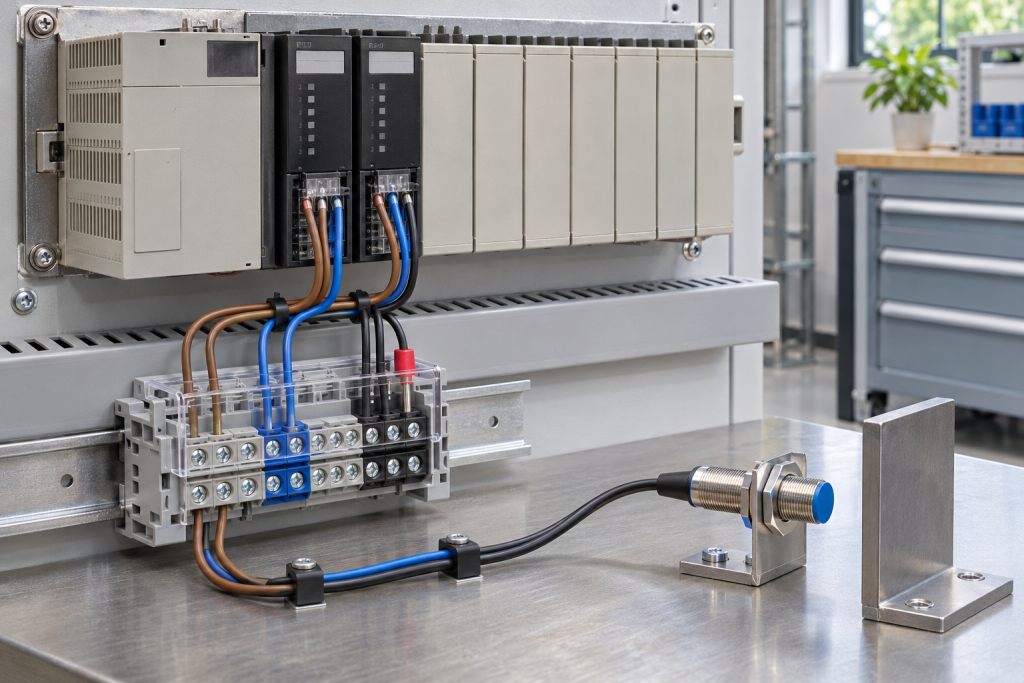
A replacement input module can fit the rack, accept the terminal block and still be wrong for the sensors attached to it. On an SLC 500 installation, the distinction between a sinking input and a sourcing input is an electrical interface requirement, not a purchasing preference. Counting sixteen channels and reading 24 V DC on a label does not resolve that requirement.
This is an evergreen identification guide for maintenance and spare-parts teams. Its objective is to preserve the existing current path before a replacement is ordered. It is not a wiring instruction for a live cabinet, an authorization to convert sensor types, or a statement that legacy hardware can perform a safety function.
Identify which device supplies the signal current
In a typical DC sensor circuit, a sourcing sensor output delivers current toward the receiving input; a sinking sensor output provides a path toward the negative supply. The input module must provide the complementary path. PNP and NPN descriptions usually help identify the sensor output, but the actual manufacturer wiring diagram remains the deciding evidence. Wire colors alone are not a reliable substitute for that diagram.
Rockwell’s SLC remote I/O documentation identifies 1746-IB16 as a DC sinking input and 1746-IV16 as a DC sourcing input. The SLC hardware migration reference also illustrates the different common connections. These are established product distinctions, not a newly announced change.
For an installed sinking-input circuit, the 1746-IB16/C input-module listing is a candidate to identify against the original module and approved records. Its presence in a catalog is not proof that the sensor, terminal arrangement, series and application have already been checked.
Make the common connection visible in the record
A useful spare record shows more than the module front. Capture the complete catalog number and series, the rack and slot designation, the terminal legend, the associated power supply and the field sensor reference. Include the drawing revision and any documented modifications. A clear photograph taken under the plant’s safe-access procedure often resolves an ambiguity that a typed stock description misses.
Separate three items in the drawing review: the sensor’s supply connections, its switched output and the module’s common. A conductor marked zero volts elsewhere in a cabinet does not establish that it belongs to this particular input group. Likewise, a shield or protective-earth connection must not be treated as a convenient signal return. Trace against controlled documentation; do not improvise a new common to make a test pass.
The 1746-IV16/C sourcing-input option belongs in a separately identified spare requirement when that is the installed electrical arrangement. It should not be offered as an interchangeable sixteen-point alternative to an IB16 solely because the enclosure looks familiar.
Separate a sensor fault from an interface mismatch
When a channel does not change state, preserve the observed conditions before moving parts. Record whether the fault affects one signal, a group sharing a supply, or the entire module. Note the field device indication, module indication and PLC value separately. Agreement between two of those observations does not automatically establish the condition of the third.
A qualified technician can then plan appropriate checks using the exact equipment manuals and the site’s electrical safety procedure. Those checks may address supply availability, conductor continuity, terminal condition, sensor operation and the input path. The test must use the intended reference point and an approved instrument. Do not bridge terminals, inject an arbitrary voltage or swap a powered module as an informal diagnostic shortcut.
If several channels fail together immediately after a replacement, compare the input family and common arrangement early. If one channel failed before any work occurred, investigate its field circuit rather than assuming a family-wide compatibility issue. This distinction keeps the spare request tied to evidence instead of the most recent component touched.
Write an RFQ that prevents an accidental conversion
The request should name the installed part, series, required condition and included terminal hardware. Add a plain statement of the circuit requirement: sinking input serving the documented sourcing field outputs, or sourcing input serving the documented sinking outputs. Attach the relevant drawing excerpt without exposing unrelated plant network details.
Ask the supplier to separate exact-match offers from proposed alternatives. An alternative needs an engineering review of electrical behavior, connector mapping, rack compatibility, software configuration and acceptance testing. A purchasing substitution is not the right mechanism for authorizing a sensor conversion. Keep commercial approval and technical approval as distinct records.
Receiving inspection should reconcile the offered identity with the delivered label before the spare enters general stock. Record discrepancies, damaged terminals and missing accessories. If a functional report is supplied, check which channels and circuit conditions it actually covers. A generic powered-on photograph does not demonstrate every input path.
Frequently asked questions
Can IB16 and IV16 share one spare-stock code?
They should remain separately identifiable because the input current paths differ. A warehouse grouping may be useful for locating SLC hardware, but the issue record must preserve the exact catalog number and electrical requirement. Similar appearance is not an engineering equivalence approval.
Does a lit sensor indicator prove the PLC input is healthy?
No. The indicator describes something about the sensor, not the complete circuit. The switched output, cable, common connection, input electronics and PLC interpretation still need to be considered. Record the indications independently before deciding which component requires replacement.
Should the field wiring be changed to use an available module?
Not as an unreviewed repair. That would change the established circuit and may affect other devices sharing its supply or common. Treat any conversion as a controlled engineering change with updated drawings and an approved verification plan, not a shortcut around a stock shortage.
What information should accompany a sourcing inquiry?
Provide readable module and sensor labels, the rack position, terminal arrangement and controlled wiring reference. State the required supplied accessories and whether an exact match is mandatory. Send those details to NINERMAS so the quotation can address the actual input circuit rather than channel count alone.
Image: AI-generated editorial illustration, not an exact product photograph or installation reference.
© 2026 NINERMAS. All rights reserved. Official Website: https://ninermas.com Inquiry: sale@ninermas.com | WhatsApp/Tel: +86 18750215667
Next Step
Move the research into a cleaner RFQ.
Send the part number, quantity, condition expectation, destination, and timing details so the sourcing team can reply with better availability and lead-time context.