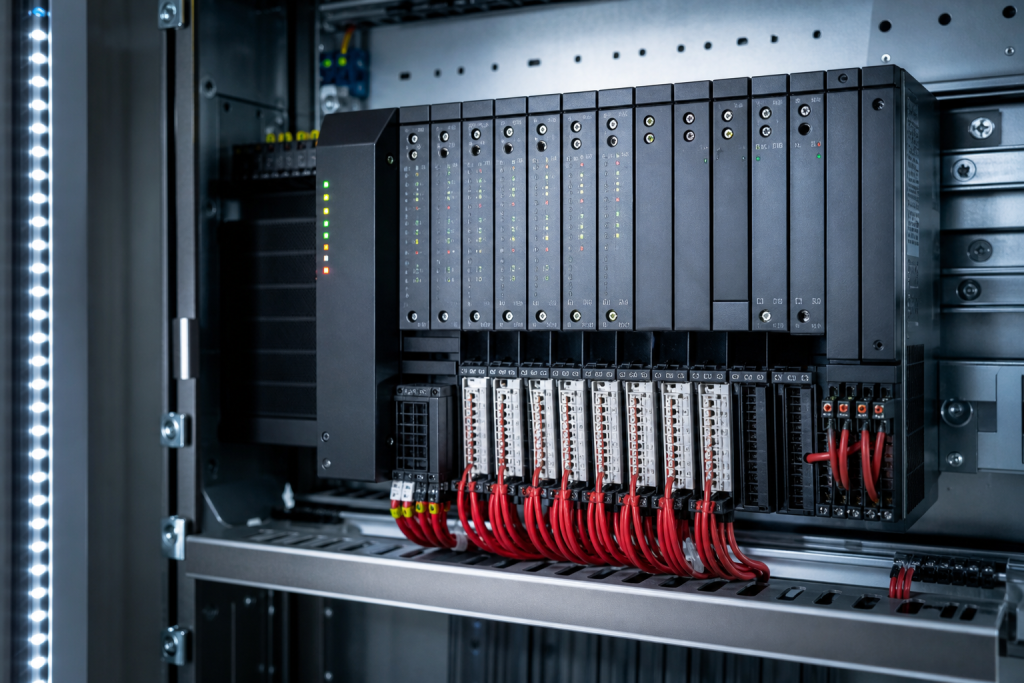

A turbine protection alarm is not an invitation to pull the first board whose prefix looks familiar. In a Mark VI installation, primary control, independent protection, termination, voting and trip actuation are separate parts of a larger safety function. A fault can originate at the speed pickup, field wiring, terminal board, protection module, configuration or trip circuit. Replacing a board before locating the boundary can remove useful evidence and, more seriously, disturb a protection function that must remain available. Treat the nameplate as the start of identification, not the end of engineering review.
Start with the protection architecture
Use the approved system drawing and site cause-and-effect documentation to establish whether the questioned assembly belongs to the primary control path or an independent protection path. GE Mark VI documentation describes distinct turbine control and protection functions, with terminal assemblies carrying signals to the relevant modules and trip devices. Confirm the installed architecture from the actual project record; configurations differ by turbine, rack, protection arrangement and retrofit history. Record cabinet, rack and slot, the exact board label, revision, connector arrangement, adjacent modules and every cable designation before discussing a replacement.
Distinguish a board fault from a field-path fault
Correlate the first alarm with the first affected signal. A speed-channel disagreement, loss of a pickup, board diagnostic, network status fault and trip-circuit alarm point to different boundaries. Compare the three speed inputs and their event timestamps against the approved logic and redundancy design. Inspect the accessible connector and termination evidence under the site’s electrical and process-safety procedure; do not disconnect, jumper or inject signals into an operating protection circuit as an exploratory test. If multiple channels fail together, investigate shared power, terminal and cable paths before concluding that several electronics modules have failed at once.
Identify TPRO by complete evidence
The NINERMAS catalog lists a GE IS200TPROH1B Mark VI spare reference. That listing is a useful item to investigate, not proof that it matches a particular cabinet. Compare the complete order code, suffix, board revision, printed circuit markings, terminal arrangement and installed rack location with the approved bill of material and the removed unit. The GE IS200TPROH1B Mark VI board listing should only be used as an identification reference until the responsible turbine controls engineer confirms role and compatibility.
Keep turbine functions separate during diagnosis
Protection and excitation can interact in the wider unit operation but they are not interchangeable troubleshooting paths. If a generator event includes voltage, field-current or AVR alarms, retain that record separately from turbine speed and trip-path events. NINERMAS has a related guide on separating excitation, sensing and field-circuit faults; use it to keep generator-side evidence distinct rather than assuming one alarm proves a common board failure. Preserve sequence-of-events data before any reset and record the process state, speed, load and operator actions.
Build a controlled sourcing and acceptance package
For a critical spare request, include the full nameplate, board revision, rack and slot, terminal-board identity, cable labels, installed protection configuration, firmware or application baseline where applicable, alarm text, event chronology and requested condition. State whether the requirement is unused, repaired or previously installed, and request the available inspection and test evidence. Do not ask a supplier to approve a safety-system substitution. The site engineer must verify system fit and the manufacturer procedure must govern configuration, testing and commissioning.
Plan the return to service before work begins
Agree the maintenance boundary, permits, operations hold points, independent protection, bypass controls and abort criteria before intervention. Use only an authorized outage or approved online maintenance method. After work, verify module identity, connectors, configuration checksum, diagnostics, alarms and trip-path availability using the site’s approved proof-test procedure. Remove temporary inhibits and jumpers, confirm the expected voting and alarm states, and obtain operations acceptance. Store the as-found and as-left evidence with the spare record so the next shift can distinguish a verified repair from an unproven parts exchange.
Preserve a useful fault chronology
Build a simple timeline from the first process deviation through the alarm, operator response and final protection indication. Compare affected channels with independent indications only where the approved logic makes that comparison valid. Note recent connector work, power disturbances, configuration changes or turbine maintenance that could explain a new symptom. Save controller time settings and event exports with the work order so later reviewers can reconcile alarm order across systems. This evidence helps distinguish a genuine electronics fault from a field-path or configuration issue and makes the spare decision more defensible than replacing a board based on a single alarm description.
Keep protection evidence traceable
Before an approved intervention, define the tests that demonstrate the protection function is available, the evidence to retain and the people authorized to accept the result. Record the as-found configuration identifier, alarm sequence, module diagnostics and any approved bypass state. After work, compare the as-left condition against the site’s proof-test procedure and verify temporary inhibits are removed. Do not treat a cleared alarm or normal display as proof of a healthy trip path. A traceable record helps the next shift distinguish a verified return to service from a component exchange that has not yet passed functional acceptance.
Questions maintenance teams ask
Does a matching IS200 prefix prove that a board is interchangeable?
No. Confirm the full suffix, revision, board role, terminal arrangement, installed architecture and approved configuration. Prefix similarity alone is not compatibility evidence.
Can a protection board be swapped while the turbine is running?
Only if the exact design and an approved site procedure explicitly allow it. Do not infer online replaceability from another Mark VI component or another turbine installation.
What should be captured before resetting a turbine protection alarm?
Preserve alarm sequence, speed inputs, module diagnostics, process state, controller event times, configuration revision and operator actions under the site’s data-handling rules.
What belongs in a TPRO spare inquiry?
Send complete nameplate and revision photos, rack and slot, associated terminal-board code, cable labels, alarm evidence, system configuration and required condition. Ask for identity and test records.
For a GE turbine-control inquiry, send NINERMAS the complete board label, rack and terminal-board photos, event record, installed revision and outage window. We can help verify the catalog identity and sourcing evidence for your engineering review.
© 2026 NINERMAS. All rights reserved. Official Website: https://NINERMAS.com Inquiry: sale@NINERMAS.com | WhatsApp/Tel: +86 187 5021 5667
Next Step
Move the research into a cleaner RFQ.
Send the part number, quantity, condition expectation, destination, and timing details so the sourcing team can reply with better availability and lead-time context.