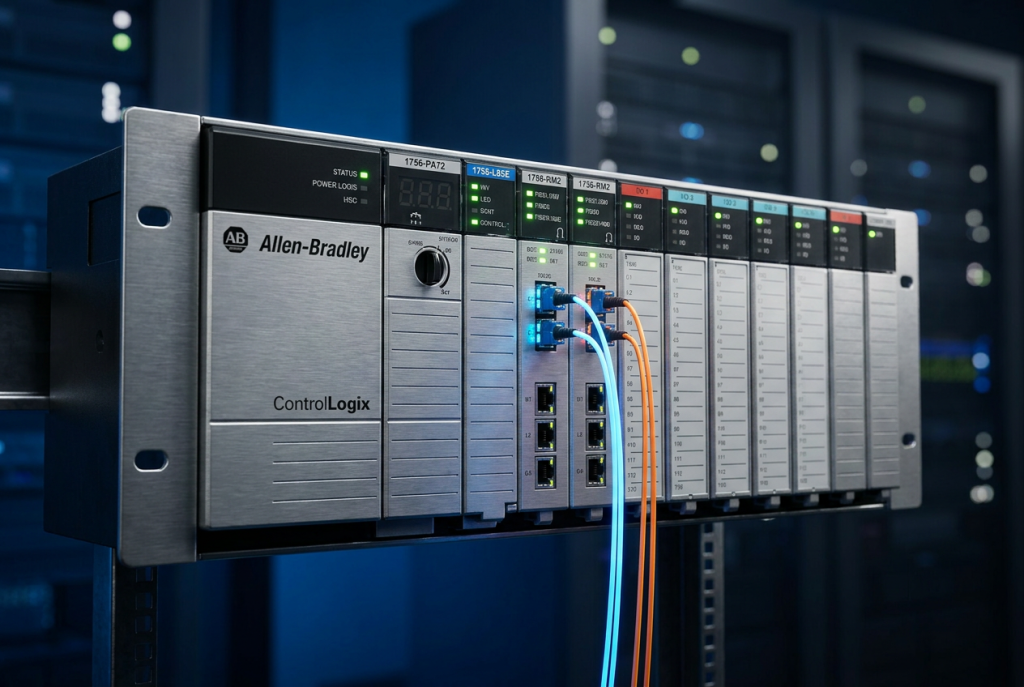
If you have spent any time in the control room of a major refinery, automotive assembly plant, or food processing facility, you know the sound of a thriving Allen-Bradley ControlLogix rack. It is the sound of thousands of I/O points communicating with surgical precision. As we move through May 2026, the ControlLogix 1756 platform remains the “Gold Standard” for North American and global manufacturing. However, being the gold standard also makes it a high-value target for both cybersecurity threats and supply chain volatility.
With over 20 years of experience troubleshooting and optimizing Rockwell Automation environments, I have watched the ControlLogix evolution from the early L1 controllers to the powerhouse L8 series. Today, I am seeing a shift in how engineers manage their ControlLogix infrastructure. It is no longer enough to simply keep a few spare cards on the shelf. In 2026, maintenance is about “Hardware Integrity”—ensuring that every redundancy module and CPU in your rack is both secure against modern network exploits and verified as original hardware. Today, we will dive into why the latest security advisories regarding the 1756-RM2 are a wake-up call for the industry.
The 1756-RM2 Security Wake-Up Call: Lessons from ICSA-26-029-03
In early 2026, the industrial security landscape was rattled by CISA advisory ICSA-26-029-03, which highlighted critical vulnerabilities in the Allen-Bradley 1756-RM2 redundancy modules. For many maintenance teams, redundancy is often viewed as a “set and forget” feature. We install the fiber sync cables, verify the primary and secondary status, and assume the system will handle a failover without issue.
However, the 2026 advisory revealed that the communication layer between these redundancy modules could be leveraged for denial-of-service (DoS) attacks or, in worse cases, unauthorized manipulation of the redundancy state. If an attacker can force a “switchover loop,” your entire process is at risk. As a peer who has managed high-availability systems, I cannot stress this enough: your redundancy is your last line of defense. If you are still running older firmware on your 1756-RM2 modules, you aren’t just risking downtime; you are leaving a back door open to your most critical control loops. Auditing these modules for firmware integrity is now a mandatory monthly task, not a “when we have time” project.
Navigating the L7 to L8 Transition and CPU Obsolescence
While the L8 series (such as the 1756-L81E) is the current flagship, the reality of industrial automation is that thousands of plants still rely on the older ControlLogix CPUs. The 1756-L7 series is currently in a “sweet spot” of being incredibly capable but increasingly difficult to source as Original New stock. Many procurement managers are being tempted by “refurbished” L71 or L72 modules found on discount sites.
As someone who has seen the inside of those “refurbished” boards, I have a clear warning: In 2026, a refurbished board is a security liability. We are seeing more instances where secondary-market hardware has been improperly flashed or contains non-industrial grade components that fail under the heat stress of a real-world rack. When your process depends on the deterministic performance of an Allen-Bradley ControlLogix system, saving a few hundred dollars on a “gray market” CPU could cost you hundreds of thousands in unplanned downtime. Reliability in 2026 starts with a clean supply chain. This is why we focus heavily on verified Allen-Bradley spare parts that come with documented factory provenance.
Communication Integrity: The 1756-EN2T Factor
No ControlLogix discussion is complete without mentioning the Ethernet/IP gateway: the Allen-Bradley 1756-EN2T. This module is the most common bridge between your OT floor and your IT data layers. In my 20 years, I have seen more “ghost in the machine” issues caused by faulty or unpatched EN2T cards than almost any other module.
In 2026, the EN2T is more than just a bridge; it is a firewall. Ensuring you have high-revision (Series C or higher) cards in your inventory is critical for supporting the latest security protocols and higher traffic volumes required by modern Digital Twin initiatives. If your spares locker is full of Series A or B cards, you may find that they cannot handle the network load or the security encryption required by your 2026 IT standards. It is time to audit your communication modules and move toward the EN2T or EN3TR standards to ensure future-proof connectivity.
The Proactive Spare Parts Strategy for the 2026 Landscape
How do you stay ahead in an environment where hardware is both aging and under attack? First, move away from reactive purchasing. Don’t wait for a 1756-RM2 failure to realize you don’t have a secure, factory-sealed spare. Second, verify the firmware of every spare part in your inventory. Many “New In Box” spares have been sitting on shelves for 5+ years and are running vulnerable firmware.
At NINERMAS, we believe in peer-to-peer transparency. We aren’t just moving boxes; we are ensuring that the original 1756-RM redundancy modules and CPU cards you receive are ready for the high-stakes environment of 2026. Whether you are maintaining a legacy Logix5555 system or a modern redundancy rack, your hardware is your foundation. Build it on verified, original components.
Frequently Asked Questions
1. Can I mix 1756-RM and 1756-RM2 modules in the same redundancy pair?
No. Redundancy modules must be identical in catalog number and firmware revision to ensure proper synchronization and failover timing. Mixing generations will lead to “partner mismatch” errors and system instability.
2. Why did CISA flag the 1756-RM2 redundancy modules specifically?
The advisory (ICSA-26-029-03) identified vulnerabilities in the dedicated fiber-optic synchronization protocol. If an attacker gains access to the OT network, they could potentially interfere with the “heartbeat” between the primary and secondary chassis, causing a process crash.
3. Is the 1756-L7 series still supported by Rockwell Automation in 2026?
The L7 series is in the “Active Mature” or “End of Life” phase depending on the specific catalog number. While software support continues in Studio 5000, new hardware production is limited. This makes sourcing “Original New” spares from verified suppliers critical.
4. How can I tell if an Allen-Bradley module is “gray market” or truly Original New?
Look for intact factory security seals, matching serial numbers on the box and the module, and correct PCB revision codes. At NINERMAS, we provide full technical verification for every ControlLogix component to ensure you are getting the real deal.
Audit Your ControlLogix Spares with NINERMAS
Protecting your plant’s legacy and its future requires a partner who knows the technical details of the 1756 platform. Whether you need a critical 1756-RM2 redundancy module to patch a security gap or a verified L7 CPU to keep an older line running, NINERMAS has the inventory and expertise you need. Contact our technical team today to discuss your ControlLogix maintenance strategy.
© 2026 NINERMAS. All rights reserved. Official Website: https://NINERMAS.com Inquiry: sale@NINERMAS.com | WhatsApp/Tel: +86 187 5021 5667
Next Step
Move the research into a cleaner RFQ.
Send the part number, quantity, condition expectation, destination, and timing details so the sourcing team can reply with better availability and lead-time context.