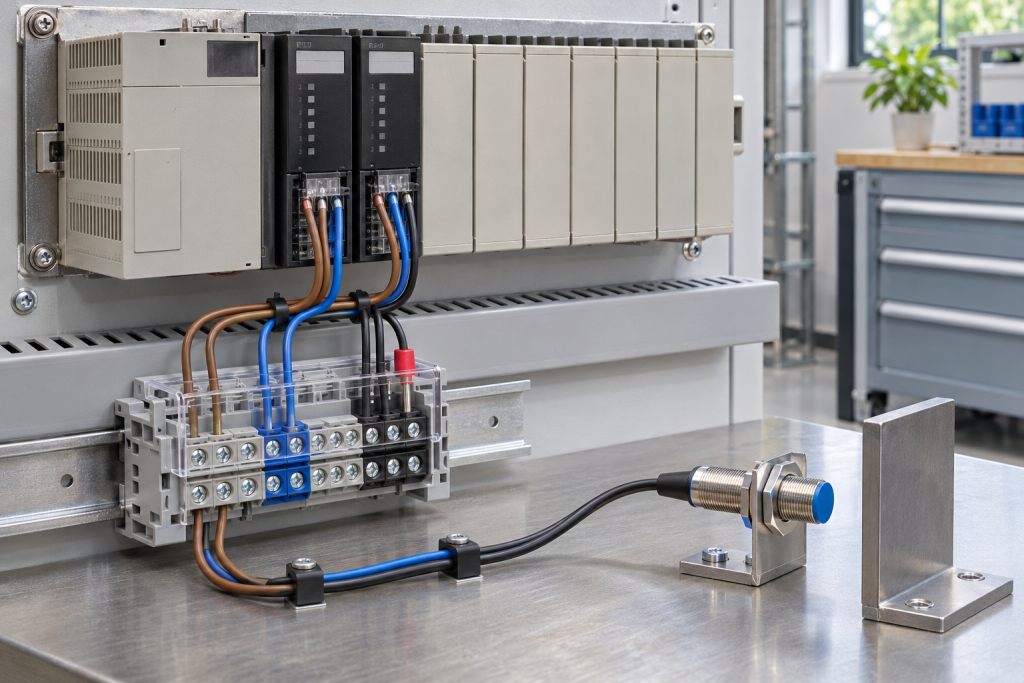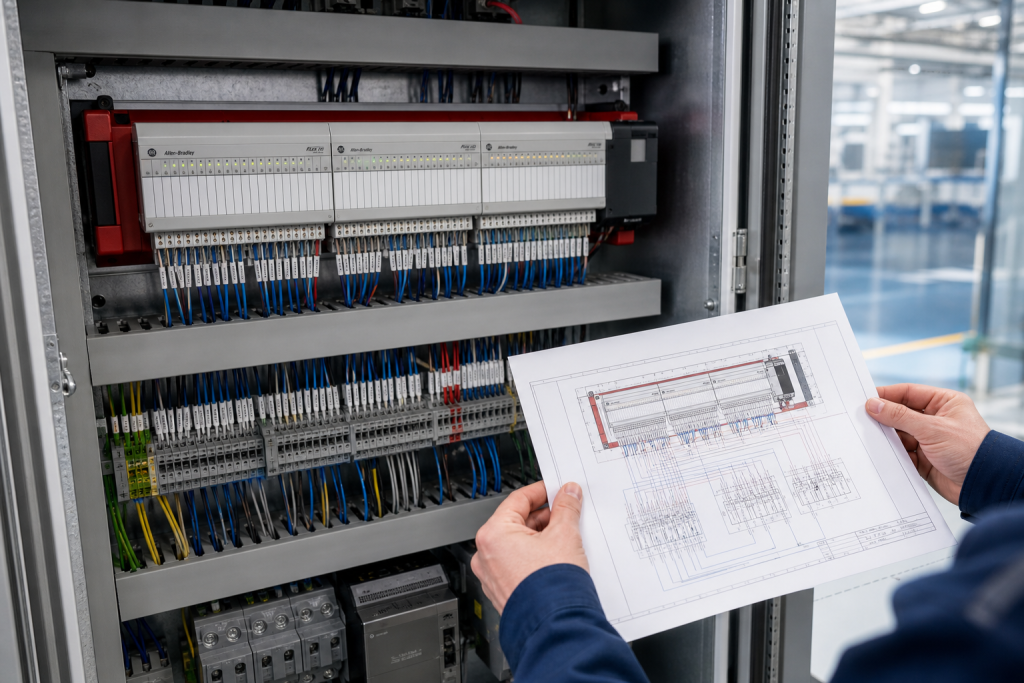
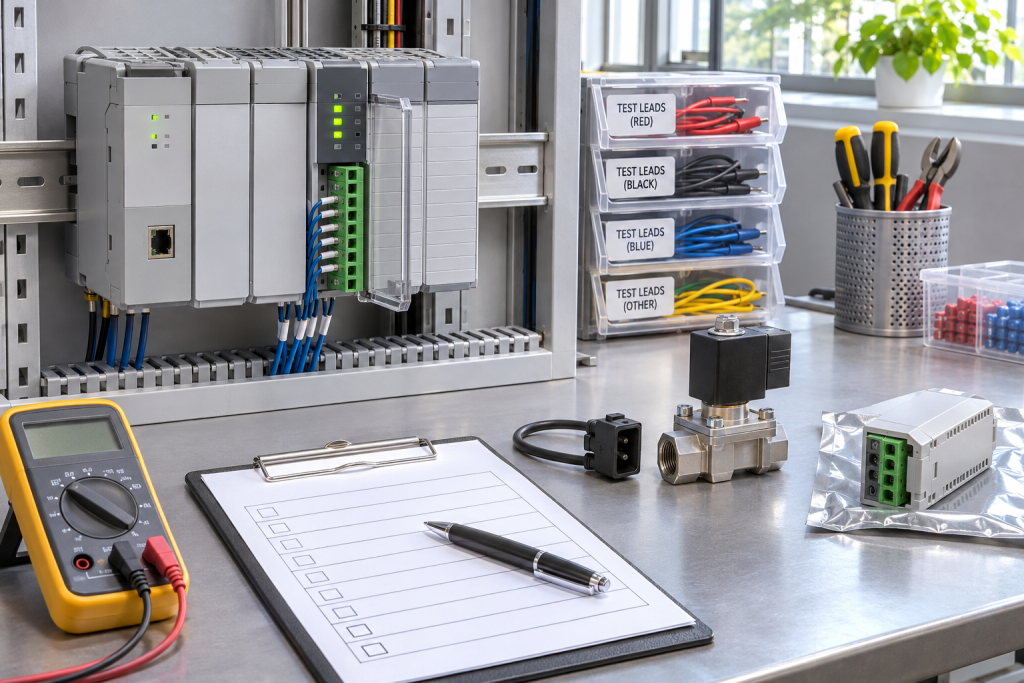
A stopped solenoid and an output fault can lead to the same urgent request: send another sixteen-point output module. That description is not enough for a ControlLogix spare. The installed module, its protective behavior and the field circuit must be identified separately. Otherwise, the replacement may inherit the same fault or introduce a protection arrangement the maintenance team has not assessed.
This is an evergreen maintenance and purchasing guide, not a new product announcement. Its practical question is narrow: what evidence should accompany a 1756-OB16 or 1756-OB16E request when an output has stopped working? The aim is to preserve the approved design while distinguishing module identification from fault diagnosis.
Read the suffix before interpreting the fault
Rockwell identifies the 1756-OB16E as an electronically fused DC output module. Its Logix Designer diagnostics reference provides separate fuse-reset controls for points 0-7 and 8-15. Those controls are specific to this module; they should not be assumed to exist on every sixteen-point output card.
Start the purchasing record with the full catalog number, series, revision and rack position. Photograph the module label and terminal-block identity without disturbing wiring. For an installed 1756-OB16 DC output module, preserve that exact identity in the inquiry. Do not append an E because electronic protection sounds like an improvement. A variant change is an engineering decision, not a spelling correction.
A protective trip is evidence, not a diagnosis
The ControlLogix digital I/O manual distinguishes protection arrangements by catalog number. Its electronic-fusing cautions matter: protection intended for a module does not automatically provide complete protection for every connected device or field conductor. Use the exact module documentation and the approved circuit design when reviewing that boundary.
For the maintenance record, separate three observations. First, did the controller request the output? Second, what did the module report? Third, what was observed at the load under an approved diagnostic procedure? An illuminated status indicator alone cannot establish all three. Likewise, a disappeared fault after a reset does not demonstrate that the original cause has been removed.
A useful incident note records the machine state, affected point numbers, diagnostic text, time and any recent work on the load. Include whether several affected points share a supply or terminal group. Avoid writing “card failed” until the evidence supports that conclusion. A neutral description keeps purchasing from prematurely treating every stoppage as a hardware replacement.
Keep the field circuit in the investigation
The output module is only one part of the circuit. The load, suppression arrangement, connectors, cable routing and external protection all deserve review by qualified personnel. A damaged cable and an unsuitable load can produce symptoms that resemble a failed output. Swapping cards repeatedly is neither a reliable diagnostic method nor a substitute for correcting the field condition.
Isolation, stored energy and movement hazards must be addressed before physical work. Follow the plant’s electrical safety procedure and machine-specific maintenance instructions. Do not repeatedly reset a protective condition to keep production moving, bypass external protection or force an actuator without an approved safe test plan. This article is a record-building guide, not a live troubleshooting procedure.
Ask the investigating engineer to state what was checked and what remains unknown. “Load circuit assessed against drawing revision C; cable insulation result attached” is more actionable than “wiring seems fine.” Where evidence is incomplete, mark it incomplete. That qualification is valuable to the receiving technician as well as the buyer.
Order an identifiable spare, not a presumed upgrade
When the installed reference is the 1756-OB16E electronically fused output module, state that identity explicitly and request label photographs for the offered unit. Ask whether terminal blocks, connectors or other accessories are included. The product page is a sourcing reference; it does not establish that a proposed unit matches the site’s revision, certification or application requirements.
The acceptance sheet should distinguish identification, condition and functional evidence. Identification means the offered part can be traced to the ordered reference. Condition means the supplier clearly describes whether it is unused, surplus or repaired. Functional evidence means the stated test scope is available for review. None of these should be silently substituted for another.
Also retain the removed unit’s label and disposition record. If a later investigation finds the field load was responsible, that information should reach the spare-parts owner. A stock replenishment decision based on an unconfirmed failure can otherwise repeat itself for years.
Define the return-to-service evidence
Before the outage, agree which records will close the job: approved configuration, correct physical identity, resolved fault cause, relevant output checks and a signed handover. Keep acceptance criteria specific to the installed machine. A bench demonstration of one point does not prove every field load, protective function or operating state has been validated.
After authorized work, document the result and any restrictions. Record the actual spare used, rather than only the purchase-order line. This makes a future fault investigation faster and prevents an undocumented variant from becoming the assumed standard. For sourcing support, send NINERMAS the full label, required supply scope and the engineer’s approved reference; request confirmation before committing to an alternative.
Frequently asked questions
Does electronic fusing protect the whole field circuit?
Do not assume that. Module protection, load protection and conductor protection are separate design questions. Use the exact Rockwell documentation and the approved electrical drawing to establish what each protective element covers.
Can an OB16E replace an OB16 without review?
A similar name or point count is insufficient evidence. Preserve the installed reference and have the responsible engineer assess any proposed variant, including configuration, wiring, ratings and protective behavior.
Should a fuse reset be part of routine recovery?
Only within an approved diagnostic and recovery procedure after the cause and hazards have been assessed. A reset button is not permission to repeatedly re-energize a faulted load.
What should procurement send with the request?
Provide readable module and terminal-block labels, series and revision, required condition, accessory scope and relevant fault evidence. Identify the person authorized to approve an alternative instead of asking the supplier to infer compatibility.
Image: AI-generated editorial illustration, not an exact product photograph or installation reference.
© 2026 NINERMAS. All rights reserved. Official Website: https://ninermas.com Inquiry: sale@ninermas.com | WhatsApp/Tel: +86 18750215667
Next Step
Move the research into a cleaner RFQ.
Send the part number, quantity, condition expectation, destination, and timing details so the sourcing team can reply with better availability and lead-time context.