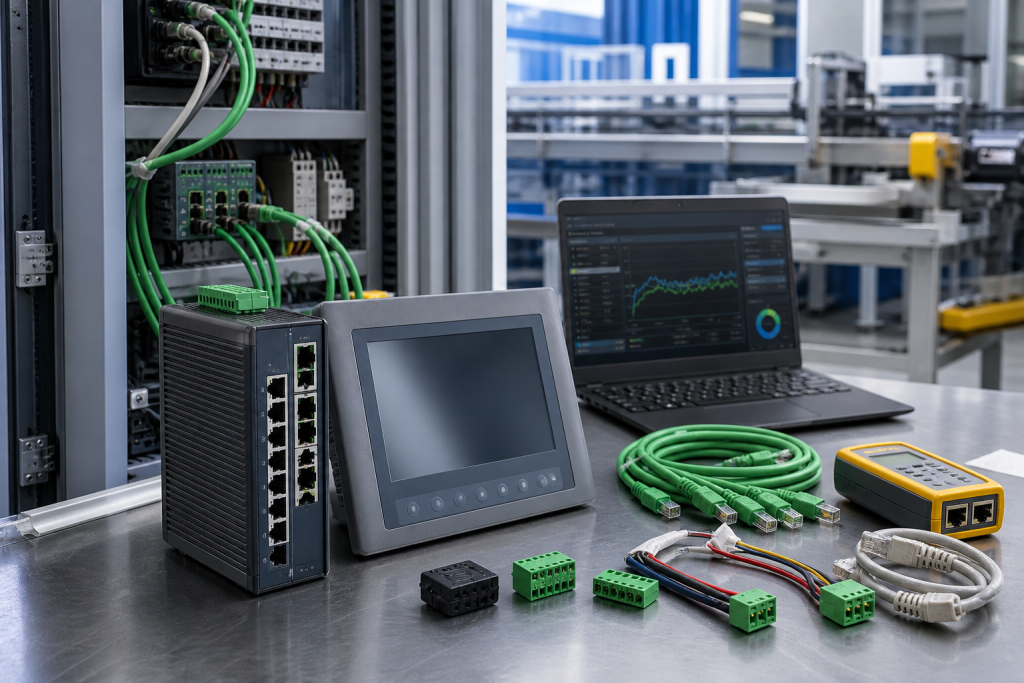
A line recovery after a network fault often starts with the obvious switch and ends at the operator panel. If a rugged Ethernet switch, HMI panel, power feed, patch cable, or address setting is wrong, the machine may appear alive while operators still cannot control it. The useful spare plan follows the network and the operator workflow together.
Recent OT exposure discussions have put network hardware back under scrutiny, especially in water, utility, packaging, and skid-mounted systems. For NINERMAS readers, the practical question is not only whether the network is secure. It is whether the plant can replace the right switch or HMI and prove the segment works again.
Map The Cabinet Network Before Ordering
Record switch model, port map, power input, copper or fiber links, grounding, connected PLCs, HMI path, cabinet location, fault history, and whether the segment supports production, safety, historian, or remote access traffic.
The live Moxa ES-1026 industrial Ethernet switch is a product match when the RFQ is about restoring cabinet-level network connectivity.
Photograph cable tags, port LEDs, terminal power, DIN rail mounting, patch panels, PLC connections, and any network diagnostic screen before the cabinet is changed.
The HMI Path Is Part Of The Same Recovery
A switch can be correct while the operator station remains unusable because the HMI project, power, touchscreen, mounting, or network address has not been matched.
The related MCGS TPC7062KX legacy HMI panel is relevant when line recovery depends on both network hardware and local operator access.
Ask suppliers to quote exact switch, tested exchange, refurbished HMI, and substitute options separately. Include condition, photos, accessory scope, power connector, and test method.
Acceptance Should Use Traffic And Operator Tests
After replacement, verify link state, PLC visibility, HMI communication, alarm display, recipe or setpoint access, diagnostics, and a controlled production sequence.
If the system still fails, check cable quality, port speed, power supply, IP settings, project file, panel firmware, grounding, and device names before rejecting the spare.
Store topology sketches, photos, HMI backup status, switch test results, and final controls approval with the spare record.
RFQ Evidence That Reduces Downtime
Send switch labels, port photos, cable map, HMI panel photos, project backup status, condition requirement, and recovery deadline.
Do not let a network RFQ become only a switch quote. If operators need the HMI to restart the line, include panel evidence at the same time.
For substitutes, require review of port count, power, mounting, project compatibility, address settings, and acceptance test.
The core discipline is simple: prove identity, prove function, and prove acceptance. Identity confirms the installed hardware. Function explains what the plant expects the spare to restore. Acceptance defines how maintenance will know the replacement is ready for service.
This matters because mature automation platforms rarely fail in isolation. A module, cable, terminal, firmware note, project backup, cabinet power path, and field device can all shape the same symptom. The RFQ should keep those dependencies visible instead of reducing the request to a copied title.
Actual-item photos are still one of the fastest ways to remove uncertainty. Front labels, side labels, connector faces, terminal assemblies, memory devices, handles, latch points, and accessory scope often expose differences that a catalog description hides.
Condition language should be precise. New surplus, factory sealed, refurbished, repaired exchange, tested used, and untested used parts should not be compared as if they had the same risk. Ask what was tested and what remains a site responsibility.
For urgent downtime, define the fallback before ordering. If the item fails bench or field acceptance, the plant should know whether to reinstall the old unit, try a repaired exchange, isolate a noncritical function, or escalate toward migration.
Finally, keep the purchasing evidence with the spare after it arrives. If the evidence disappears into email, the next engineer has to repeat the same investigation under more pressure. A good spare record saves time twice: once during sourcing and again during the restart.
Receiving inspection should repeat the same evidence check. Compare the approved photos with the received item, confirm connector condition, verify included accessories, record visible damage, and keep packaging notes when the item has fragile terminals, exposed boards, probes, displays, or communication ports.
The request should also state what the supplier is not being asked to prove. If field configuration, software loading, safety validation, or final loop testing remains the plant responsibility, say so clearly. Clear boundaries reduce confusion when the maintenance window is already open.
For plants with several similar systems, include the installed unit or machine name. A spare that fits one package skid, turbine train, boiler burner, or PLC rack may not be suitable for the next cabinet even when the brand and family appear the same.
If lifecycle pressure is part of the discussion, record it without exaggeration. Scarcity, weak test evidence, missing accessories, or frequent substitution requests are useful signals for migration planning, but they should be supported by sourcing facts rather than assumptions.
Good RFQs do not slow the job down. They remove vague follow-up questions and give the supplier a fair chance to confirm exact stock, repaired exchange options, substitution limits, and realistic dispatch timing before the plant commits to a recovery path.
FAQ
What must match on a Moxa switch spare?
Match port count, power, mounting, copper/fiber scope, topology role, environmental rating, and network test method.
Why include the HMI in the network spare plan?
Because the line may have connectivity but still be unusable if the operator panel project, address, or power does not recover.
What should procurement send?
Send labels, port photos, cable map, HMI photos, backup status, condition requirement, and downtime deadline.
What proves recovery?
Stable links, visible PLCs, working HMI screens, restored alarms or recipes, and approved production test.
Send NINERMAS the switch labels, port map, HMI photos, project backup status, condition requirement, and recovery deadline. We can help prepare a traceable network spare RFQ.
© 2026 NINERMAS. All rights reserved. Official Website: https://NINERMAS.com Inquiry: sale@NINERMAS.com | WhatsApp/Tel: +86 187 5021 5667
Next Step
Move the research into a cleaner RFQ.
Send the part number, quantity, condition expectation, destination, and timing details so the sourcing team can reply with better availability and lead-time context.