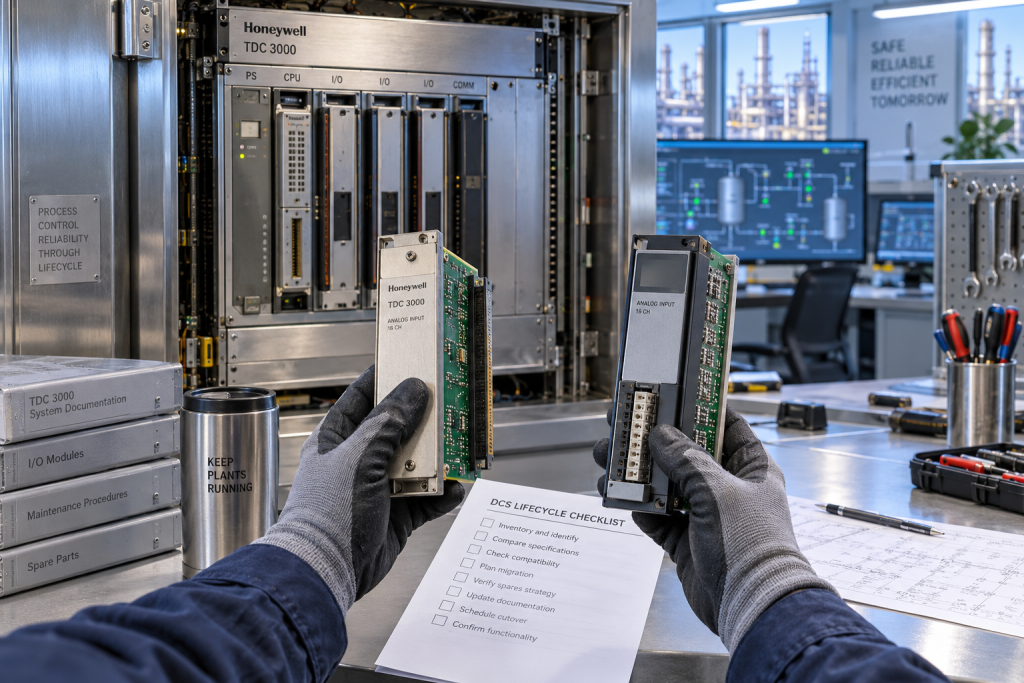

When a DeltaV controller begins to reboot, loses redundancy, or reports a diagnostic that will not clear, the spare decision quickly becomes an outage decision. The visible controller is only part of the installed system. Carrier, power supply, I/O interface, firmware, configuration, network identity and application ownership all affect whether a replacement will restore control. A similar-looking controller can consume valuable shutdown time if its revision or configuration path does not match the cabinet.
Modernization programs make this issue more important. Plants are adding analytics and new connectivity while keeping proven control layers in service. The practical response is to identify the installed controller family and preserve the recovery evidence before a failure turns a lifecycle question into an emergency purchase.
Record the installed controller, not just the family
Capture the complete part number, revision, firmware, serial number, controller role, carrier, rack, slot, power source, redundancy partner, network address and application assignment. Photograph the front label, rear connections, status LEDs, carrier and nearby I/O. Save controller diagnostics and event history before a reset. Record when the symptom appeared, whether it follows a power event or temperature change, and whether the standby controller carries the load correctly.
Preserve the approved project and configuration backup with its software version, licenses, libraries, checksum and restore owner. A file on an engineer’s laptop is not a recovery plan unless the plant has tested that it can be opened and downloaded using the available tools. Note any engineering workstation, interface cable or media required to complete the procedure.
Separate controller health from the rack path
Check the incoming power, grounding, carrier contacts, backplane, network links, cooling and adjacent module diagnostics under the approved maintenance procedure. If several modules show instability, a common supply or carrier path becomes more plausible than a single failed controller. If only one controller reboots, compare its logs with the standby and check whether the event correlates with heat, vibration or a communication disturbance.
Do not pull a controller from a live redundant system simply to see whether the alarm changes. Establish the process state, bypass controls, change authorization and rollback first. Preserve the as-found state and use one controlled substitution at a time. A successful restart after reseating is evidence of an intermittent path, not proof that the controller itself is defective.
Match revision, firmware and configuration
An urgent RFQ should state the full designation and suffix, hardware revision, firmware constraints, carrier and rack role, redundancy arrangement, quantity, condition expectation and required date. Include readable label photographs and the relevant configuration context. If a tested-used or repaired unit is acceptable, specify what was tested: power-up, diagnostics, firmware, configuration load, network communication, redundancy behavior and any functions not covered.
The Emerson KJ1501X1-BC3 VE5009 DeltaV controller is a published catalog item. Its listing should be treated as a starting point for identity verification, not a universal cross-reference. Confirm installed system generation, carrier, firmware, application role and acceptance method before approving the part for a critical process.
Use redundancy as evidence
For redundant controllers, record which unit is primary, how the standby is synchronized, what diagnostics are present, and whether a controlled switchover has recently been demonstrated. A healthy-looking standby may have an old configuration, an incompatible firmware level, or a fault in its communication path. The redundancy state belongs in the spare plan because it changes the recovery time and the safe sequence for replacement.
Before an outage, define the replacement steps, backup location, identity checks, switchover authority, test points and rollback criteria. At installation, verify module identity, carrier seating, power, diagnostics, configuration, network address, controller state, I/O values, alarms, historian updates and operator access. Do not close the work order when only the front LEDs are normal.
Keep the removed controller tagged until the cause is known. Record serial number, condition, failure evidence, repair decision and test results. This prevents the same unit from returning to stock without a documented disposition and helps the reliability team decide whether to hold one bridge spare or a complete controller-and-carrier kit.
Also define the evidence threshold for declaring the controller healthy again. A useful record includes the original diagnostic, the test environment, the firmware and configuration versions, the person who authorized the change, and the observations made after the process returned to service. For a redundant pair, retain both the pre-change and post-change synchronization status. If the plant uses a formal management-of-change process, attach the spare identity and acceptance results to that record rather than leaving them only in a purchase order. This detail matters when the same alarm returns months later and a different shift must decide whether to replace the controller, inspect the carrier, or hold the process in a safe state. It also gives procurement a clearer basis for comparing new, repaired, and tested-used options.
Questions maintenance teams ask
Does a DeltaV controller alarm prove the controller is failed?
No. Power, carrier, network, firmware, configuration and redundancy conditions can create similar symptoms. Preserve diagnostics and isolate one variable at a time.
Can a controller with the same family name be used as a spare?
Only after checking exact suffix, hardware revision, firmware, carrier, rack role, configuration and approved acceptance tests.
What should be sent with an urgent controller RFQ?
Send full part number, revision, photos, system generation, carrier, redundancy state, fault evidence, condition expectation, quantity and required date.
How do we know the standby controller is really ready?
Verify synchronization, configuration revision, diagnostics, communications and an approved controlled switchover or equivalent test.
Plan the bridge before the failure
A controller spare is useful only when it matches the installed recovery path. Send labels, diagnostics, backup details and outage timing to NINERMAS. We can help verify the published item and prepare a focused quotation while the plant retains control of configuration, safety and commissioning decisions.
© 2026 NINERMAS. All rights reserved. Official Website: https://NINERMAS.com Inquiry: sale@NINERMAS.com | WhatsApp/Tel: +86 187 5021 5667
Next Step
Move the research into a cleaner RFQ.
Send the part number, quantity, condition expectation, destination, and timing details so the sourcing team can reply with better availability and lead-time context.