Industrial AI is moving from a presentation topic into real factory programs. Siemens describes its Erlangen factory as a blueprint for AI-powered, adaptive manufacturing, while other automation suppliers are showing how new analytics can sit on top of existing control assets. For maintenance teams, the practical question is less glamorous: can the legacy robot, controller and terminal wiring survive long enough to support the next upgrade?
Robot downtime is often blamed on the controller because the alarm appears in the cell interface. In older cells, the real risk may be a gearbox with rising backlash, a brake that is no longer predictable, a connector disturbed during cleaning, or an interface terminal that has lost a reliable connection. A sensible spare plan protects the motion layer before a digital upgrade makes the cell more important.
Map the motion chain before buying
Record the robot make, controller family, axis, gearbox position, motor, brake, encoder, dress pack and teach-pendant symptoms. Photograph the nameplates and capture the current cycle, payload, speed and repeatability. A part number without the axis and robot model is not enough to approve a gearbox purchase. The same-looking mechanical unit may have different ratios, mounting details or service requirements.
Also document what the cell does in the wider line. A robot that loads a non-critical buffer does not carry the same risk as one that handles a furnace, press, palletizer or safety interlock. Add the production consequence, recovery time target and available bypass to the spare register. This lets procurement prioritize evidence rather than simply buying the most expensive component.
Use symptoms to separate gearbox and control faults
Check whether the symptom follows position, speed, temperature or payload. Backlash, noise and positional drift that grow with load point toward mechanical wear, but a following error can also come from encoder feedback, tuning, brake release or power quality. Trend the axis current and error codes where the controller permits. Do not rotate a suspect axis outside the approved safe procedure just to create a more dramatic symptom.
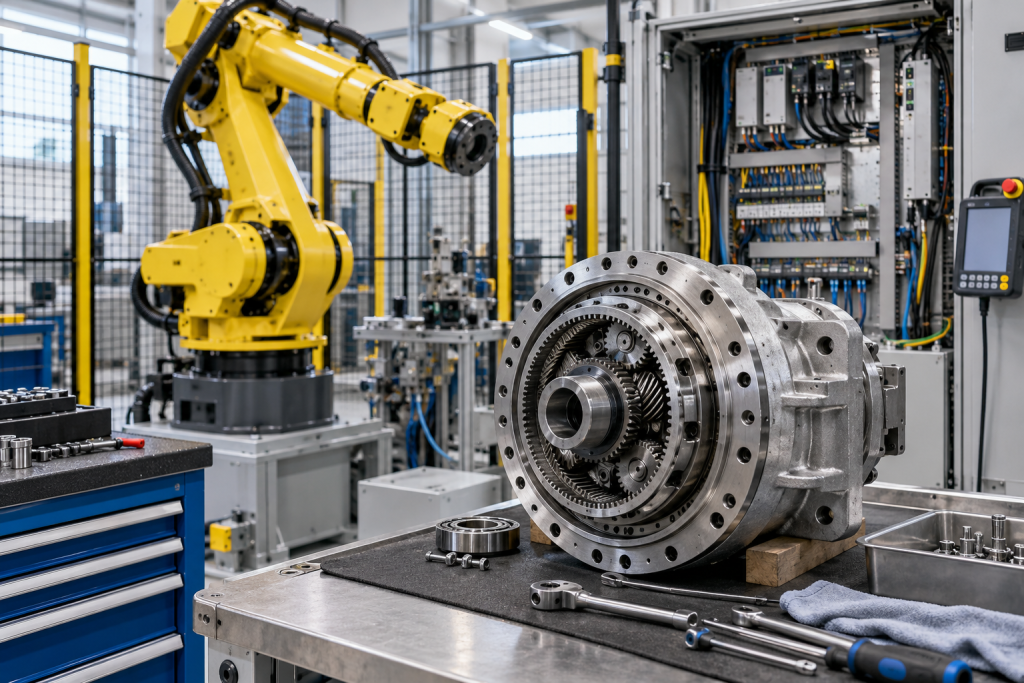
The KUKA 033.56.84.10C/10D retrofit-compatible gearbox should be matched to robot model, axis, ratio, mounting, lubrication and acceptance test. Ask whether the unit is new, repaired or tested used, and require a condition statement that describes the actual checks. A supplier saying “compatible” should still identify the mechanical and functional limits.
Do not ignore the cabinet interface
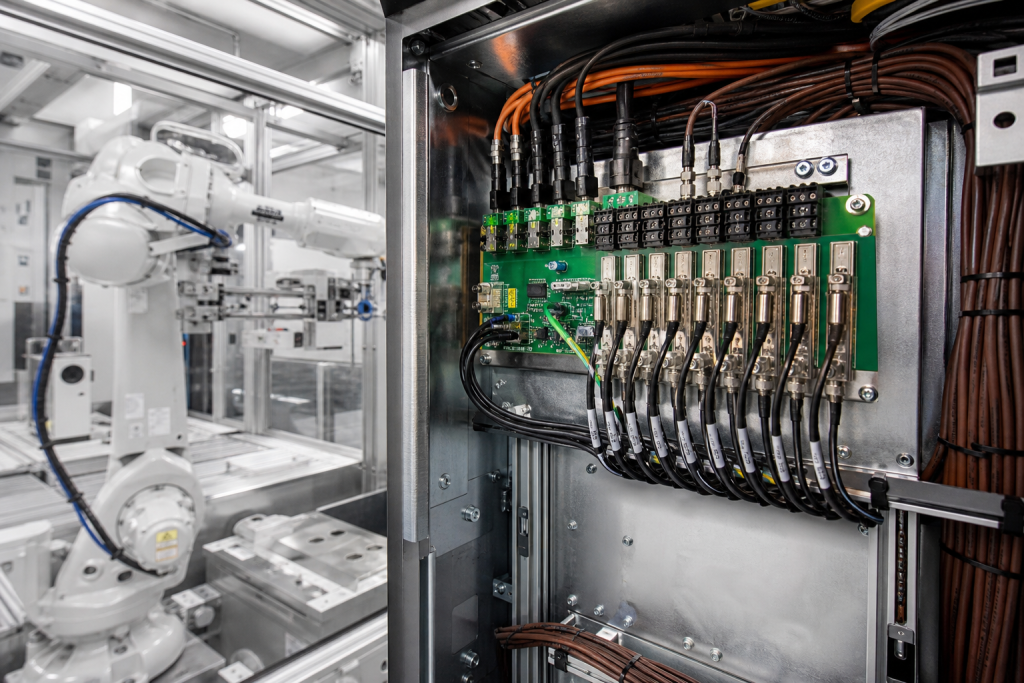
A mechanical repair can fail at commissioning if the cabinet side is not documented. Record drive terminals, brake wiring, feedback connectors, safety circuits and the interface between the robot cell and the plant DCS or PLC. Check for loose conductors, heat damage and evidence of repeated reseating. Preserve the old wiring labels and the last-known-good parameter backup.
The Emerson KJ4001-CB1 retrofit terminal block is relevant when a legacy control interface needs a documented replacement path. Confirm the terminal role, carrier, wiring, signal type and cabinet drawing before treating it as a drop-in. The goal is not to add a part to an RFQ; it is to preserve the signal path that the robot sequence depends on.
Prepare a recovery test that survives modernization
Bench-test critical spares when practical, but do not confuse a visual inspection with a functional acceptance. For a gearbox, define allowable backlash, noise, run-in and dimensional checks. For an interface component, define continuity, terminal fit and the signals to be verified after installation. Record serial numbers and test limits. This evidence becomes especially valuable when the part is held as a bridge asset during a larger cell upgrade.
Before the shutdown, export the robot program and parameters through the authorized engineering process. Record mastering data, tool frames, user frames, payload settings and safety configuration ownership. At restart, verify homing, teach-point repeatability, brake behavior, interlocks, cycle time and the downstream handshake. Ask operations to confirm the complete production sequence rather than accepting a green controller display.
Industrial AI projects tend to increase the value of clean historical data. Keep the pre-repair trend, failure evidence, replacement report and post-repair baseline together. A digital twin or analytics layer is only useful if it can distinguish a mechanical degradation signature from a communication or wiring fault. The spare record is part of that data foundation.
For a robot cell that will receive new analytics, keep the mechanical baseline in a format the reliability team can use. Record backlash checks, repeatability, axis current and the date of the last lubrication or gearbox inspection. Without that baseline, a new AI layer may identify an anomaly but the plant will still lack a controlled repair decision.
During the first production cycle after a repair, compare the robot’s cycle time, payload behavior and downstream handshake with the saved record. A successful dry run is necessary, but it does not prove that the cell is ready for the full duty cycle. Keep the removed gearbox and interface part available until operations signs off.
Questions maintenance teams usually ask
How can we tell whether a robot gearbox is really failing?
Trend backlash, noise, position error, current and temperature against axis, speed and payload. Confirm encoder, brake, tuning and power conditions before ordering the gearbox.
Is a retrofit-compatible gearbox a direct replacement?
It may be suitable, but verify robot model, axis, ratio, mounting, lubrication, acceptance limits and the supplier’s actual test evidence.
Why include a terminal block in a robot spare plan?
Because a reliable mechanical repair can still fail if the cabinet signal path is intermittent, miswired or no longer documented.
What should an urgent robot RFQ include?
Send robot and controller model, axis, part number, symptoms, photos, payload, required date, condition expectation and whether a functional test is required.
Keep the motion layer ready for the next control layer
Factory AI does not remove the need for disciplined legacy maintenance. It makes the old motion assets more consequential. A documented gearbox and interface recovery path gives the plant time to modernize on its own schedule.
Send labels, photos, fault evidence and the outage date to NINERMAS. We can help verify the motion spare, clarify condition and prepare a focused quotation.
© 2026 NINERMAS. All rights reserved. Official Website: https://NINERMAS.com Inquiry: sale@NINERMAS.com | WhatsApp/Tel: +86 187 5021 5667
Next Step
Move the research into a cleaner RFQ.
Send the part number, quantity, condition expectation, destination, and timing details so the sourcing team can reply with better availability and lead-time context.